The Russian Su-57 combat aircraft may have gone down in a crash in the Moscow Oblast, in what could be a big setback to Russia’s flagship fifth-generation fighter program.
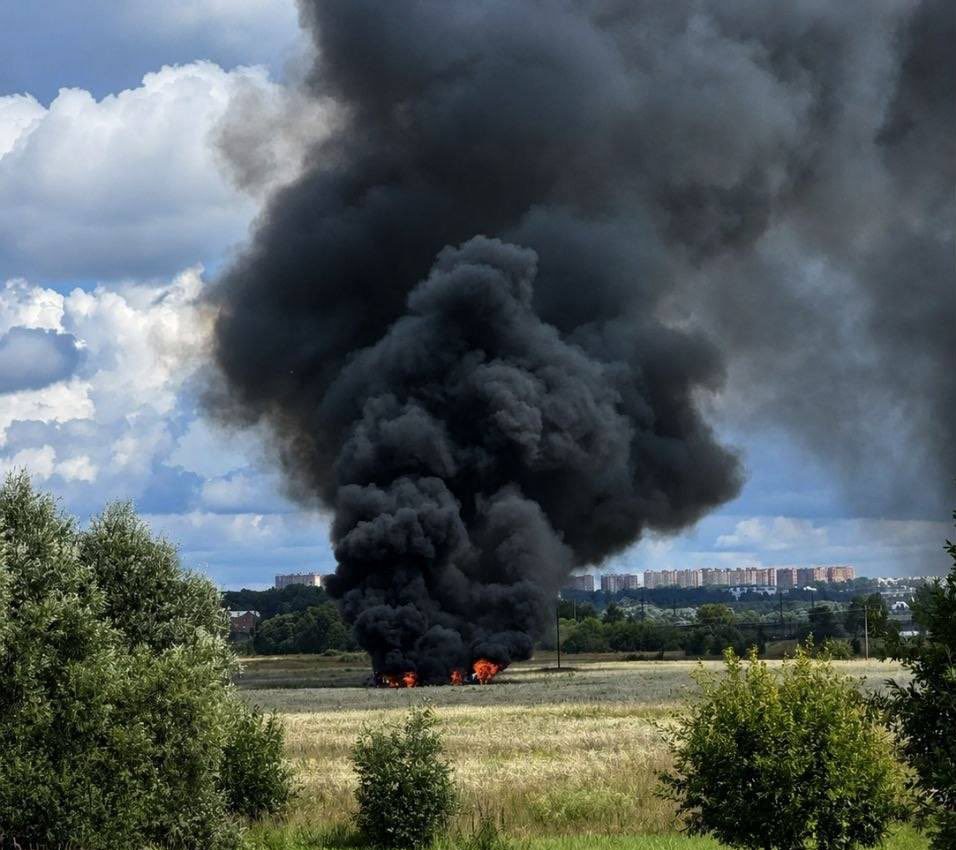
On July 23, dramatic visuals of a burning aircraft and thick plumes of smoke circulating on social media quickly drew global attention, prompting Russia to accept the loss.
“On July 23rd of this year, a training and combat aircraft crashed in the Moscow Region during takeoff. The pilot ejected safely, and his life is not in danger. The aircraft crashed in a deserted area, and there is no damage on the ground,” the Russian Ministry of Defense (RuMoD) said in a statement, as reported by the state media.
Notably, the images shared on social media showed no debris that could help identify the aircraft. However, the Russian publication Kommersant, which is believed to have a pro-state stance, later reported that the fighter involved in the crash was a Su-57.
Citing an unidentified source, the Kommersant report stated that “a Su-57 fighter crashed in the Odintsovo city district. The pilot managed to eject, and there were no casualties. The aircraft was unarmed. The Investigative Committee initiated a criminal case for violation of the rules of flight or preparation for them under Article 351 of the Criminal Code of the Russian Federation.” Further, “military experts and a Defense Ministry commission will investigate the cause of the accident,” the report added.
💥✈️BREAKING: A Russian Su-57 fighter jet has crashed in Moscow region.
The aircraft went down near the village of Lutsino. The pilot managed to eject. pic.twitter.com/SBbdXZlkcg
— Special Kherson Cat 🐈🇺🇦 (@bayraktar_1love) July 23, 2026
Separately, state-controlled broadcaster REN TV also confirmed that the aircraft crashed in the Odintsovo area, without mentioning the airbase that it took off from for the sortie.
Soon after the crash, Russian military bloggers and Telegram channels quickly got to work to pinpoint the location using geolocated eyewitness photos. An independent Russian channel, Astra, determined the site lay roughly 6 to 7 kilometers from Zvenigorod, near the villages of Lutsino and Shikhovo.
Notably, the crash site is located roughly 10–20 kilometers from Kubinka Air Base, a prominent Russian Aerospace Forces facility that houses various fighter units and is frequently used for training and air show demonstrations. It is therefore plausible, though still unconfirmed, that the Su-57 took off from Kubinka.
The EurAsian Times could not independently verify that the aircraft involved in the crash was indeed a Su-57 or some other aircraft.
Some Ukrainian military trackers claimed on X that the incident was a case of friendly fire, while others claimed that a joint Ukrainian human-cyber intelligence operation manipulated Russia’s BARS Moscow air defenses into shooting down a Su-57 in the Moscow region.
Ukraine’s InformNapalm, an international volunteer OSINT (Open Source Intelligence) community, claimed it intercepted training streams, analyzed the system’s software, hardware, combat procedures, and vulnerabilities, and then passed them on to the Ukrainian Armed Forces. This purportedly helped in hacking the system and forcing the Russians to commit fratricide.
If the Su-57 has indeed crashed, it would be the second publicly known crash in nearly seven years.
Earlier, a Su-57 fighter jet crashed in the Khabarovsk Region in the Far East in December 2019 due to a technical failure of the aircraft’s control system, as TASS reported at the time. The pilot ejected safely without injury.
On its part, Ukraine has claimed multiple strikes on Su-57 on the ground over the course of the war, now in its fifth year. In April 2026, for instance, the Ukrainian military claimed to have hit a Su-34 fighter-bomber and a Su-57 stealth fighter at Shagol Airfield in the Chelyabinsk region, about 1,700 kilometers from the border.
Similarly, they claimed to have hit a Su-57 at Akhtubinsk Air Base in Russia’s Astrakhan Oblast in June 2024.
However, the Su-57 was hit on the ground in both incidents, rather than in the air. In fact, the Russian flagship fifth-generation fighter is never seen in the skies along the frontline, unlike other jets like Su-34 or Su-35 that operate close to the war zone.
Instead of conducting aggressive deep strikes, the Russians have so far used their lone operational stealth aircraft to launch standoff attacks from the security of Russian airspace, as explained in depth earlier by the EurAsian Times.
Experts and military analysts believe Russia has deliberately kept the Su-57 out of intense combat — unlike the United States and Israel, which have extensively deployed their F-35 stealth fighters against Iran — primarily to protect these high-value, limited, and expensive assets from enemy air defenses.
A Su-57 Crash Could Exacerbate Russian Woes
A Su-57 crash could prove extremely expensive for Moscow, particularly since the program has been plagued by persistent production challenges, which have aggravated since Russia’s full-scale invasion of Ukraine in February 2022. The protracted conflict has diverted resources, and Western sanctions have severely hampered Russia’s access to essential components, leaving manufacturers well behind schedule.

Russia aimed for large-scale production, with a 2019 contract for 76 aircraft to be delivered by 2027–2028.
Furthermore, the crash doesn’t augur well for the Su-57’s reputation, especially since the aircraft has failed to make a mark in the export market.
So far, only Algeria is known to have purchased the Russian stealth fighter, even though the RuMoD claims sustained buyer interest in the jet.
Russia has been aggressively pitching the Su-57 for export to India for more than a year. Last year, Russia offered India a comprehensive “golden deal” that included the supply of ready-made Su-57 fighters, local production of the aircraft in India, and technical assistance for India’s indigenous fifth-generation fighter program, the Advanced Medium Combat Aircraft (AMCA). Rosoboronexport later refined the proposal, stating that it could leverage India’s existing Su-30MKI production infrastructure to support Su-57 manufacturing.
To make the deal more attractive, Russia also offered full licensed production, extensive technology transfer, and the possibility of developing a two-seat variant of the Su-57, which was unveiled in May this year, as the EurAsian Times reported at the time.
Last month, Russian President Vladimir Putin renewed the Su-57 pitch to India, citing the former FGFA (Fifth-Generation Fighter Aircraft) collaboration between the two allies and calling it the best fifth-generation aircraft in the world. “It’s fifth-generation technology — I think it’s the best in the world as of now,” the Russian President proudly declared.
India, on its part, has so far shown no enthusiasm for purchasing a Russian jet, even though reports indicate that some discussions have taken place.
In addition to India, Russia has been marketing the jet in the Middle East, Southeast Asia, and Latin America, albeit to no avail.
However, the Su-57’s absence from the Ukrainian battlefield has already failed to inspire confidence among prospective buyers. In fact, analysts believe that even traditional buyers of Russian weapons are reluctant to purchase the aircraft due to production constraints, its limited role in the ongoing Ukraine War, and suspicions about its capabilities and stealth.
Against that backdrop, a crash could dent the reputation of the Su-57, though any impact is likely to be temporary, since no other aircraft in the world—including the F-35—has remained immune to crashes.
- Contact the author at sakshi.tiwari13 (at) outlook.com
- Follow EurAsian Times on Google News