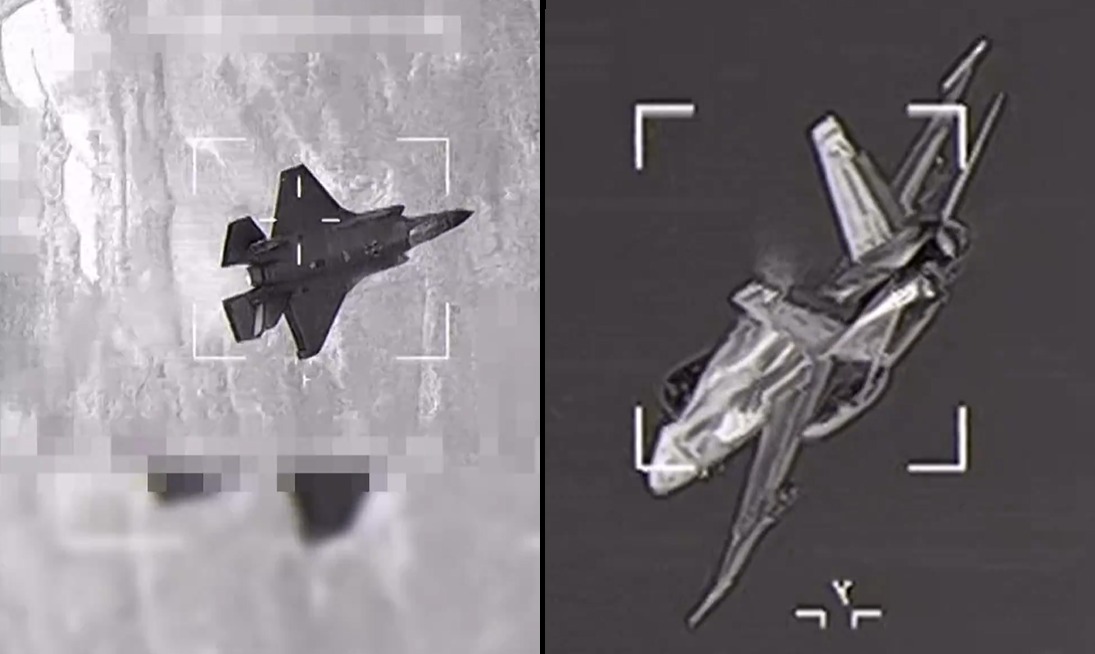
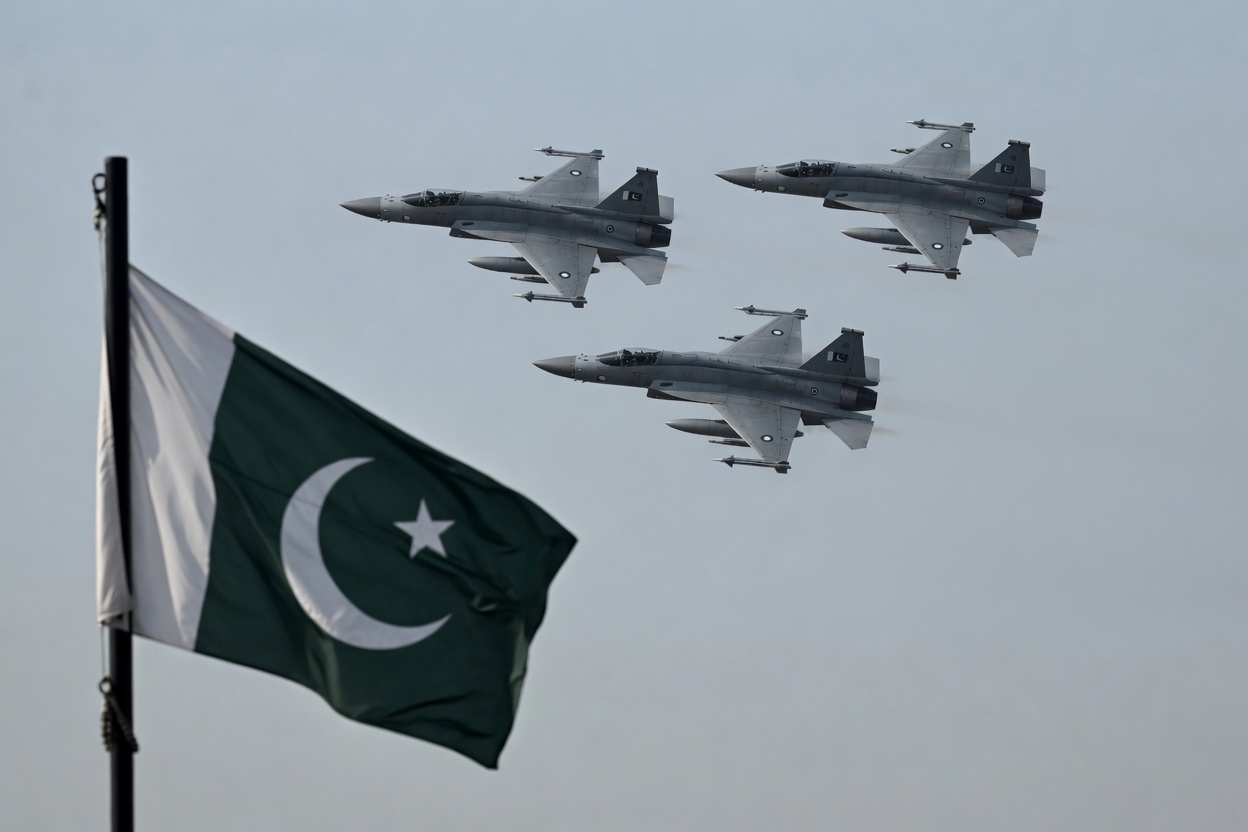
As the Yemen-based Houthi militia intensified strikes on Saudi Arabia, a story started to swirl on social media: a strike from Yemen had destroyed the Pakistani Air Force (PAF) JF-17 fighter jets based on Saudi soil.
Fresh hostilities between the Yemen-based Houthi and Saudi-backed Yemeni government forces reignited in July 2026 after the latter bombed Sanaa’s airport while seeking to prevent an Iranian aircraft carrying a Houthi delegation from landing—a move seen by the Houthis as a breach of the 2022 ceasefire, escalating into tit-for-tat attacks by both sides, a ground advance by the Houthis in Yemen, and Houthi strikes on Saudi territory.
The Houthis scored a major victory against Riyadh by downing an F-15SA belonging to the Royal Saudi Air Force (RSAF) on September 16, near Marib, using a locally made surface-to-air missile (SAM).
Riyadh has not publicly acknowledged the loss despite the Houthis publishing photos of the wreckage, and the fate of the crew remains unknown to this day, as previously explained by the EurAsian Times.
Days after this shootdown, some posts on social media claimed that PAF JF-17 jets had been struck in a missile attack on King Abdulaziz Air Base in Saudi Arabia, while asking whether this would trigger the Pakistan-Saudi strategic mutual defense agreement and the Makkah Pact signed between Saudi Arabia, Pakistan, and Turkey.
However, these claims and unverified posts were not backed by any concrete evidence—such as video of the attack or visuals showing wreckage—that could decisively prove that the JF-17 was struck. Several of these posts contained AI-generated visuals depicting a hypothetical Houthi missile attack on the Abdulaziz base.
More importantly, the Houthis, who were quick to report the downing of the F-15SA, never claimed anything.
The fast-spreading report apparently forced Pakistan’s Ministry of Information to issue a clarification. Calling the assertions “absolutely fake,” the Ministry said they were part of a propaganda campaign launched by Indian netizens, as Dawn reported.
The ministry, in a post on its fact-checking X account, said that social media accounts supporting Indian propaganda were spreading false claims that three PAF JF-17 aircraft were damaged and had to evacuate after Houthi missiles targeted King Abdulaziz Air Base in Saudi Arabia. Additionally, the Ministry shared a screenshot of a post from one of these accounts, with the word “fake” stamped on it.
“This is absolutely fake. No credible or official source has also reported any sort of damage to PAF JF-17s,” the Ministry of Information reportedly said in its statement. The “deliberate fabrication of damage to PAF aircraft and their alleged evacuation is only blatant Indian propaganda, part of Hindutva deceit and a deceptive mindset,” the Ministry said.
Notably, the Pakistani Air Force fighter and support aircraft, including JF-17 jets, arrived in April 2026 under the Strategic Mutual Defense Agreement that Pakistan and Saudi Arabia signed in September 2025.
The deployment was meant to enhance joint military coordination and operational readiness between the two allies. The Pakistani Ministry said that the Houthis attacked hangars, radar installations, runways, and munitions stockpiles at King Khalid Air Base in Khamis Mushait, in the southern part of the kingdom, but there were no reports of attacks against King Abdulaziz Air Base.
The EurAsian Times dug in and found that most X accounts sharing the unverified claims were indeed based in India, with some boasting more than 100K followers.
Direct attack by Houthis on Pakistan
Houthis attacked King Abdulaziz Air Base of Saudi Arabia where Pakistani Airforce is deployed.
Over 6 missile hit the hangers of airbase, damaged at least 3 Chinese origin Pakistani JF-17 Pakistani aircraft.
Where is Mecca Defence Pact pic.twitter.com/FioY4U2ki9
— Baba Banaras™ (@RealBababanaras) September 19, 2026
Earlier, Pakistan-linked social-media accounts had circulated AI-generated or doctored videos of Indian officials, including former Army chiefs and air force officers, “admitting” Rafale and S-400 losses. India’s Press Information Bureau (PIB) later debunked the claims as fake news.
Iran War Proves Aircraft on Ground Not Safe
The Indian Air Force (IAF) launched devastating, targeted attacks on terror sites located deep within Pakistan on May 7, 2025, as part of “Operation Sindoor,” which was initiated to exact revenge for the heinous terror attack on Pahalgam, Kashmir, which killed 26 unsuspecting tourists. In response, Pakistan launched its own “Operation Bunyan al-Marsus,” a counter-operation it may have planned.
The two sides then engaged in a major aerial duel while operating outside the other’s air defense envelope.
Early in the conflict, Pakistan claimed to have shot down several Indian aircraft, including the Mirage-2000, Rafale, and Su-30MKI, using Chinese-made J-10CE fighters equipped with PL-15 long-range air-to-air missiles.
India never accepted these losses, and French media reports quoted Dassault chief Eric Trappier as saying that one of the Rafales participating in the operation crashed due to a technical malfunction. Dassault later formally denied that Trappier made any operational or technical comments about Rafale use in Operation Sindoor.
In turn, India claimed that Pakistan lost multiple warplanes, including JF-17s.
At an annual press conference on October 3, Indian Air Force (IAF) chief Air Chief Marshal A.P. Singh said that the IAF destroyed 12 to 13 Pakistani aircraft, including 9-10 fighter jets, including the US-made F-16s and the JF-17s, with an additional four to five F-16s destroyed in the hangar, as the EurAsian Times reported at the time.
Pakistan, as expected, rejected any loss.
Honestly, there is no solid public proof that Pakistan lost JF-17s at a Saudi airbase or even during Indian strikes during Operation Sindoor. Independent checks also found no confirmed images, official confirmation, or any reliable reporting.
The real question is simpler: Can fighter jets or other aircraft sitting on the ground be damaged even when air defenses are active? The Middle East conflict shows the answer is yes.
US bases are defended by some of the best air-defense systems in the world — Patriot and THAAD.
Iran has fired large waves of missiles and drones. Most were intercepted, but many slipped through.
The biggest loss came on 27 March at Prince Sultan Air Base in Saudi Arabia, where an Iranian strike destroyed an E-3G Sentry AWACS, valued at about $500 million. The same campaign also damaged multiple parked KC-135 Stratotankers at the base; five were hit on the ground in mid-March, and more were damaged in the late-March attack.
Overall, seven KC-135s were damaged or destroyed. At least one THAAD AN/TPY-2 radar was destroyed. A CH-47F Chinook was reported destroyed in a hangar at Camp Buehring in Kuwait. Satellite analysis and a later Pentagon inspector-general report found hundreds of buildings, hangars, and equipment damaged or destroyed at American sites in Saudi Arabia, Kuwait, Iraq, and other countries.
Now compare that with Pakistan.
Pakistan does not have cutting-edge THAAD and Patriot AD systems defending its military bases.
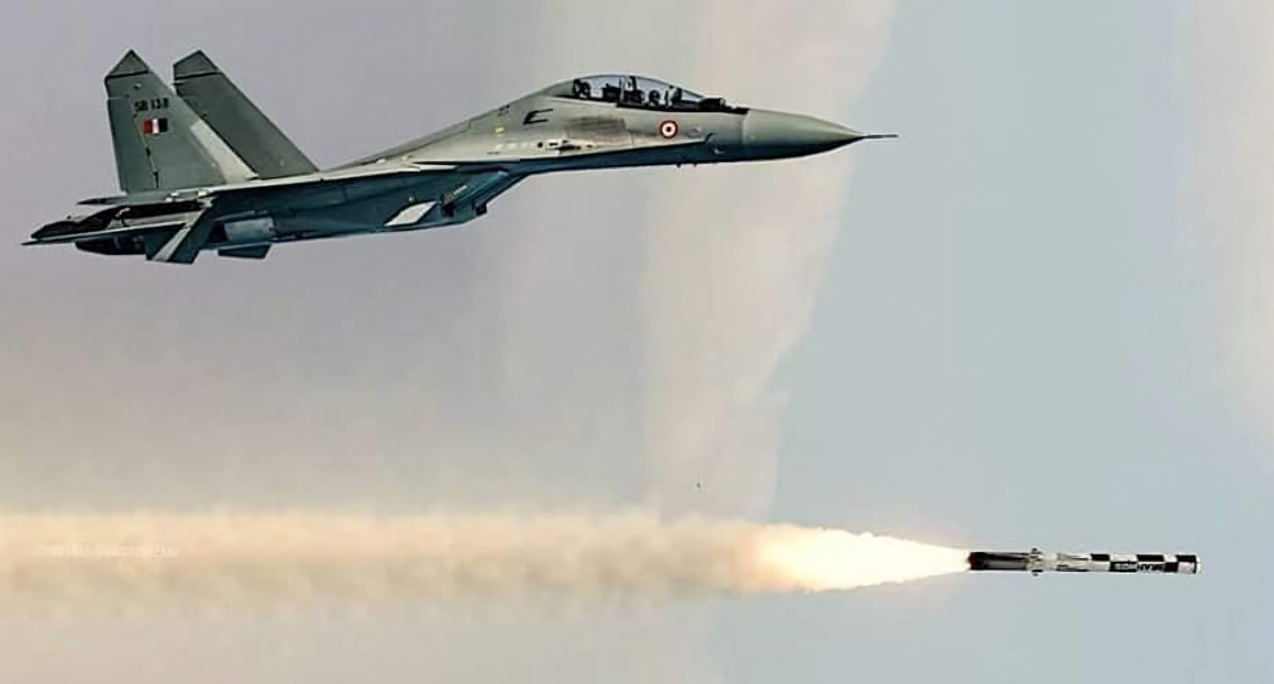
India fired supersonic BrahMos and SCALP from its Su-30 and Rafale jets, from its own airspace. Independent satellite analysis, including by the Washington Post, found damage at several Pakistani airfields: hangars, runways, and support buildings.
Pakistan initially downplayed any damage. Later, some Pakistani officials, including Air Force veterans, admitted damage to both men and material. India’s own later official account listed hangars, runways, radars, command centers, and aircraft/drone facilities among the targets. Even if both sides exaggerated, the independent evidence does not show “zero damage.”
The logic is straightforward. If even US aircraft, protected by Patriot and THAAD, can be hit or damaged, it is not surprising that Pakistani airbases—with limited air defense shields—could also take hits.
Denial is normal in war. It is not proof that nothing happened.
Iran has given a live demo of what missile and drone strikes can do. Pakistan’s defenses were far less capable than America’s. Indian missiles did reach Pakistani bases. Therefore, the chance of serious harm at PAF bases cannot be ruled out.
- Contact the author at editor (at) eurasiantimes.com
- Follow EurAsian Times on Google News