The Indian Air Force (IAF) will host the second edition of Exercise Tarang Shakti, India’s premier multinational air exercise, in Jodhpur, Rajasthan, from 26 September to 12 October 2026.
It will bring together air forces from multiple countries for joint aerial operations, tactical training, and advanced interoperability drills day and night. They will conduct well-planned joint aerial maneuvers, complex multinational combat integration, and counter-UAS capability tests.
The U.S. Air Force’s F-35A is taking part in tactical drills on Indian soil for the first time. Current reporting puts the U.S. package at six F-35As and two KC-135 tankers. France is expected to field seven Rafales with three A400Ms and two MRTT tankers; the UAE six F-16s and a Global 6000. Australia and Germany are sending transport aircraft (C-130 and A400M respectively), Bangladesh a C-130J, and Sri Lanka a King Air 350.
IAF will field the entire fighter inventory, including Rafale, Mirage-2000, Jaguar, Tejas, MiG-29, and Su-30MKI. Officers from 32 nations will attend as observers to monitor exercises and tactical integration. India will also use the occasion to showcase the growing capabilities of indigenous aerospace and defense manufacturing under Aatmanirbhar Bharat.
Exercise Tarang Shakti: The Next Leap
Air Marshal Ashutosh Dixit, Vice Chief of the Air Staff, while addressing a press conference, said, “Let me begin with what Tarang Shakti means for the IAF. For many years, operational engagement with foreign air forces was largely through bilateral exercises. We learned to operate with one partner at a time. Tarang Shakti changed that approach. In 2024, we brought multiple air forces together for the first time in a large multinational air exercise hosted by the IAF.”
“For Tarang Shakti-24, which was the last edition, the scale and operational output were significant. Across the two phases, 11 countries participated with their air assets, with 45 aircraft undertaking 76 missions, generating 867 sorties and over 1,180 flying hours. The exercise covered a wide canvas of air operations, from counter-air, air defense and close combat to recce, airlift, air-to-air refueling and other highly complex mission sets. For the IAF, it was an important transition from exercises primarily being bilateral to planning, operating and integrating with multiple air forces simultaneously… So Tarang Shakti-26 is the next logical step. This year, invitations have been sent to 65 friendly foreign countries…”
Exercise Overview
During his media briefing, Group Captain T Deswal, Director Exercise, highlighted that Tarang Shakti 2026 will be the largest multinational exercise ever in Asia.
It will showcase combined capabilities and integrate diverse platforms. Realism will be brought through contemporary combat scenarios across day and night. Interoperability will be tested through common procedures, planning, targeting, and tactical integration. Lastly, the exercise will strengthen partnership through professional military engagement and specialist interactions.
IAF’s Growing Exercise Participation and Footprint
The IAF has participated in over 100 international air exercises since 2001.
These include the multinational, biannual “Pitch Black” exercise in Australia, “Red Flag” – Alaska (USA), Exercise “Cobra Warrior” (UK), India’s own Exercise “Tarang Shakti”, “Desert Knight” (India, France, UAE), Ocean Sky (Spain), and “Desert Flag” (UAE). Also, there are bilateral exercises “Garuda” (France), “Veer Guardian” (Japan), “Udara Shakti” (Malaysia), “Iniochos” (Greece), “Indradhanush” (UK), and “Eastern Bridge” (Oman), “Cope India” (USA), Aviaindra (Russia), and “Desert Warrior” (Egypt), among others.
IAF fighters have flown against or alongside most leading types on the international circuit, including the F-35 at overseas drills such as Pitch Black and at Aero India. Tarang Shakti is different: it is the first time F-35s will fly tactical missions with the IAF from an Indian base.
Tarang Shakti exercise series is perhaps smaller in size and scope than the “Air Defender” exercise of NATO, “Red Flag” of the USA, and “Pitch Black” in Australia. Over 75 combat aircraft are expected to take part, focusing on enhancing mutual understanding of air power, realistic operations, strengthening military ties, and showcasing indigenous defense equipment.
India also conducts air exercises without foreign participation. These include Multi-Agency Exercise ‘Pralay Sahayam’ (Disaster response exercise), Exercise DANX (Defense of Andaman & Nicobar Exercise), Gaganshakti, Vayushakti, Exercise Iron Fist, and Bharat Shakti (Tri-service), and have been on a very large scale.
The frequency and number of air exercises have gone up in recent years. After a short pandemic-related lull, the pace has picked up.
Force Multipliers and Combat Enhancers
The IAF is also expected to deploy airborne early warning and control (AEW&C) aircraft, transport aircraft, and air-to-air refueling tankers. Their inclusion would allow training to extend beyond fighter maneuvers to surveillance, coordination, logistics, and sustained air operations.
AEW&C will provide airborne surveillance and help coordinate aerial maneuvers. Airborne refueling tankers will extend aircraft endurance and operational reach. Transport aircraft will move personnel, equipment, and supplies required to support deployments. Helicopters and Special Forces will have their own combat exercises. The exercise will use ground-based, fully networked radars.
It will be an air traffic control exercise. It will test ground-based AD systems. It will test communications.
Big Drills
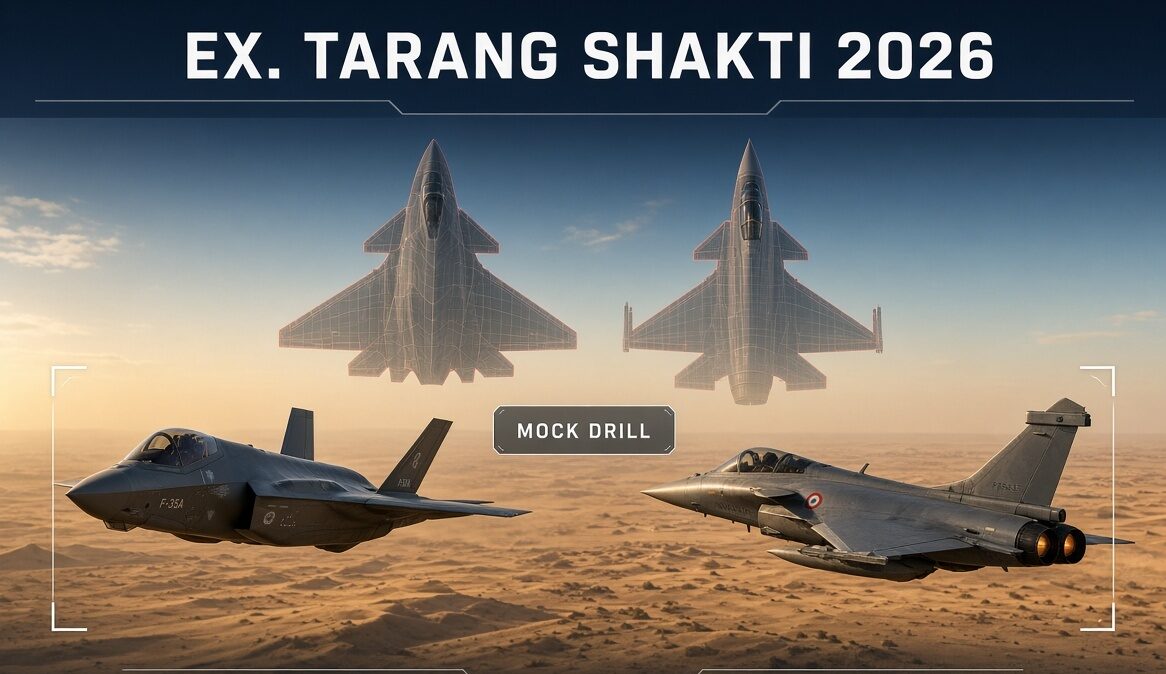
The mix of visiting aircraft also lets the IAF rehearse against the kinds of threats it actually faces, even if those types aren’t on the visitor list. No Chinese-origin J-20, J-10, or JF-17 fighter jets are coming to Jodhpur. However, the F-35 (for the stealth J-20) and the French Rafale (for the J-10C) can still stand in for them in mock drills.
The F-35A is the only fifth-generation fighter in the exercise. In mock drills, it is much better than China’s J-20: stealth, low observability, sensor fusion, and first-look, first-shot tactics, and will be a better simulation for the J-20.
That does not mean the IAF will see the F-35’s classified envelope. It does mean, however, that Indian crews can practice finding, tracking, and studying a stealth aircraft from an Indian base—to better understand the Chinese J-20.
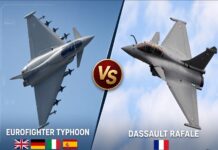
French Rafales and the UAE’s F-16 ‘Desert Falcons’ can serve as capable 4/4.5-generation adversaries, closer to a J-10C or JF-17 Thunder Block III. Rafale is a superior aircraft to the Chinese ones, and the IAF’s Su-30MKIs, Tejas, Mirage-2000s, and Jaguar pilots will get a good opportunity to counter these Western-origin jets.
This is not an official IAF statement, but multinational exercises are designed this way. Use the best available stand-ins, keep classified data out, and test tactics against a peer-plus threat.
Major Operational Planning and Execution Considerations
Large-force exercises among professional air forces take months of planning. The host must choose airspace and bases that can handle mixed fleets, site radars so they can see the fight, keep drop zones clear and — if live weapons are used — have a range. Staffs then build the mission set, starting with small packages and working up to large-force engagements that test offense, defense, and everything between.
Missions would include beyond-visual-range combat exercises as part of large force engagements (LFE), in offensive counter-air and air-defense roles. LFE require very detailed mission plans.
The build-up will be phased. The exercise pace will start with smaller packages and gradually increase in difficulty. Operational complexity will also increase gradually. The exercise will also test the maintenance crew to ensure high serviceability and meet the high mission tempo.
The plan must account for multiple aircraft flying in confined space, including slow-flying helicopters and UAVs and very high-speed fighters engaged in combat maneuvering.
Flight paths must be de-conflicted. Ground-based and airborne radars must closely control or monitor air engagements. Flight safety considerations have to be spelled out. Plan ‘B’ will be put on the table. Mission aims have to be explicit. Electronics briefing will be important. Electronic warfare will be selectively practiced.
Detailed debriefs will derive lessons and help improve future missions. Radio procedures must be coordinated. Mission commanders must be designated. Each mission must have a clearly spelled-out aim and a detailed briefing. A detailed safety and operational debrief is always conducted. The air effort must draw lessons for all air and ground crew.
Learning Enhancers
In addition to improving combat knowledge by imbibing best practices of other air forces, it also improves interoperability. Young aircrew get exposure by flying aircraft of other air forces. Social and casual interactions help exchange ideas and imbibe knowledge. Special lectures are organized to educate the participants.
These exercises are also a part of defense diplomacy. There are cultural events and exchanges. The saying “The more you sweat in peace, the less you bleed in war” is best exemplified by these air exercises. India should be proud that all Western air forces have rated IAF aircrew as great professionals and exceptional in air combat capabilities.

Operational and Administrative Planning
Tarang Shakti will help the IAF build professional relationships with the world’s leading air arms. Hosting a complex multinational exercise is highly valuable for the host.
Over the years, India has very successfully hosted large aviation events such as the Aero India “Airshow” at Yelahanka, Bengaluru. IAF understands the support required to host and position diverse equipment and platforms.
It will also be a major challenge to accommodate such a large number of personnel in secure nearby accommodations. Jodhpur is well equipped to handle a large flow of tourists.
The Win-Win for All
Multinational training helps air forces practice communication, mission planning, and coordination for enhanced interoperability. Operating different aircraft together requires compatible procedures, even when participants use different equipment. The crew will get exposure to diverse operational practices.
Interaction with foreign crews offers opportunities to compare training methods and mission approaches. The planned presence of F-35s would add a fifth-generation aircraft dimension, although participation does not imply access to classified technology or unrestricted sharing of capabilities.
Exercises build professional relationships, increase familiarity between armed forces, and strengthen defense diplomacy. Hosting a large multinational event also gives India a platform to engage several defense partners through a common training activity.
A complex multinational activity will help the IAF assess coordination among fighters, surveillance platforms, and support aircraft. Engaging several countries supports India’s broader defense relationships and strategic autonomy. Managing visiting aircraft and personnel develops experience in logistics, airspace coordination, and ground support. Lessons identified during the exercise can inform future training and operational procedures.
Challenges in Such Exercises
Variations in terminology, communications, and operational practices can complicate coordination and require attention.
Because each air force already participates in multilateral exercises, it can handle these issues appropriately. Participants may want to limit the sharing of sensitive aircraft data and mission information. Multiple aircraft types require different maintenance arrangements, equipment, and ground support, and could be a logistical and administrative challenge.
Much advanced information flows through this channel, and many countries are quite self-contained when in doubt. A large concentration of aircraft requires careful airspace management and clear operating procedures. Flight Safety remains paramount.
Air Power Tenets and Tarang Shakti
“Airpower is the most difficult of all forms of military force to measure, or even express in precise terms,” said Winston Churchill many years ago. Air power capabilities result directly from its characteristics of speed, range, and elevation. Military operations in the air and space differ significantly from those in land or sea.
Air power capabilities include operational flexibility, responsiveness, range, precision, and mobility. Aircraft can move rapidly over vast ranges, independent of sea or land boundaries. Air forces provide global range and global power. Air power is the integrated employment of all air and space forces to control and exploit the air and space environments to achieve national security objectives.
Air power exploits the properties of its operating medium to realize unique operational characteristics and thus employ unique capabilities to provide the nation a broad range of military options. The fundamental strengths of Air Force air power are air superiority, reliable global mobility, rapid global employment, and global situational awareness.
Concentration of force is a product of air power’s responsiveness, mobility, and tremendous agility of maneuver.
Concentration is not measured in numbers, but in overwhelming effect, at the decisive time and place. Centralized control and decentralized execution are an important approach to air power and need training. All these need to be tested and exploited. With very long-range weapons and platforms, and due to the highest impact of changing technology, platform employment and tactics change.
Thus, regular air exercises are needed. These exercises are required not only to train Air Warriors and improve interoperability between friendly air forces, but also to sensitize the joint staff and political leadership.
IAF is fast transforming from a continental air force to one with global reach. It now has trans-domain operations capability, and prides itself on its reach, flexibility, versatility, responsiveness, and offensive lethality.
Given the evolutionary nature of air power and the need to stay relevant across the spectrum of conflict in an interconnected environment, exercises and doctrinal reviews are needed. Exercise Tarang Shakti will help clarify the nuances of air power capabilities and their application.
Why Repeat Exercises
Since newer operational equipment keeps being inducted and crews keep changing, exercises need to be repeated every few years. Such international exercises expose participants to large-scale engagements with dissimilar aerial platforms. They also expose the IAF crew to different tactics and flight techniques under electronic and cyber warfare conditions.
Showcasing India
Many indigenous platforms will be seen in action. “Make-in-India equipment, including LCA Tejas, LCH Prachand, Netra AEW&C, Akash SAM, and some other weapon systems, will be showcased. LCA and some other indigenous aircraft would perform air displays.
The Diplomatic Corps, Officers of other services, industry members, Media, and think-tank analysts will attend some of these events. IAF’s Center for Aerospace Power and Strategic Studies (CAPSS) will organize an Air Power Seminar.
To Summarise
India’s economy and diplomacy have transformed, and the world is taking notice. New Delhi is thus in a position to engage the world on its own terms. Tarang Shakti is one such engagement.
The IAF would use structured post-exercise reviews to identify practical improvements in mission coordination and support operations. Common communication procedures, carefully defined information-sharing arrangements and strong safety practices can improve the quality of multinational training. Sustained professional exchanges between editions can help convert short-term interaction into lasting operational understanding and stronger defense relationships.
Tarang Shakti is showcasing the IAF and India more broadly. IAF will learn and share best practices with the leading visiting air arms. The Exercise has allowed the country to showcase its indigenous military capabilities to the world, including the LCA ‘Tejas’, Prachand light combat helicopter, Dhruv advanced light helicopter, and its armed version Rudra, among many others.
Key takeaways from the exercise include enhanced interoperability with international partners and a shared understanding of employment philosophy in a multinational environment. It will provide meaningful exposure for young crew members.
The exercise will prove the IAF’s professional reputation and cement the country’s place as a serious geopolitical player. Tarang Shakti is on track to become a regular IAF-hosted multinational exercise. The first two editions were two years apart (2024 and 2026); whether it settles on a biennial cycle or another has not been formally fixed.
- Air Marshal Anil Chopra (Retired) is an Indian Air Force veteran, fighter test pilot, and ex-director-general of the Center for Air Power Studies. He has been decorated with gallantry and distinguished service medals during his 40-year tenure in the IAF.
- He tweets @Chopsyturvey
- Follow EurAsian Times on Google News