The Yemen-based Houthis have shot down a Saudi F-15 fighter jet; however, the fate of the two crew members aboard the aircraft still remains unknown.
The Houthis downed a Saudi Arabian F-15 (SA) on September 16, near Marib, using a locally-made surface-to-air missile (SAM).
“The Yemeni Armed Forces, with Allah’s aid and grace, succeeded in shooting down a Saudi F-15 fighter jet while it was carrying out hostile operations in support of its military mobilizations in the airspace of Marib province,” Houthi military spokesman Yahya Saree announced in a post on social media.
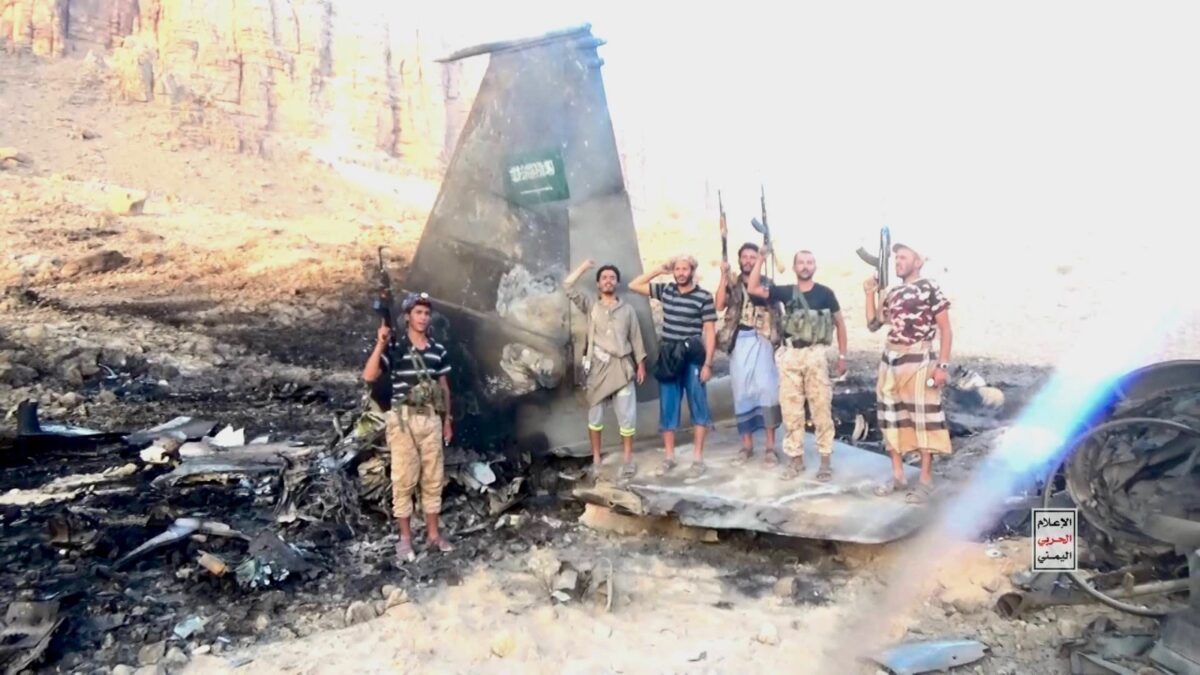
Following the shootdown, the Houthis released images of their fighters posing with the aircraft debris.
The downed aircraft has since been identified as the F-15SA Tail N.5539, operated by the 55th Squadron of the Royal Saudi Air Force.
The F-15SA is equipped with a fly-by-wire system, AN/APG-63(V)3 AESA radar, Digital Electronic Warfare System (DEWS), and Infrared Search and Track (IRST) capability, and is regarded as the RSAF’s most advanced F-15 variant. It is similar to the US Air Force’s F-15EX, as EurAsian Times previously explained.
Notably, Saudi Arabia has not officially accepted the loss of the aircraft. It has also not denied it!
EurAsian Times spoke with former IAF Test Pilot Air Marshal Anil Chopra to understand the situation.
Mystery Surrounding The Fate Of F-15 Crew
The F-15 SA is a two-seat aircraft that accommodates a pilot and the weapon systems officer (WSO).
As is customary for an aircraft of that type, the aircraft’s standard ejection system gives both crew members a realistic chance of survival if they punch out in time, but outcomes depend on altitude, speed, missile effects, terrain, injuries, and what happens after landing.
For example, the F-15E crew downed in April 2026 over southwestern Iran were able to eject, but behind enemy lines. This triggered a 36-hour intense search and rescue operation for the Weapon Systems Officer (WSO) who went missing, leading to cascading losses for the US military. The fighter pilot was rescued quickly, unlike the WSO.
The jet did not come down in Marib city. BBC Verify placed the wreck in isolated hills about 25 miles (40 km) west of the city.
Marib city and the oil-rich core of the province are still held by Yemen’s internationally recognized government and its Saudi-backed allies. That is why some analysts first assumed the crew might have been rescued quickly.
West of Marib is a Houthi stronghold. The area is rugged, thinly settled, and contested. Houthi militia reached the F-15 debris fast enough to film the tail and pose with it. But that does not prove they also found the crew.
One thing is clear: government forces control the city of Marib; the Houthis dominate the hills west of it. The F-15 crash site appears to be closer to the Houthi-controlled area than to Marib’s garrison.
How far could the crew have come down?
An F-15SA carries two people: a pilot in front and a weapons officer in back. If they ejected, they would not land right next to the jet. The seats fire a fraction of a second apart, then the parachutes drift with wind and speed. In the April 2026 US F-15E shootdown over Iran, the two crew members came down miles apart. The same can happen here.
No one knows the public altitude or speed of the Marib hit. A high, fast ejection can put a flyer several kilometers from the wreck. A low, late ejection can put them much closer — and in more danger.
Ejection itself is violent. Seats pull many times the force of gravity. Survival is common if the seat works inside its envelope. Serious injury is also common: spine, legs, head. Rocky hills west of Marib make a hard landing worse.
Where could be the Saudi Pilots?
The first scenario is that both crew members managed to eject safely, landed far away from the crash site (near the Marib city) during high-altitude ejection, and were recovered by the Saudi-backed forces.
In that scenario, the crew likely activated their beacons, made radio contact, and a combat search-and-rescue (CSAR) effort succeeded quickly.
However, that may be a very short time frame for a successful recovery, especially since the Houthis claimed that they engaged follow-on formations of the Saudi F-15s and Eurofighter Typhoons trying to locate the wreckage of the downed F-15SA and forced them to withdraw.
The second scenario is that both the pilot and the WSO ejected just in time, but were captured by the Houthis upon landing.
The crew could have been located by Houthi fighters or tribesmen, even before Saudi help could arrive.
In theory, Marib’s rugged terrain and the speed of the Houthi response could have favored a rapid capture. However, Houthis have remained silent on the issue, and no photos or videos of the crew have surfaced on social media.
These high-value captures would have high propaganda value for the Iran-backed Houthis, meaning that the possibility of the capture is somewhat weak unless they are secretly negotiating with Saudi Arabia.
The third scenario is that one or both crew members of the downed F-15SA were killed in the shootdown or ejection.
It is worth considering that the impact of the missile, the resulting fire to the airframe, structural breakup, or high-speed ejection could have caused fatal injuries to one or both crew members of the F-15SA before or during parachute deployment. The wreckage photos show significant fire and fragmentation, consistent with a high-energy impact.
Moreover, parachute malfunction, landing in difficult terrain, or post-ejection injuries cannot be ruled out at this point.
However, neither parachutes nor remains have been recovered, suggesting the crew may not have ejected successfully and were likely lost in the high-energy impact.
The fourth scenario is that both crew members landed safely and have been missing or evading capture.
In this scenario, the pilots and the WSO could have landed near or far from one another, then moved toward safer areas. They could be using their survival equipment and awaiting an extraction while suppressing their beacon to avoid detection by the Houthis.
The wreck is in Houthi-filmed hills west of Marib. If the crew left the jet, they likely came down somewhere else in that same belt of high ground. Riyadh has said nothing about a shootdown or a rescue.
Until one side produces names, bodies, or prisoners, the honest line is the same as before: the jet is on the ground. The two men are unaccounted for. The EurAsian Times stresses that these are possibilities discussed with aviation specialists, not confirmed facts.
Nonetheless, it is worth emphasizing that this is the fifth F-15 combat jet downed in the Middle East in over six months. Earlier, Iran shot down an F-15E Strike Eagle, callsign Dude 44, from the 494th Fighter Squadron of the 48th Fighter Wing, based at RAF Lakenheath, UK.
The hit was scored on April 3, 2026, using a shoulder-launched missile, marking the first confirmed loss of a manned US combat aircraft to Iranian fire over Iranian territory in the conflict.
Before that, three F-15Es were shot down in Kuwaiti airspace in a suspected case of friendly fire by Kuwaiti air defenses—most likely an F/A-18C/D Hornet—during the opening days of Operation Epic Fury, on March 1, 2026. All crew members ejected safely.
- Contact the author at sakshi.tiwari13 (at) outlook.com
- Follow EurAsian Times on Google News
- Story Updated