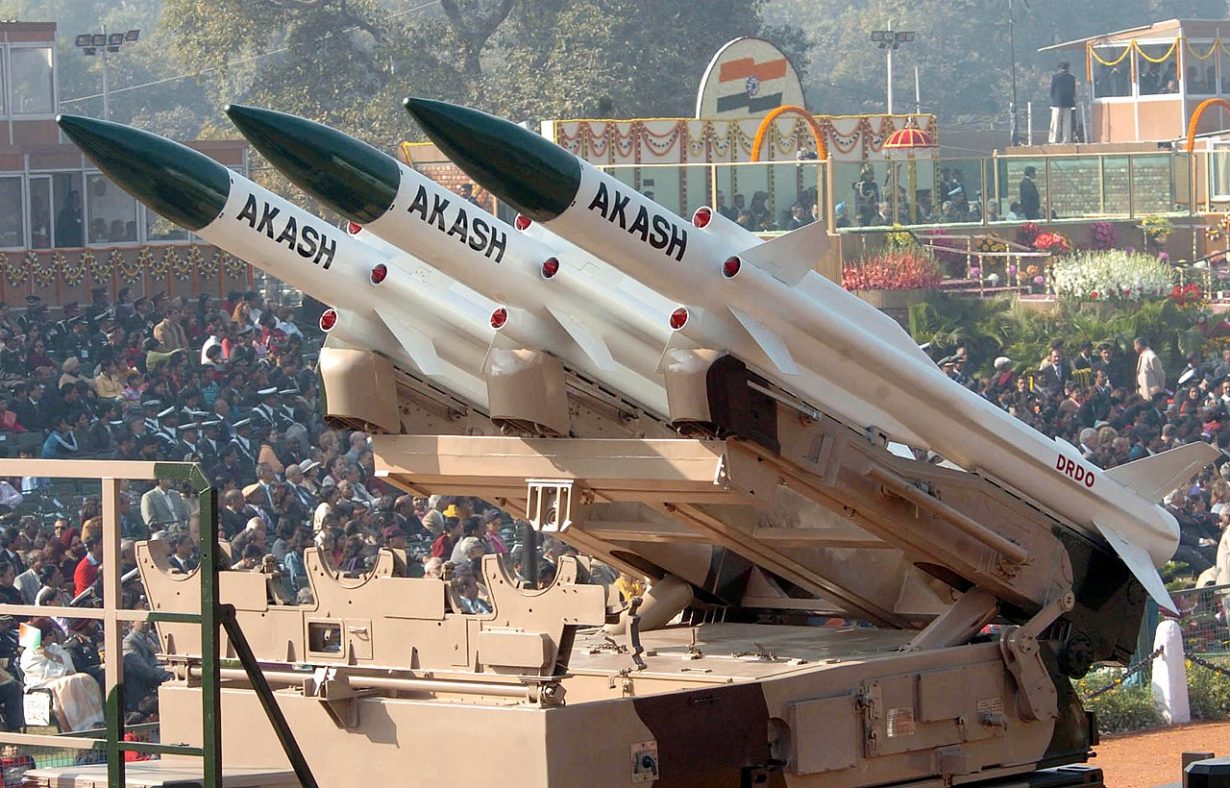
As nations worldwide race to bolster air defenses against missiles and one-way attack drones, India’s indigenous Akash surface-to-air missile system—proven in combat against Pakistan during Operation Sindoor in May 2025—is rapidly gaining popularity in the export market.
India’s Defense Secretary Rajesh Kumar Singh recently disclosed that the Akash air defense system has been exported to three countries.
Although Armenia’s purchase of the system is already known, this is the first time a high-ranking Indian official has revealed that the AD system has been acquired by two other countries in Central Asia: Turkmenistan and Tajikistan.
“The first customer was Armenia, which has taken multiple batteries. Thereafter, we’ve also exported it to Tajikistan and Turkmenistan. Production has stabilized. We have additional orders for our own services, and I’m sure there will be many more from various parts of the world, including some of the areas that you mentioned,” the Defense Secretary told ANI on Oct 1, 2026, in an exclusive interaction.
Describing Akash as a milestone in self-reliance, Singh said, “Akash, I would say that it is one of our success stories. It shows the maturing of our indigenous missile design and production system. It is effective in dealing with high-velocity aerial targets.”
He also noted that production of the Akash missile system has stabilized, and orders from other nations are growing even as procurement for the Indian Armed Forces continues.
A mobile short-to-medium-range surface-to-air missile system developed by the Defense Research and Development Organization (DRDO), Akash provides area air defense against multifarious air threats to mobile, semi-mobile, and static vulnerable forces and areas. The missile has a range of 25–30 kilometers, can intercept targets at altitudes of about 18–20 kilometers, and carries a 60 kg high-explosive fragmentation warhead.
“The real-time multi-sensor data processing and threat evaluation enables simultaneous engagement of multiple targets from any direction. The entire system is flexible, upscalable, and can be operated in group and autonomous modes. It employs command guidance and relies on phased array guidance radar to guide the missile till intercept,” states BEL, the manufacturer of the system.
With this export, India appears to have gained a foothold in Central Asia, where the countries have historically relied on Russian arms, but are now diversifying arms supplies as Moscow remains embroiled in a protracted conflict with Ukraine.
Notably, China has emerged as the biggest beneficiary of this vacuum left by Russia’s preoccupation with Ukraine, as previously explained in depth by the EurAsian Times. In fact, both Turkmenistan and Tajikistan already operate a host of air defenses sourced from Beijing, making India’s Akash purchase an even more noteworthy development.
The decision to acquire Akash possibly stems from its strong combat performance during the conflict with Pakistan as part of Operation Sindoor.
Earlier, former DRDO scientist Ravi Kumar Gupta told EurAsian Times: Akash’s versatility gives it an edge over other systems. He said that unlike other surface-to-air missiles that work only at particular altitudes and in specific climates, Akash’s biggest advantage is that it can work “all places.”
“The systems are developed for diverse conditions and can withstand extreme conditions anywhere in the world, which makes them ‘most reliable and sturdy.’ Since the system is fully indigenous, India can fine-tune it to any buyer’s requirements cost-effectively with a high degree of effectiveness against the adversary,” Gupta told EurAsian Times.
Akash: Sky in the Limit
On May 7, 2025, the Indian Air Force (IAF) launched attacks on terror sites located deep within Pakistan as part of “Operation Sindoor.” Pakistan retaliated with “Operation Bunyan al-Marsus.”
Following the first round of strikes by the IAF, Pakistan started to attack India’s western sector with waves of drones, including Chinese and Turkish-origin drones, missiles, rockets, and other aerial threats targeting Indian military installations and civilian areas. At one point, more than 600 drones were fired simultaneously across India’s western front.
The Akash AD—part of a layered air defense network that also included S-400, Barak-8/MRSAM, older systems like Pechora and OSA-AK, counter-UAS grids, and the Integrated Air Command and Control System (IACCS) or Akashteer—showcased resilience in the face of these attacks, ensuring that none of the Pakistani drones and missiles hit any targets.
At the official press briefing on Operation Sindoor, Air Marshal A.K. Bharti, the Director General of Air Operations (DGMO) of the Indian Air Force, specifically praised the Akash AD for thwarting Pakistani attacks.
“Another highlight has been the stellar performance of the indigenous air defense weapon system like the Akash system,” he stated. The sentiment was echoed uniformly across the board, with Lt Gen Rajiv Ghai, who later became the Deputy Army Chief, saying, “BrahMos, Akash and many other homegrown platforms and weapons played a decisive role in Operation Sindoor.”
Notably, small drones made up the majority of Pakistan’s projectiles during the conflict, which were mainly used to scan Indian defenses and overwhelm the air defense network, although a few kamikaze drones, missiles, and aircraft-launched munitions were also used.
Akash operated as a key hard-kill layer against these low-to-medium altitude threats, as its indigenous design, mobility, multi-target capability, and cost-effectiveness suited it well for the threats that characterized much of Pakistan’s response.
According to reports from the time, the Akash intercepted multiple drones and loitering munitions, disrupted swarm attempts, and even helped down guided missiles mid-flight at low altitude.
Akash interceptors helped protect higher-value, longer-range assets by keeping drone-saturation attacks out of the S-400 envelope. However, defense officials cited by Indian media said Akash, which has an interception range of 25 kilometers, played a major role in countering all kinds of threats, including aircraft, armed attack unmanned aerial vehicles (UAVs), and the Turkish Byker Yiha III kamikaze drones.
“It has been very effective against aircraft and other systems. This is the first time we saw it in active conflict. We hear that Akash has been used, and it has brought down a couple of aircraft. The whole team of scientists who have worked on the project is very, very happy. A great moment for all of them,” former DRDO chairman, Dr. G. Satheesh Reddy, said in an interview with NDTV days after the ceasefire was announced on May 10, 2025.
The most compelling commentary on Akash came from Gaddamanugu Chandramouli, the former Akash project director and DRDO scientist, who spent his entire career developing the system.
“Akash, which was indigenously built from scratch, was used in a combat zone for the first time and has proved to be robust and effective. The automated missile system caught the other countries by surprise,” Chandramouli told The Hindu in May 2025.
The Akash Weapon System can simultaneously engage Multiple Targets in Group Mode or Autonomous Mode. It has built-in Electronic Countermeasures features. The entire weapon system is mounted on mobile platforms. It can effectively engage helicopters, jets, and UAVs at ranges of 4-25 kilometers. It is fully automatic and has a quick response time from target detection to kill.
DRDO claims it is the first system in the world capable of engaging four aerial targets simultaneously at a range of 25 kilometers by command guidance using a single firing unit.
- Contact the author at sakshi.tiwari13 (at) outlook.com
- Follow EurAsian Times on Google News