The US honored seven airmen who piloted F-22 Raptors in combat operations in the Middle East with the “Distinguished Flying Cross” (DFC), even as the United States has relaunched a military buildup in the Region.
Of the seven airmen, six were awarded the DFC for their role in “Operation Midnight Hammer,” launched against Iran in June 2025, while one was honored for a mission in the Middle East without disclosing details.
The DFC is the fourth-highest award for gallantry in the military and honors acts of bravery or exceptional accomplishment in the air.
The USAF launched Operation Midnight Hammer in June 2025 following 12 days of intense clashes between Iran and Israel. The operation included an armada of 125 combat aircraft, including B-2 stealth bombers, F-22 and F-35 stealth fighters, F-16s, F-15Es, and several aerial tankers for refueling, as the EurAsian Times previously reported.
Although the role of the seven B-2 Spirit stealth bombers that dropped 14 bunker-buster GBU-57 MOP bombs on Iran’s underground nuclear facilities has been widely recognized, the F-22 Raptors also played a crucial role in the operation.
These air superiority stealth fighters moved ahead of the B-2 bombers along with the F-35s, conducting air superiority and air defense-suppression missions to clear the way for the B-2s to operate safely and effectively and bomb the three Iranian nuclear sites.
Of the aviators who received the DFC for Operation Midnight Hammer, four came from the Active-Duty 94th Fighter Squadron, part of the 1st Fighter Wing at Joint Base Langley-Eustis, Va., while two came from the associated Virginia Air National Guard’s 149th Fighter Squadron of the 192nd Wing.
Air Combat Command commander Gen. Adrian L. Spain presented the medals to the aviators in a ceremony at the Virginia base on August 31, 2026.
“Their job was to provide air superiority,” Spain said, referring to the F-22s. “The bombers and the rest of the support package relied on these Raptor pilots to clear the skies, shield them from surface threats, and ensure a safe route through heavily contested airspace.”
The F-22 is the USAF’s premier fifth-generation air superiority stealth fighter, allowing it to evade radar detection unlike the 4th- and 4.5th-generation fighters. In fact, the Raptor was purpose-built as an air dominance fighter, optimized to clear the skies of enemy aircraft, escort high-value assets, and operate in the most hostile environments.
Before Operation Midnight Hammer, the F-22 Raptors were also deployed against the Yemen-based Houthis in 2024, as the EurAsian Times reported at the time.
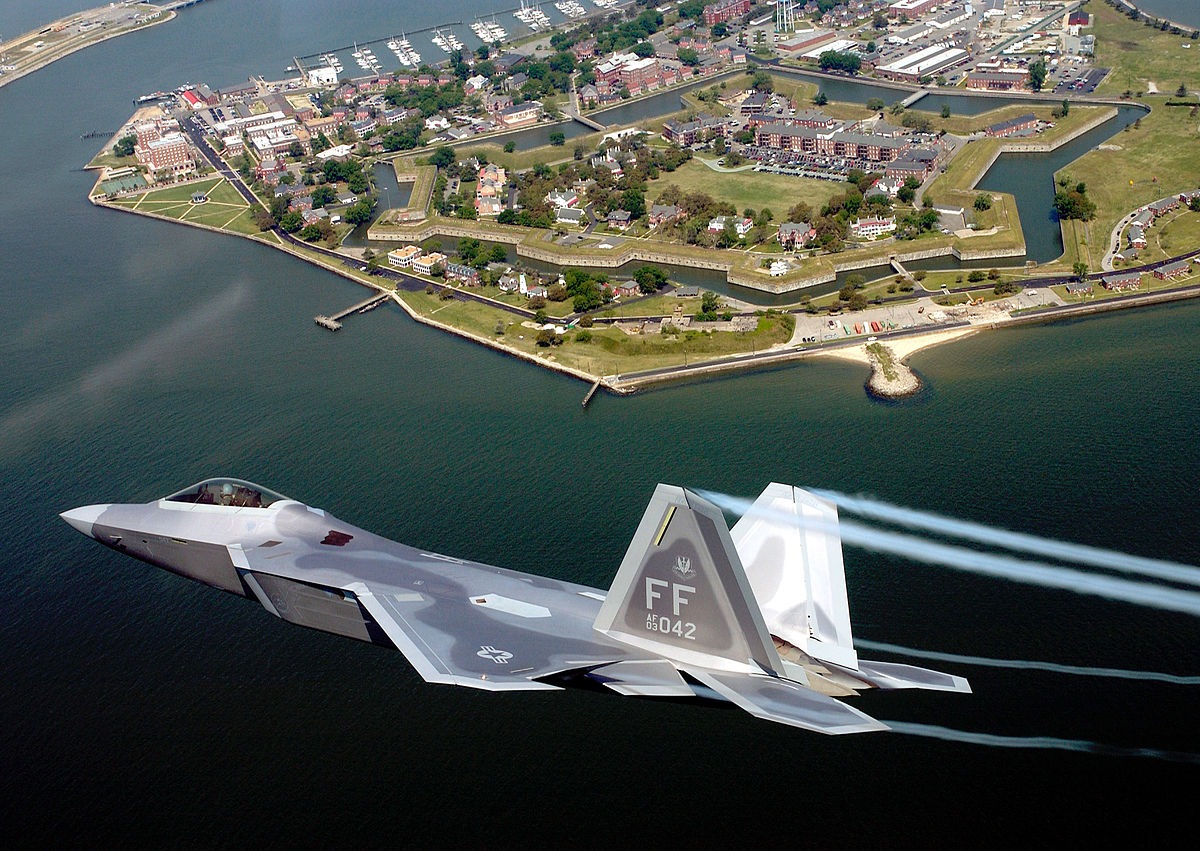
Earlier this year, the F-22 Raptors were once again summoned to the region for Operation Epic Fury, launched against Iran on February 28, 2026, together with Israel’s Operation Roaring Lion.
The F-22 Raptors of the 1st Fighter Wing at Langley Air Force Base were deployed to the Ovda Air Base in Israel for the first time ahead of the operation.
During the initial days of Operation Epic Fury, F-22s reportedly suppressed advanced Iranian air defenses, such as the S-300 and Bavar-373 systems, clearing the way for B-2 bombers and other strike packages.
Flying deep into Iranian airspace, the stealth fighters reportedly carried out pinpoint strikes on high-value targets between March 1 and 9, 2026, including military sites, nuclear-related infrastructure, and IRGC (Islamic Revolutionary Guard Corps) command nodes.
The Raptors also reportedly targeted the “infrastructure connected to the Fordow Fuel Enrichment Plant and Natanz Nuclear Facility,” as US Central Command (CENTCOM) previously noted. It “also coordinated with B-2 Spirit bombers and EA-18G Growler electronic attack jets in layered strike packages designed to overwhelm Iran’s integrated air defenses,” it added.
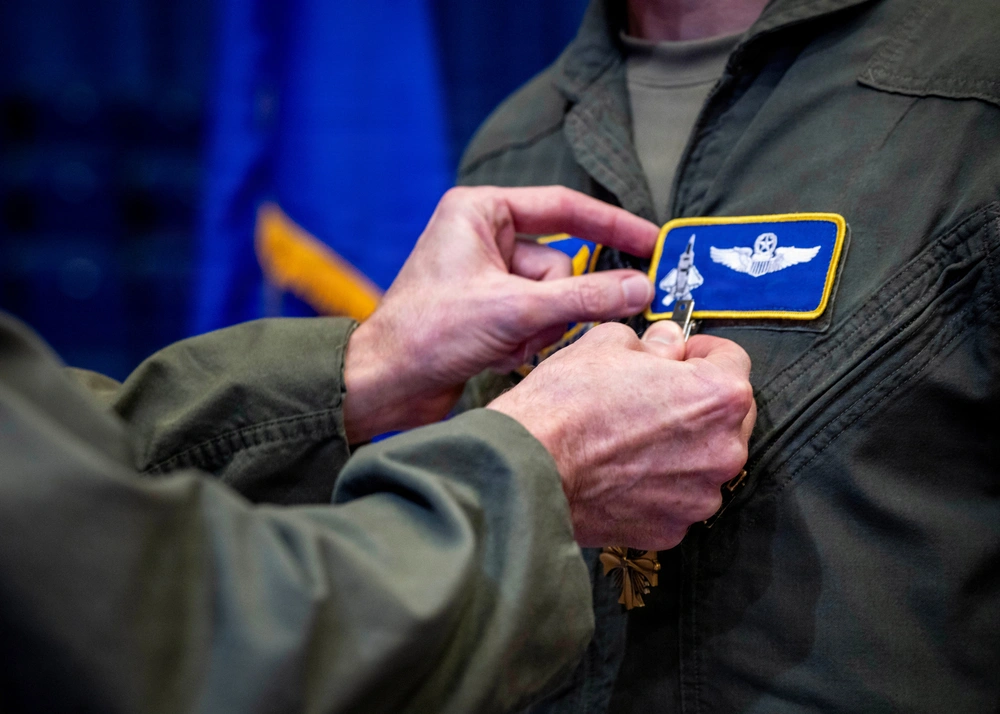
The seventh F-22 pilot—whose name was withheld—received the decoration on September 22 from Lt. Gen. Jason T. Hinds, commander of US Air Forces in Europe (USAFE), for commanding a strike package during a Middle East mission in contested airspace.
The pilot faced “challenging conditions including enemy threats” and “directed the aircraft formation, making critical decisions with limited time and little margin for error,” the USAFE stated.
“For more than an hour, [the pilot] remained focused on protecting teammates” and “acted decisively to protect the larger force, and ensured the formation could safely return,” Hinds said. “Their actions helped give the strike package the time and freedom needed to accomplish its mission.”
Interestingly, the DFC was awarded and publicized by the US Air Force at a time when tensions are escalating between the United States and Iran.
US Commences Military Build-Up in Middle East
The US is deploying a third US aircraft carrier to the Middle East as part of a fresh military buildup as President Donald Trump weighs new strikes.
The USS Theodore Roosevelt carrier strike group departed its San Diego base last week on the Pentagon’s order. The USS Makin Island amphibious readiness group followed, with its two amphibious landing ships. About 9,000 sailors, 7,000 aboard the carrier and 2,000 aboard the amphibious ships, are en route to waters near Iran.
With USS Theodore Roosevelt’s arrival, three aircraft carriers would be standing guard in West Asia by late October, according to US officials who spoke to the media. As of now, the carriers USS George HW Bush and the USS George Washington, along with the USS Boxer amphibious readiness group, are in the region amid ongoing hostilities.
This would bring the overall US naval presence to more than 20,000 sailors and Marines, along with hundreds of aircraft, significantly expanding the military posture.
🇺🇸 The USS Theodore Roosevelt (CVN-71) has left San Diego to build a three-carrier presence in the Middle East
Ahead of the U.S. midterm elections, officials confirmed the Roosevelt will join the USS George Washington and the USS George H.W. Bush, a rare trio of supercarriers,… pic.twitter.com/yisXp9TAVu
— Visegrád 24 (@visegrad24) October 1, 2026
Additionally, reports citing informed sources suggest that the US military sent two additional Patriot missile batteries to protect oil and gas facilities in Saudi Arabia and Qatar in recent weeks.
Notably, the two sides have remained locked in a tense battle since July, when they started trading fire after a long lull that followed the June memorandum of understanding.
Last week, Iran proposed a new deal in which it would open the Strait of Hormuz in return for lifting the US blockade of its ports, unfreezing funds, and removing sanctions on Iranian oil. However, Trump rejected the proposal, saying Iran is seeking an agreement now because it is losing so badly.
The two sides later held indirect talks, signaling that they may be open to negotiating a fresh deal. However, Trump caused a stir again as he told Time magazine this week that the US military could ramp up bombing of Iran after the November 3 midterm elections that will be held amid continued disapproval of the war at home.
Furthermore, the President said that Iran may have something to do with the recent incident involving the FlyDubai flight, adding that it will be hit very hard if Tehran’s connection is verified.
For now, a deal between Washington and Tehran looks more elusive than ever, especially as the Pentagon is moving major military assets to the region. If Trump decides to resume the bombing, the presence of three aircraft carriers will significantly expand his options and fighter jet presence near Iran.
- Contact the author at sakshi.tiwari13 (at) outlook.com
- Follow EurAsian Times on Google News