

Britain’s Unite trade union group has urged Prime Minister Andy Burnham to award the £2.4 billion (about $3B) military satellite contract to European aerospace company Airbus instead of US defense giant Lockheed Martin.
The dispute highlights a broader industrial rivalry between Airbus and Lockheed Martin, which have competed in various domains, including combat jets.
“Ministers keep say (ing) buying British will be the default. Skynet 6 is the first real chance this government has to prove it. Now it needs to get on with it. Our members at Airbus and its supply chain have built the MoD’s military satellites for over 20 years. You cannot justify throwing away all those good highly skilled jobs on the back of a promise which may never even materialise to deliver fewer jobs at some point in the future,” Sharon Graham, the General Secretary of Unite, the Labor Party’s biggest trade union backer, recently stated.
The UK government is now deliberating on a decision on the Skynet 6 Wideband Satellite System (WSS), a multi-billion-pound program which will deliver two new high-capacity geostationary satellites for the British Ministry of Defense (MoD). The WSS contract is part of the Skynet 6 capability, which is intended to replace and augment the current Skynet 5 constellation used by the UK armed forces.
Skynet is Britain’s military satellite communications network. It enables the armed forces to communicate securely worldwide, exchange sensitive information, coordinate troops, aircraft, and naval vessels, and maintain reliable links even during conflict.
This matters because military communications must remain secure and reliable even during war. The new satellites will reportedly carry military-grade X-band and Mil-Ka-band communications payloads and will be supported by updated launch operations and ground infrastructure.
Airbus has designed, built and supported Skynet satellites for decades at facilities in Stevenage, Hertfordshire, and Portsmouth, Hampshire. This time, however, Airbus faces a strong challenge from Lockheed Martin for the WSS contract.
Lockheed Martin has put forward a competing offer that includes creating a new manufacturing facility in the North East of England. The US firm has pledged about 500 direct jobs and additional employment in the broader supply chain, positioning its bid as an opportunity to build a new sovereign UK space manufacturing ecosystem with export potential and deeper integration with US systems. North East MPs have lobbied for the Lockheed proposal, arguing it would bring defense industrial investment to a region that receives a relatively small share of MoD spending.
Airbus has offered to continue developing and manufacturing Britain’s next-generation Skynet military satellite communications system using its established UK facilities, workforce and technology. Its main proposition is that Britain should build on its existing satellite manufacturing capabilities rather than transfer the program to a new supplier.
It intends to use its established facilities in Stevenage and Portsmouth, retaining experienced British engineers, technicians and specialist suppliers. Airbus is also proposing to build on its experience with the existing Skynet program and its Eurostar satellite platform.

Although no final decision has been announced as yet, reports indicate that some quarters within the Ministry of Defense have leaned toward Lockheed Martin’s bid. The competition has therefore been extended, with Downing Street reviewing the proposals in light of industrial, sovereignty, jobs and political considerations.
Unite Group, the Labor Party’s biggest trade union backer, has urged the Burnham government to decide in favor of Airbus, citing risks to thousands of jobs in the country.
Unite’s general secretary, Sharon Graham, has been among the most vocal critics of a potential Lockheed award. Earlier, she described as a “massive mistake” the decision to hand over the contract to Lockheed over Airbus. The group has been mounting pressure on the Burnham government, stating that awarding the contract to Lockheed would put existing skilled jobs and national capability at risk in exchange for promises of future employment that may take years to materialize, if they materialize at all.
Airbus has openly warned against choosing Lockheed to build the satellites. Last month, Guillaume Faury, Airbus’s chief executive, wrote to Burnham warning that the UK might lose a significant position in the European space industry if it decides to produce military satellites with its US rival, Lockheed Martin.
Separately, senior industry leaders have surmised that Airbus’s UK satellite operations would not be feasible without the next Skynet contract, which may eventually lead to the shuttering of its Stevenage and Portsmouth sites, which employ 3,000 people, including 600 who work on Skynet. It would also likely affect a wider supply chain estimated at around 18,000 roles.
Critics of the Lockheed bid have questioned whether the promised UK factory would deliver genuine high-value work or primarily assemble systems designed and controlled elsewhere, most likely in the United States.
Lockheed has insisted that any awarded system would meet UK sovereignty and security requirements, with assembly, integration and testing required to take place in Britain and key sub-systems subject to UK sourcing rules.
However, trade unions and Airbus continue to lobby against the American firm.
Supporters of Airbus also raise sovereignty and security arguments. They contend that keeping the design, integration, and control of critical military communications satellites within a European or UK industrial base will reduce long-term reliance on US technology and export-control regimes. They have even mentioned the restrictions the US has imposed on Ukraine’s use of the Starshield satellite network.
Meanwhile, Unite has framed the contest as an early, high-profile test of the Burnham government’s commitment to reindustrialization and its preference for British, or European, suppliers in defense procurement.
Britain is supposed to choose between an established European aerospace company with substantial British manufacturing facilities and an American defense company promising to establish a new British manufacturing operation. Analysts say the decision could have significant ramifications for the future of both the British and European space sectors.
That said, the ongoing Skynet contest is part of a longer pattern of competition between Airbus and Lockheed Martin, in which the European company has conceded multiple high-profile contests.
Airbus Has Lost To Lockheed Many Times
Airbus is a major partner in the Eurofighter Typhoon consortium alongside BAE Systems and Leonardo. The consortium has lost a series of international fighter competitions to Lockheed Martin’s F-35 Lightning II over the past decade, though the Typhoon has shown more recent sales momentum that resembles a global resurgence.
In 2016, the F-35 Joint Strike Fighter (JSF) beat the Eurofighter Typhoon and the US F/A-18E/F Super Hornet for a Danish contract. The JSF outperformed both rivals in every category, ranging from combat performance to cost and industrial cooperation. This was one of the first major upsets for the Eurofighter consortium, which included Airbus.
In 2018, Britain proposed several strategic and commercial partnerships to the Belgian government to reach an agreement to supply Eurofighter Typhoon aircraft to replace Belgium’s aging F-16 fleet.
“The proposal includes 34 Typhoon aircraft, underpinned by the offer of a deep strategic, defense and industrial partnership between the Governments of Belgium and the U.K.,” the British MoD said at the time.
However, Belgium selected the F-35 over the Eurofighter Typhoon as its next-generation aircraft, becoming the 13th country to join the Joint Strike Fighter program.
At the time, the Belgian Defense Minister Steven Vandeput told reporters that the F-35 beat the other contenders in all seven selection criteria. One source said that, at the time, Lockheed’s offering was “much cheaper and more efficient” than the Eurofighter.
Two years later, another European country—Poland—chose the F-35 Joint Strike Fighter over the Eurofighter Typhoon and the Saab Gripen-E/F as part of its modernization away from Soviet-era aircraft, citing the American fighter’s stealth characteristics.
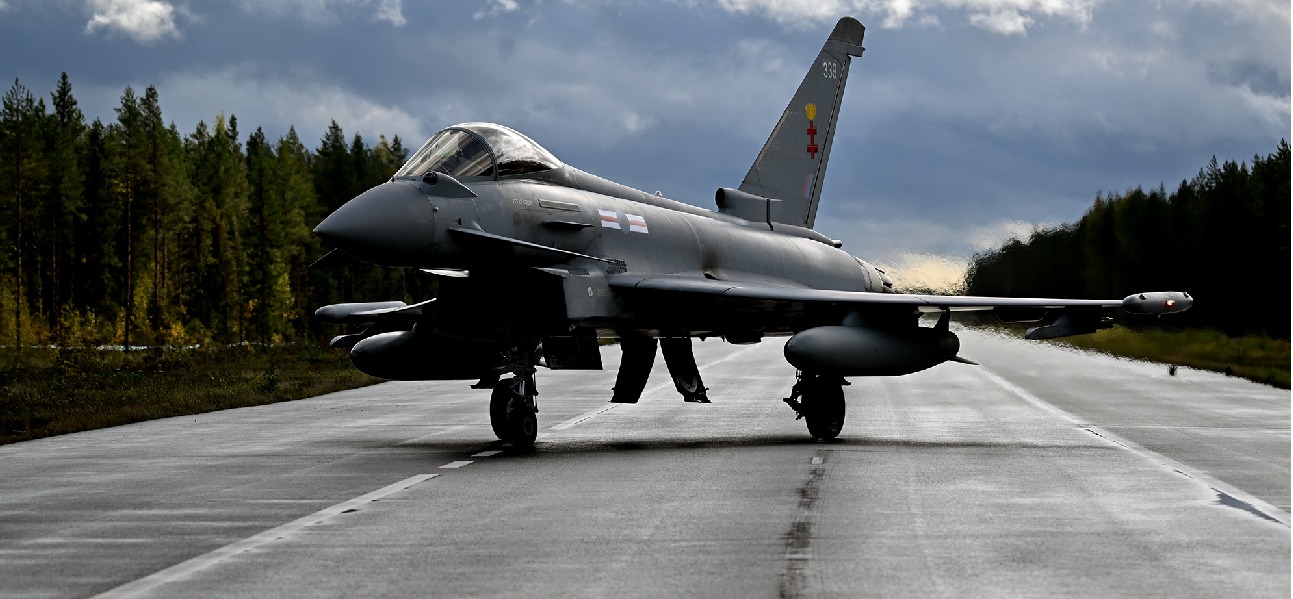
Interestingly, the Eurofighter consortium is still pitching the aircraft to Poland as the Polish government seeks a new multi-role fighter to bolster its air power well into the future.
In 2021, Airbus and other consortium members were jolted by two big losses in Switzerland and Finland, both of which conceded to the Lockheed F-35.
The F-35 beat Eurofighter in Switzerland’s fighter contest, with the Swiss Federal Council saying in a news release that Lockheed’s bid was $2.16 billion less than its closest rival over a 30-year forecast and that the F-35 guaranteed the best performance at the lowest cost.
“In terms of effectiveness, the F-35A achieved the best result because … it includes entirely new, extremely powerful and comprehensively networked systems for protecting and monitoring airspace,” the Federal Council stated. The F-35 outperformed the contenders in terms of cooperation, product support, and effectiveness.
Similarly, Lockheed’s F-35 JSF won Finland’s HX fighter competition, worth US$ 11 billion, by beating the Eurofighter and Super Hornet.
In several other selections, including Canada, the Netherlands, and Norway, the F-35 prevailed or was chosen over the Typhoon where it was also in contention.
While the Eurofighter Typhoon remains a capable 4.5th-generation aircraft, the F-35 Joint Strike Fighter’s export success stemmed from its advantages in stealth, sensor fusion, networking, and overall program scale, as well as the United States’ political influence.
However, the Eurofighter consortium has recently regained momentum, securing additional orders from partner nations and export customers. Turkey, for instance, agreed to purchase 20 British-built Typhoons in an agreement worth up to £8 billion in October 2025.
- Contact the author at sakshi.tiwari13 (at) outlook.com
- Follow EurAsian Times on Google News