The US military lost three military aircraft during peacetime in September 2026 alone, highlighting that accidents continue to hit even the world’s most advanced air force. These incidents also reminded us of the mid-air collision between a KC-130J and an F-35B in September 2020 that ended in one of modern aviation’s most remarkable saves.
On September 28, 2026, two naval aviators ejected from an EA-18G Growler assigned to Electronic Attack Squadron 130 after an arresting gear failed during recovery on the USS Dwight D. Eisenhower aircraft carrier.
Both aircrew were recovered safely. It is currently unknown whether the aircraft was lost or escaped with some damage, and an investigation is underway to determine the cause of the accident.
Earlier in the month, two F-16 Fighting Falcons were destroyed in separate training accidents.
On September 17, an F-16 from the Texas Air National Guard’s 149th Fighter Wing went down in rural Michigan during training from Alpena Combat Readiness Training Center, and on September 22, a US Air Force F-16 from the 52nd Fighter Wing at Spangdahlem Air Base, Germany, crashed on approach after a routine training sortie.
In both cases, the pilot was able to eject, but the aircraft was fully destroyed.
While September was particularly painful for the US military and its prized military aircraft, it also reminds us of the time six years ago when a mid-air collision over California nearly claimed the lives of eight Marines aboard a KC-130J.
When A KC-130 Collided With an F-35B
On the afternoon of September 29, 2020, a U.S. Marine Corps F-35B Lightning II, call sign “Bolt 93,” and a KC-130J Super Hercules tanker, call sign “Raider 50,” collided at around 4:00 p.m. while conducting air-to-air refueling operations in the Kane West Military Operations Area near the Salton Sea in Southern California.
The aircraft were participating in Weapons and Tactics Instructor (WTI) Course 1-21, which is a demanding seven-week advanced training program conducted by Marine Aviation Weapons and Tactics Squadron 1 at Marine Corps Air Station Yuma, Arizona. The course reportedly emphasized integrating Marine aviation into Marine Air-Ground Task Force operations under realistic, high-tempo conditions.
The Raider, assigned to Marine Aerial Refueler Transport Squadron 352, had already refueled one F-35B and was orbiting to tank the second. The F-35B approached the hose and drogue extended from the refueling pod on the tanker’s right wing and struck the underside of that wing.
As expected, the F-35B arrived for aerial refueling. However, as it approached, the hose and drogue extended from the tanker’s right wing, and it struck the underside of the right wing.
The impact was so massive and violent that it sheared off all propeller blades on the tanker’s two right-side engines, damaged the right fuel tank and refueling pod, and caused severe structural damage, including to the landing gear compartment.
Immediately after, fuel began leaking, raising concerns about a potential onboard fire.
The F-35B that collided with the massive refueller aircraft was critically damaged, forcing the pilot to eject. The aircraft crashed in the Ocotillo Wells area near Salton City, according to reports from the time. However, the KC-130J—piloted by Capt. Michael Wolff and co-pilot Maj. Cory Jones—had a gargantuan task ahead of them. They had to land.

“It was a really violent collision,” Wolff later recalled, adding that everything happened within “1.2 seconds or something. Not enough time to really react and do anything.” Days after the incident, he said the collision was so violent it sent everything flying inside the aircraft. “It was pretty violent… I got my headset back on, grabbed the yoke, and I got the plane back under control,” the pilot of the unfortunate aircraft told USNI News.
After the impact, the crew discovered the collision had left a hole in the aircraft, letting in a blast of outside air as they braved glaring lights and blaring alarms in the cockpit, while the displays lit up with cascading caution and warning messages.
The collision wiped out both engines on the KC-130J’s right (starboard) side. Yet “the impact did not damage our ailerons, elevators or rudder, so we still have all of our primary flight control surfaces,” Wolff later recalled in his interaction with USNI. “At that point, I’m like, OK, let’s get figuring out what’s going on and the best course of action.” “That’s when – it’s kind of cliché – the training kicks in,” he added.
The crew drew on their deep familiarity with the KC-130J, forged through countless flight hours and simulator sessions rehearsing emergency procedures in the air and on the ground. Aircrews are well known for their rigorous adherence to detailed checklists, along with the almost automatic responses and ingrained knowledge that come from repeated practice. “We start running through everything,” Wolff told USNI News later, “and figuring out where to go and communicating to the crew and then outside” to air traffic control.

The KC-130J crew declared an emergency to Los Angeles Center, reporting a mid-air collision, damage to two engines, a fuel leak, a possible fire, and an emergency descent, as later revealed in the emergency call recording. “We are declaring an emergency. We still have partial control of the aircraft,” Wolff was heard saying in a rather calm manner.
Thick black smoke streamed behind Raider 50 as flames roared from its burning fuel tanks, and the rear crew members confirmed the severity of the damage to engines No. 3 and No. 4. The crew then focused on keeping control of the aircraft and getting it safely back to the ground. “I can see the far right engine – the #4 – from my seat, but I can’t see the #3,” Wolff said. Crew members in the rear of the aircraft “gave me confirmation that [the] thing was toast, and we pulled the fire handle and [made] sure nothing got worse.”
He needed constant updates on whether the fire was dying down or if fuel was still leaking from the wing, stressing that “that communication from the back [crew] is extremely vital to get down safely.”
The crew aboard the aircraft on that fateful day had practiced for an emergency with two engines out, but never for multiple emergencies.
With the tanker still heavy with fuel and only five parachutes available for eight Marines, bailout was not a practical option. The crew committed to landing.
Determined to land safely, the pilots surveyed the surrounding terrain and found Thermal Airport—officially Jacqueline Cochran Regional Airport—a viable landing site. “We had a lot of open space between where we were and there – the Salton Sea and a lot of farmland – and we’re not worried about populated areas,” Wolff said.
However, their troubles were far from over.
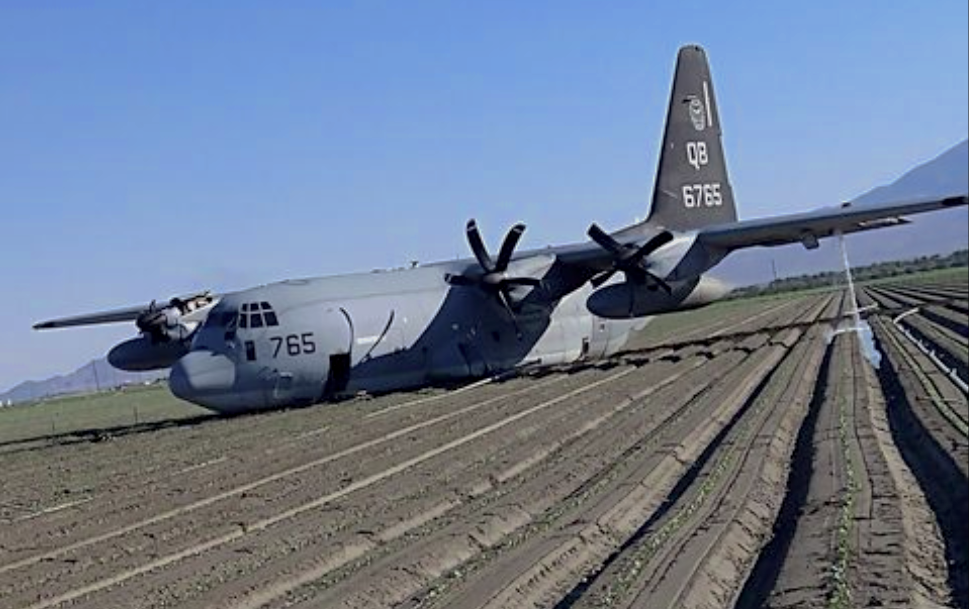
Just as the crew lined up for a runway landing, the aircraft began drifting right because of the ongoing malfunctions and the distance involved.
With only five parachutes for eight crew members and the aircraft still partially controllable on the remaining engines, they committed to a forced landing rather than a bailout.
After roughly 12–13 minutes of fighting for control—facing multiple system failures, an uncommanded right turn after dipping below minimum control airspeed, and other issues—they executed a gear-up or belly landing in a farm field near Jacqueline Cochran Regional Airport in Thermal, California.
The aircraft skidded several hundred yards and came to rest with extensive damage but intact enough for the entire crew to walk away with only mild injuries.
“It wasn’t quite like the movies where you see you have like a 747 that plows through … We came to a stop pretty quickly,” Wolf said.
Pilot sure earned that DFC
September 29, 2020: a US Marines KC-130 and an F-35 collide during mid-air refueling over California (US). Fighter crashes, pilot ejects safely, KC-130 crash-lands in a carrot field, all 8 aboard survive.
The KC-130 pilot was later awarded the… pic.twitter.com/Xu46wipUUP
— Francisco Cunha – ✈️ Aviation et al (@OnDisasters) September 29, 2026
The collision, resulting fire damage, and emergency landing meant the aircraft had to be written off. After investigators finished examining the wreckage, Marine Corps teams spent roughly a week removing it from the field. They recovered the rear stabilizers and the aircraft’s tail section, set them up outside the squadron, and painted them in the unit’s distinctive Raider black as a permanent display and reminder.
For their actions, both Capt. Michael Wolff and Maj. Cory Jones received the Distinguished Flying Cross, the highest award in flying and the fourth highest award for bravery. The award recognized the skill, discipline, and crew coordination.
The collision, engine failure, and safe landing marked one of the rare incidents in which every crew member survived, including the F-35 B pilot.
- Contact the author at sakshi.tiwari13 (at) outlook.com
- Follow EurAsian Times on Google News