An undisclosed Middle Eastern state has placed an order for SAAB’s GlobalEye AEW&CS (Airborne Early Warning & Command System) aircraft.
Saab received a SEK 10.1 billion order for two GlobalEye aircraft from a Middle Eastern country, with deliveries planned for 2030, the manufacturer said in an official statement on July 27.
“Due to the nature of the industry, circumstances concerning the customer and national security interests, no further information regarding this order or the customer will be provided,” it emphasized in the statement.
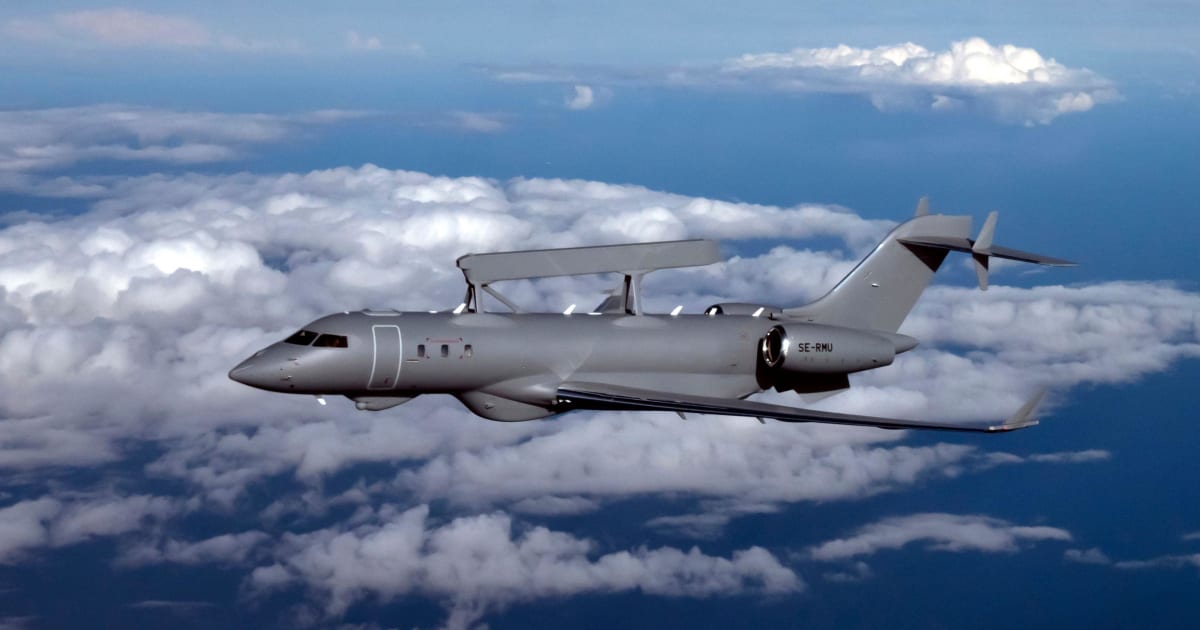
The GlobalEye system incorporates Saab’s Erieye Extended Range radar, which is mounted on the fuselage of the Bombardier Global 6000 long-range business jet. It is a multi-role, multi-domain system that provides simultaneous long-range surveillance of air, sea, and land targets from a single platform, according to Saab, the manufacturer.
“This order underscores our commitment to providing customers with mission-proven, multi-domain AEW&C capability. The increasing international interest in GlobalEye reflects its effectiveness and reliability in modern air defense operations,” Micael Johansson, President and CEO of Saab, was quoted as saying in the statement.
The undisclosed buyer becomes the second Middle Eastern operator of the GlobalEye after the United Arab Emirates, which already fields a fleet of five aircraft. Given the UAE’s usual transparency regarding follow-on purchases, the new order has been widely assessed as coming from a different customer in the region.
Military watchers and enthusiasts were quick to speculate that the buyer may be based in the Gulf region, which has been persistently attacked by Iran’s Islamic Revolutionary Guard Corps (IRGC) in the latest US-Iran war. In fact, some believe the purchase may have been influenced by the UAE’s use of the platform during the Iran war.
Although the UAE has not publicly confirmed deploying its GlobalEye, it is likely that the aircraft was used for airborne early warning and surveillance at the height of the conflict to detect Iranian drones and missiles and give its defenses more reaction time.

Typically, AEW&C platforms supply a recognized air picture and cue interceptors—roles in which ground-based radars alone are limited against low-flying or saturation threats, such as one-way attack drones. Australia, for example, deployed its E-7 Wedgetail to the Gulf region in March 2026 during the height of the conflict, for the same role.
The UAE GlobalEyes may have presumptuously operated as airborne nodes feeding real-time tracks to air defense systems such as THAAD and Patriot, as well as to fighter aircraft. This may have supported the UAE’s reported high interception rates, spanning hundreds of ballistic missiles and over 2,000 drones.
Additionally, previous reports indicated the UAE conducted its own airstrikes against Iranian targets in coordination with the US and Israel. In that case, the GlobalEye could have provided ISR (Intelligence, Surveillance, and Reconnaissance) or targeting support, though there is no public evidence to confirm that at this point.
Although the identity of the latest GlobalEye customer is concealed, we know that Saab had offered the aircraft to Saudi Arabia and Qatar last year, both of which have been repeatedly attacked by Tehran’s forces. Saudi Arabia, for one, already operates the Saab 2000 AEW and has been looking to upgrade its early warning fleet. Some sources, however, believe that Kuwait could be the new customer, particularly after the harrowing war.
Either way, the order adds to what has already been a strong year commercially for Saab. Earlier this month, NATO Secretary General Mark Rutte announced that the alliance would begin formal negotiations with the company for up to 10 GlobalEye aircraft to replace its fleet of 14 Boeing E-3A Sentry AWACS aircraft.
Ukraine Just Punched a Hole in Iran & Russia’s Secret Caspian Highway — Tehran Vows Consequences
Before that, Sweden, France, and Canada had signed deals to acquire the early-warning aircraft, as previously reported by EurAsian Times. Additionally, Saab has simultaneously ended a decade-long drought in Gripen fighter sales. Thailand and Colombia ordered the aircraft last year, while Ukraine recently signed a deal for 20 Gripen-E/F jets.
Saab’s GlobalEye AWACS
“GlobalEye is an advanced multi-domain AEW&C solution with an array of active and passive sensors that provide long-range detection and identification of objects in the air, at sea, and over land. By providing real-time information to units in air forces, armies, and navies, GlobalEye enhances situational awareness of surrounding areas and enables early threat detection,” states the manufacturer.
Notably, the GlobalEye offers real-time air, sea, and land surveillance over a range of 350 nautical miles (about 650 kilometers) by combining Saab’s Erieye Extended Range (ER) radar, marine surveillance radar, and a multi-domain Command and Control (C2) system.
The GlobalEye “combines excellent flight performance with low maintenance costs” and can remain airborne for over 11 hours, according to the manufacturer.
Although it is classified as an AEW&C by Saab, the GlobalEye can also conduct land and sea surveillance thanks to the FLIR (Forward Looking Infrared) Systems Safire electro-optical system and the Leonardo Seaspray 7500E radar mounted in pods beneath the fuselage.
The system can also detect small targets, such as drones, and provide ground-moving target indication (GMTI), which is critical in modern combat, especially in the Middle East, where an exponential rise in the use of cheap, one-way attack drones has been witnessed. Moreover, the GlobalEye is particularly good at detecting low-observable and stealthy threats, including drones and ballistic and hypersonic missiles, even in complex environments with significant clutter and electronic jamming.
The GlobalEye can gather, process, and disseminate data to all authorities and available resources, including airborne forces. Additionally, it makes it easier to share information effectively between platforms.
It can even manage and guide other assets, like fighters, and tell them when and where to take action—a critical requirement in modern, networked combat.
As for Saab, the development of the GlobalEye has allowed Saab to re-enter the global AEW market, building on the success of its previous Erieye-equipped regional airliners, the Saab 340, 2000, and Embraer 145.
Securing yet another sale of the GlobalEye is likely to further solidify the Swedish manufacturer as a trusted player in the market.
- Contact the author at sakshi.tiwari13 (at) outlook.com
- Follow EurAsian Times on Google News