

The US Defense Intelligence Agency said in a new assessment that China could deploy space-based directed-energy weapons by the late 2020s, adding to an existing suite of ground-based systems already capable of affecting satellites.
Titled “Challenges to Security in Space,” and published on October 26, the assessment is the third in a series of reports examining the military space programs of China and Russia, as well as emerging capabilities in Iran and North Korea.
Although China already fields an array of ground-based lasers capable of disrupting, degrading, or damaging satellites in low Earth orbit, the DIA report said it could deploy these directed-energy weapons in space and field more powerful ground-based systems that could threaten American satellites by the end of the 2020s.
These DEWs will be part of a broader Chinese counterspace arsenal that includes electronic warfare, cyber tools, kinetic anti-satellite (ASAT) missiles, and co-orbital platforms.
The assessment follows US Space Force Gen. Stephen Whiting’s August 2026 public assertion that China has ASAT missiles, ground-based lasers, jammers, and maneuverable, dual-use satellites.
“These developments intend to degrade our current space superiority and would potentially give China a maneuver and logistics advantage in space – something we would not accept on the land, at sea, or in the air,” he emphasized at the time.
Directed-energy weapons, for one, transmit concentrated electromagnetic energy, including high-power lasers or high-power microwaves, toward a target to damage, disable, disrupt, or destroy it, rather than relying primarily on conventional fires, shells, or missiles.
DEWs are significantly cheaper than conventional weapons.
Chinese state-owned media dismissed the reports as “hype,” accusing the United States of raising alarms about purported space threats even as it presses ahead with its own orbital military buildup, deploys weapons in space, and advances the aspirational space-based Golden Dome missile defense initiative.
US Already Has Weapons in Space
While the above is typical of a Chinese response to such accusations, the United States has indeed placed weapons in space whilst cautioning about the domain’s militarization.
USAF Secretary Troy Meink said in September 2026 that the country now possesses “on-orbit space control weapons” capable of defending US and allied forces, as the EurAsian Times reported at the time.
Although he did not say which weapons the US has deployed, US Space Force doctrine emphasizes “space control,” the ability to contest and control the space domain using kinetic and/or non-kinetic means to disrupt, degrade, or destroy adversary capabilities. Thus, the deployed weapons can serve either offensive or defensive purposes.
Meink linked the deployment to threats from China and Russia, asking rhetorically whether anyone doubted those countries’ development of similar weapons. “It is critically important that we maintain our dominance not only in the air but in space, and so we’ve had to take steps to make sure that when we’re threatened, we can take care of that,” he asserted.
At the time, the Chinese foreign ministry responded to the U.S. announcement by accusing Washington of “preparing for war in outer space” and warning against turning space into a battlefield or triggering an arms race, the same things it often campaigns against.
When asked whether the admission of placing weapons in space amounts to militarization of space by the US and if it could trigger an arms race, Group Captain Pandey (retd) told the EurAsian Times, “By design, the Pentagon wants potential adversaries to know that an operational defensive and offensive counterspace shield exists in orbit, without revealing how it functions. Disclosing exact specifications (such as frequencies, physical yield, or tracking systems) would allow rivals to develop countermeasures.”
“Meink’s emphasis on innovating faster than competitors highlights the rapid technological race between the US, China, and Russia. Because space capabilities can be upgraded or deployed faster than ground infrastructure, staying ahead depends on continuous deployment, autonomous software, and rapid launch iterations,” he added.
Whether US systems include directed-energy weapons remains unknown and is the subject of speculation. However, non-kinetic options such as electronic warfare or jamming payloads are currently believed to be among the more plausible options for early on-orbit deployments, as they avoid generating debris.
From Ground-Based To Space-Based DEWs
China already fields a host of directed-energy systems, including counter-drone laser weapons and military-grade dazzlers used to intercept other fighter jets in international airspace, as the EurAsian Times has noted in the past.
However, US officials have repeatedly noted that China also has an inventory of ground-based laser weapons that could threaten satellites.
“Aside from missiles, the PLA has fielded multiple ground-based laser weapons able to disrupt, degrade, or damage satellite sensors. By the mid-to-late 2020s, we expect them to deploy systems high enough in power that they can physically damage satellite structures,” Gen. Chance Saltzman, Chief of US Space Operations, warned in a strongly worded statement last year.
China allegedly operates lasers capable of reversible effects, such as temporarily blinding satellites’ optical sensors in low Earth orbit, although more powerful configurations could permanently damage satellite sensors and other onboard components.
These systems, however, face operational limits from atmospheric distortion, line-of-sight constraints, weather, and the time required to slew and track targets.
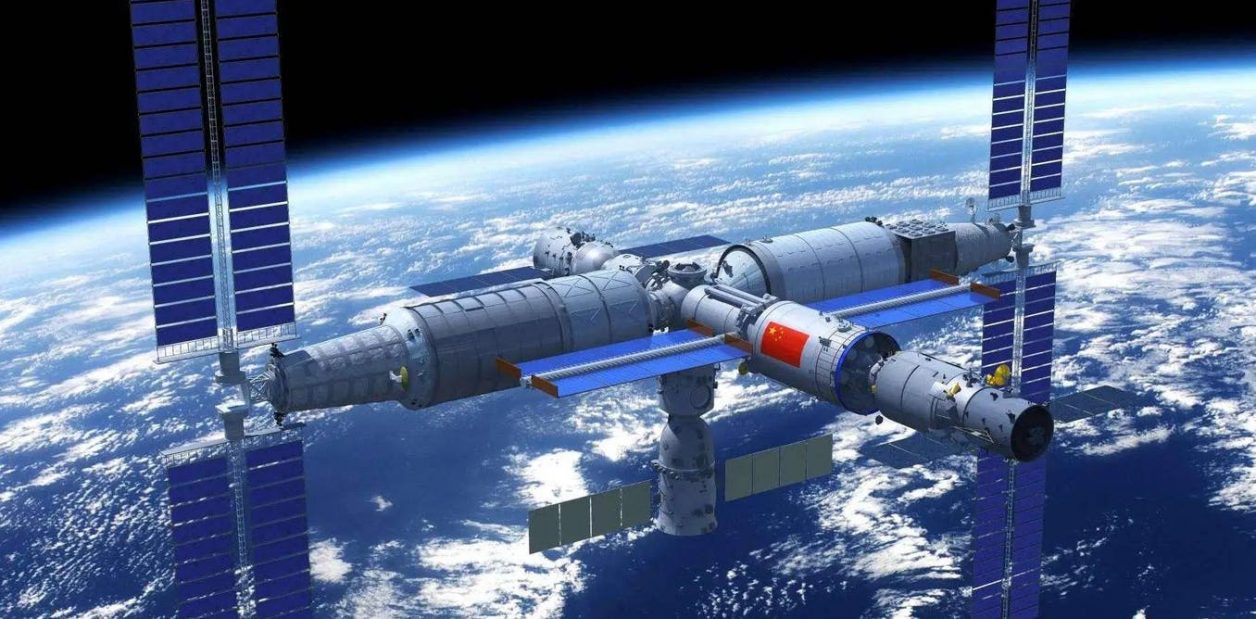
Thus, putting lasers or microwaves in space would virtually remove these restrictions and provide unbridled access to potential targets. A satellite-based DEW could maintain longer dwell times on targets, engage satellites in higher orbits that are currently harder to reach from the ground, and potentially hold multiple targets at risk across successive orbits.
China currently has multiple anti-satellite weapons in space that could endanger US satellites providing critical communications and situational awareness to its troops on Earth during a conflict. However, deploying DEWs in space would let Beijing attack designated targets without the lasting orbital debris generated by kinetic anti-satellite missiles.
Notably, kinetic interceptors create debris that threatens everyone’s satellites for decades, while directed energy weapons are expected to leave the orbital environment largely intact. Therefore, these non-kinetic options offer clearer escalation control and reduced risk of self-inflicted damage, while allowing military planning to operate in a contested space domain and preserve access.
This could be bad news for the United States because a conflict with China is never off the table, especially in the event of a Taiwan invasion.
Currently, the US military operations depend heavily on space for navigation, ISR (intelligence, surveillance, and reconnaissance), missile warning, and communications.
A capable orbital DEW capability would give China additional options to blind or degrade US or allied sensors and communications during a confrontation, especially in a Taiwan invasion scenario.
More importantly, it would give Beijing the option to conduct lower-escalation or deniable attacks targeting both LEO proliferated constellations (such as Starlink) and higher-orbit assets simultaneously. This would, in turn, complicate US space domain awareness, attribution, and response timelines.
At the same time, however, directed energy weapons could be employed defensively—to protect one’s own satellites from interference or attack—and to support space domain awareness and integrated defense architectures.
Legally, China is allowed to place DEWs or other conventional weapons in space because the 1967 Outer Space Treaty only prohibits the placement of nuclear weapons or other weapons of mass destruction in orbit.
However, just because it can does not mean China can deploy or sustain directed energy weapons in space. This is because factors such as power generation, thermal management, beam control, and delivering militarily useful energy levels from a satellite remain substantial engineering challenges to fielding DEWs in space.
Whether China has overcome these obstacles sufficiently to field operational systems by the late 2020s remains to be seen.
- Contact the author at sakshi.tiwari13 (at) outlook.com
- Follow EurAsian Times on Google News