

The United States Air Force (USAF) just ordered the AGM-183 Air-launched Rapid Response Weapon (ARRW), officially reviving its first hypersonic missile program three years after it was unceremoniously shelved.
USAF said in a statement on October 26, 2026, that the Department of the Air Force awarded Lockheed Martin a $694 million contract to produce and field the AGM-183A Air-launched Rapid Response Weapon (ARRW) on September 29, 2026. The Department of War executed the contract under its Enterprise-Wide Agile Acquisition Contract.
The US Air Force has described the AGM-183A as a long-range hypersonic boost-glide standoff weapon and “a lethal capability against high-value time-sensitive targets.”
It is intended to improve the service’s ability to strike heavily defended targets, such as enemy military bases and surface warships, from outside the range of many air-defense systems.
With the latest contract, the program officially moves from flight testing and prototyping into production. However, no information is currently available on how many missiles the contract will produce or when the Air Force will start receiving them.
“This is a turning point in our advanced weapons roadmap,” Secretary of the Air Force Troy Meink was quoted as saying in the statement. “By moving ARRW from test to production, we’re providing our combatant commanders with a credible, high-speed strike weapon capable of penetrating the most advanced anti-access and area-denial systems.”
The order is noteworthy because the ARRW program, once expected to be the USAF’s first operational hypersonic weapon, was shelved in 2023.
ARRW is Back
The ARRW’s demise began after a failed test on March 13, when the missile was fired from a B-52H Stratofortress off the coast of California. The former Air Force Secretary Frank Kendall later told a Congressional hearing on March 28 that the “tests were not successful (and we) did not receive data from the tests that we needed.”
In late March 2023, the Air Force announced it would not pursue follow-on procurement of the AGM-183A Air-launched Rapid Response Weapon (ARRW) once the prototyping program was over, as the EurAsian Times reported at the time.
At the time, USAF leadership said it intended to divert all resources and attention previously devoted to the ARRW to another USAF hypersonic program, the Hypersonic Attack Cruise Missile (HACM), which Raytheon and Northrop Grumman are developing. The HACM remains under development and has reportedly entered flight tests.
Despite funding cuts, the USAF urged that the program not be completely abandoned. In written testimony, then-Air Force acquisition chief Andrew Hunter recommended completing All-Up Round (AUR) test flights…to garner the learning and test data that will help inform future hypersonic programs and potential leave-behind capability.
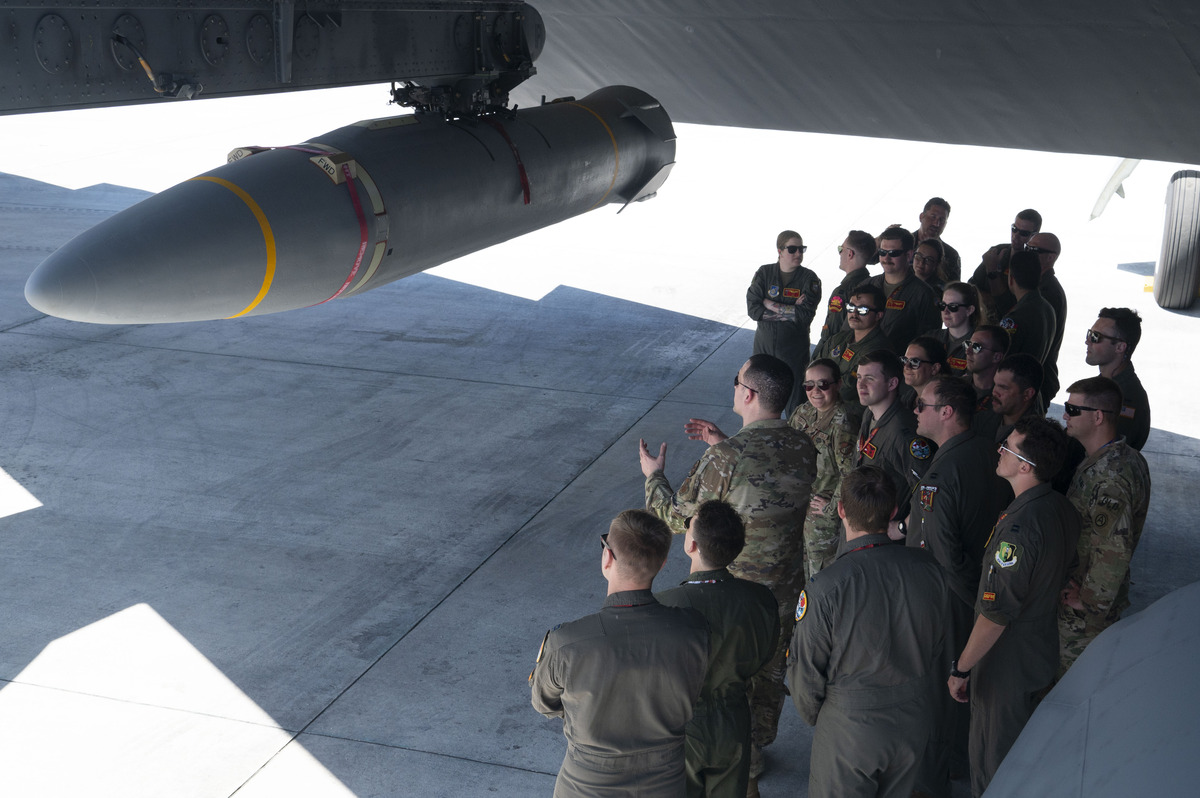
In fact, the USAF published photos of a live AGM-183 Air-launched Rapid Response Weapon (ARRW) affixed under the wing of a B-52H bomber at Andersen Air Force Base in Guam in February 2024. The last test of the hypersonic weapon reportedly took place on March 17, 2024, when it was launched from a B-52H flying out of Andersen Air Force Base, Guam, toward the Reagan Test Site.

However, the USAF overturned its decision in June 2025 when former USAF Chief of Staff Gen. David Allvin told lawmakers in a hearing that the service wanted to include both ARRW and the HACM in the fiscal 2026 budget proposal.
“We are looking, and have in the budget submission — assuming it’s what we had put forward — two different [hypersonic] programs,” he said. “One is a larger form factor that is more strategic and long-range that we have already tested several times. It’s called ARRW, and the other one is HACM.”
More recently, plans “to begin [ARRW] INC 2 [Increment 2] technology efforts such as but not limited to integrating pre-planned product improvements, design, trade studies, hardware upgrades, facilitization, affordability initiatives, and testing” were disclosed in the service’s 2027 Fiscal Year budget request, which was published earlier this year.
The revival has been seen as an epic story, especially since the ARRW went from an abandoned program to the first USAF missile to enter production.
Notably, this comes as the US is grappling with a major problem: It has yet to operationally field a hypersonic weapon; its competitors, like China, Russia, and countries like Iran and North Korea, have purportedly fielded hypersonic weapons.
The US’s primary adversary, China, has amassed a variety of weapons that travel at five times or more the speed of sound and are hard to intercept because of unpredictable trajectories, including the DF-17, the YJ-21 anti-ship missile, and the long-range DF-27, to name a few.
Russia, on the other hand, has Kinzhal, Zircon, Avangard, and Oreshnik, though doubts have been raised about whether Kinzhal and Zircon are truly hypersonic.
Why is ARRW Back
To understand why the Air Force revived ARRW, it is important to know how the weapon works.
The AGM-183A is a boost-glide hypersonic missile: a rocket booster accelerates it to hypersonic speed and high altitude, then separates, releasing an unpowered glide vehicle that maneuvers toward the target.
Then, the ARRW’s nose cone separates, releasing a wedge-shaped, unpowered boost-glide vehicle that was hidden inside.
After that, the vehicle travels at hypersonic speed through the Earth’s atmosphere over a short flight path to reach its destination, likely maneuvering along the way on an unpredictable trajectory.
This combination of speed, flight path, and maneuverability makes interception of this missile extremely difficult.
The USAF has historically positioned both its hypersonic programs, the ARRW and HACM, as critical to success against near-peer adversaries, especially in the Indo-Pacific conflict with China’s People’s Liberation Army forces.
The service likely revived the ARRW program to diversify capabilities, possibly after concluding that relying on a single type of hypersonic weapon left significant gaps in its ability to hold targets at risk in heavily defended environments, such as those near China.
Both ARRW and HACM are air-launched weapons, but they differ significantly.
ARRW is a larger boost-glide hypersonic weapon system, which makes it suitable for long-range strategic strikes launched from bombers such as the B-52 and B-1.
Meanwhile, HACM is a smaller air-breathing scramjet cruise missile. After an initial rocket boost, a scramjet engine provides continuous powered flight at lower altitudes, allowing greater sustained maneuverability. Its smaller size means tactical fighters such as the F-15E and F-15EX, as well as long-range bombers, could carry it.
Succinctly put, fielding both types forces an adversary to defend against two distinct flight regimes—one high-altitude, extremely fast, and quasi-ballistic, and the other lower-flying, continuously powered, and highly maneuverable.
For the US Commanders, using both missile types in a conflict would make it much harder for the adversary to defend itself, as it would require broader radar coverage, more varied interceptor capabilities, and more complex command-and-control systems. This would, in turn, multiply the defender’s costs and spread limited air-defense resources thinner, forcing the adversary to look in multiple directions at once.
Additionally, having both missiles would also give the USAF valuable operational flexibility: ARRW could strike a deep, heavily defended target from a bomber, while HACM could handle a more tactical engagement.
China, for instance, fields both types of weapons. Therefore, developing ARRW would help close the capability gap.
Moreover, awarding an ARRW contract may reduce risk, especially since hypersonic weapons are prone to delays, as Washington’s experience shows. For example, a July report from the US Congress watchdog, the Government Accountability Office (GAO), noted that the HACM risks delays, as the EurAsian Times explained in detail at the time.
The Air Force initially structured the HACM program around a compressed five-year rapid-prototyping phase, planning to transition to production if testing proved successful. It initially scheduled 13 flight tests between October 2024 and March 2027.
It later tightened the test plan and shrank the testing to seven flights as design delays pushed the program behind schedule. However, the plan revised again in 2025 as reports indicated the USAF was considering reducing the campaign from seven end-to-end demonstrations to five because of delays in finalizing the weapon’s hardware design. The missile’s first flight occurred only earlier this month.
The ARRW is not expected to be a panacea for the US military’s existing hypersonic woes, but moving ARRW into production gives commanders a concrete, high-speed standoff option while the Air Force continues to mature a complementary air-breathing system.
As the Chief of Staff of the Air Force, Gen. Ken Wilsbach said, “Fielding ARRW enhances our ability to hold targets at risk anywhere around the world. This hypersonic weapon provides the Joint Force a flexible and rapid response option for highly contested environments.”
- Contact the author at sakshi.tiwari13 (at) outlook.com
- Follow EurAsian Times on Google News