

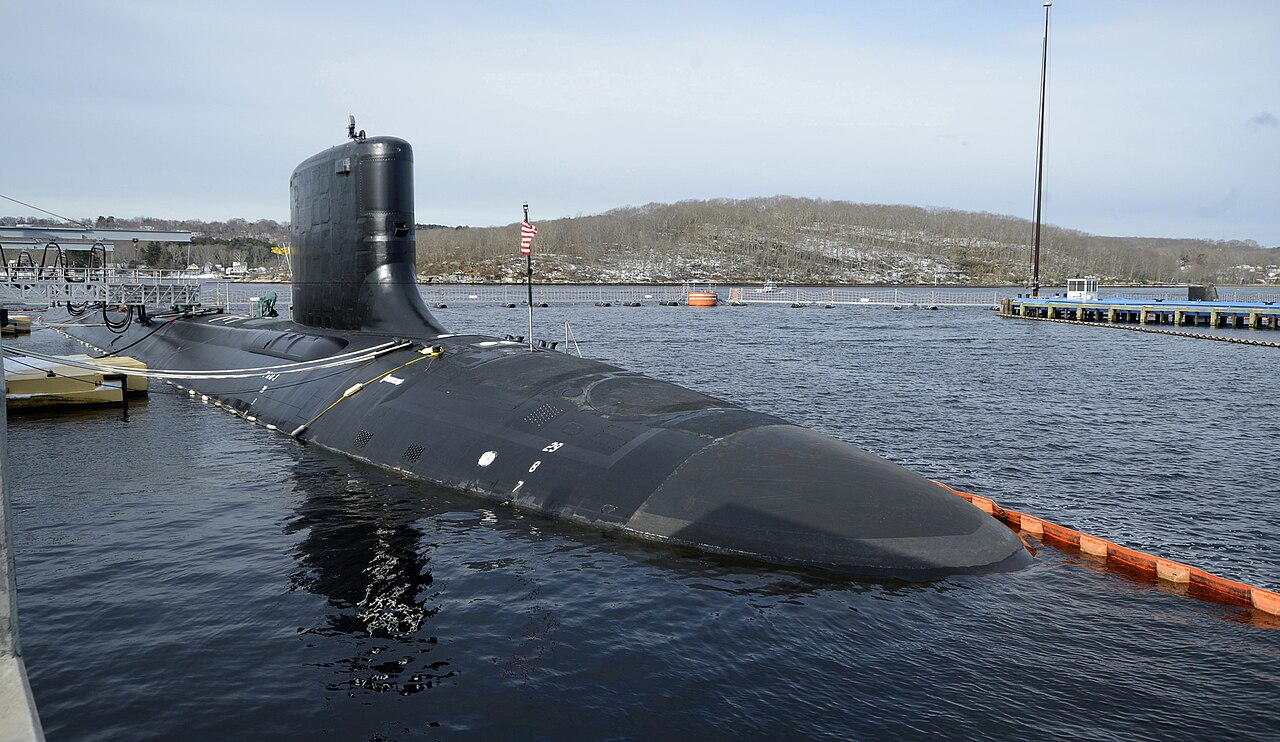
The United States will deploy USS Colorado as the first US nuclear-powered attack submarine to join a rotating force based in western Australia, under the AUKUS pact.
US Secretary of War Pete Hegseth, Australian Deputy Prime Minister and Minister for Defense Richard Marles, and UK Secretary of State for Defense Wes Streeting said they were pleased to announce the designation of the USS Colorado (SSN 788) as the first US Navy Virginia-class fast-attack submarine assigned to Submarine Rotational Force-West (SRF-West) beginning in late 2027.
This announcement comes ahead of the upcoming United States Submarine Maintenance Period, which begins later this week and will further demonstrate Australia’s growing ability to sustain US and UK nuclear-powered fast-attack submarines.
The deployment is a “significant milestone” in building joint U.S.-Australia-UK deterrence in the Pacific under their AUKUS defense pact, the allies said in a joint statement. The selection of the USS Colorado “marks a significant milestone for AUKUS Pillar I and is a decisive step in strengthening collective deterrence in the Pacific,” the statement added.
The rotating force of nuclear-powered submarines—known as Submarine Rotational Force-West—is to be hosted at a naval base in Western Australia, HMAS Stirling.
The base is projected to host up to five fast-attack submarines—four from the United States and one from the UK—on a rotational basis. The force will operate under existing arrangements, including the US-Australia Force Posture Agreement, and will not constitute a permanent foreign base.
The three countries said it will help Australia prepare to operate and maintain its own nuclear-powered submarines while supporting its allies’ deployments and maintenance. Australian sailors will gain at-sea experience on American and British submarines, while local maintenance personnel will support the vessels ashore.
Vice Admiral Jonathan Mead, director-general of the Australian Submarine Agency, called the designation “a clear demonstration of the trust and confidence the United States has in Australia’s people, workforce and infrastructure.”
He added that the Colorado’s presence “will help accelerate the development of the skills, experience and knowledge transfer that are fundamental to delivering Australia’s future conventionally armed, nuclear-powered submarine capability.”
Chief of Navy Vice Admiral Matt Buckley described the move as “a significant milestone for Australia, our Navy and the AUKUS partnership,” noting that sailors would work alongside “the world’s most experienced nuclear-powered submarine operators.”
Overall, AUKUS is part of a broader effort to build Australian “undersea power” in the Indo-Pacific region. Nuclear-powered submarines offer speed, endurance, and stealth that conventional submarines lack, and they serve as a cutting-edge deterrent rather than preparation for war against China.
The USS Colorado, commissioned in 2018, is one of the US Navy’s most advanced attack submarines. It is the first of up to four US Virginia-class submarines expected to rotate through the base, alongside a Royal Navy Astute-class submarine.
The Trump administration launched a review of the 2021 AUKUS pact, signed under the Biden administration, on June 11.
AUKUS
Earlier, on July 29, the US said it would review the AUKUS pact with the UK and Australia.
The US Under Secretary of Defense for Policy, Elbridge Colby’s office, said in a post on X that the review will be an “empirical and clear-eyed assessment” of the deal.
“The Department anticipates completing the review in the fall. Its purpose will be to provide the President and his senior leadership team with a fact-based, rigorous assessment of the initiative.”
The Trump administration launched a review of the 2021 pact struck during the Biden administration on June 11.
The AUKUS pact, signed in September 2021, is a trilateral security partnership between Australia, the United Kingdom, and the United States aimed at promoting a “free and open Indo-Pacific.”
The deal has two central pillars.
Pillar 1 is about the supply and delivery of nuclear-powered attack submarines.
Under the pact, Australia will buy three second-hand nuclear-powered but conventionally armed (SSNs) Virginia-class submarines from the US, with options to purchase two more. These SSNs were expected to be delivered to Australia beginning in the 2030s.
After that, the plan is to design and build an entirely new nuclear-powered submarine model for the UK and Australian navies.
The United States and the UK will also deploy their own nuclear-powered submarines in the region as part of “Submarine Rotational Force-West.”
Pillar 2 focuses on allies collaborating on “advanced capabilities,” including sharing military expertise in critical areas such as long-range hypersonic missiles, undersea robotics, quantum technology, and AI.
The deal will tremendously boost Australia’s undersea capabilities. Nuclear-powered submarines offer many advantages over non-nuclear submarines, including extended range, endurance, and stealth, and they don’t have to surface as often, which could give away their position.
The deal will make Australia, alongside the UK, the only countries with which Washington would share nuclear-propulsion technology.
Furthermore, the US and UK commitment to deploy their own nuclear-powered submarines in the region will reinforce Australia’s position in the Indo-Pacific. In addition, Australia will gain access to sensitive technologies, substantially boosting its naval prowess.
AUKUS is Australia’s biggest-ever defense project and has committed A$368 billion (US$240 billion) over three decades.
Why Trump Wanted To Review AUKUS?
Questions have been raised over the deal’s relevance to Washington and whether it fits ‘America First’ policy.
Colby’s office said the AUKUS review would “be an empirical and clear-eyed assessment of the initiative’s alignment with President Trump’s America First approach.”
Notably, Colby has long been skeptical of AUKUS.
He has previously questioned the benefits of the pact’s submarine-sales element, arguing before the US Senate Armed Services Committee in March that the United States wasn’t producing enough submarines to meet its own Indo-Pacific requirements.
When the Senate’s Armed Services Committee asked Colby about the AUKUS deal, Colby replied: “I have expressed concerns, as I understand, shared by many on this Committee, regarding US attack submarine force structure and production rates. I believe we must increase US attack submarine production to meet US military requirements in the Indo-Pacific region.”
However, during that hearing, Colby also expressed his commitment to AUKUS, saying, “I also agree with Secretary Hegseth that AUKUS is a model for how we should engage with our closest allies and partners when it comes to technology cooperation, scaling production, and integrating our industrial bases.”
If media reports are to be believed, the US wants to impose additional conditions on the deal, including a commitment by Australia to spend 3.5% of its GDP on defense and a promise by Canberra to deploy its submarines to support the US in a potential conflict with China.
Speaking before the US Senate Armed Services Committee in March, Colby suggested the US should press Australia to increase defense spending.
“The main concern the United States should press with Australia, consistent with the President’s approach, is higher defense spending. Australia is currently well below the 3% level advocated for NATO by NATO Secretary General Rutte, and Canberra faces a far more
powerful challenge in China,” Colby had said.
Australian Prime Minister Anthony Albanese rejected that Washington was using AUKUS review as “leverage.”
“We expected a review from an incoming government, just like the Keir Starmer government did (in the UK). We expect that those things take longer than just 30 days,” Albanese added.
Mail us at: editor (at) eurasiantimes.com