

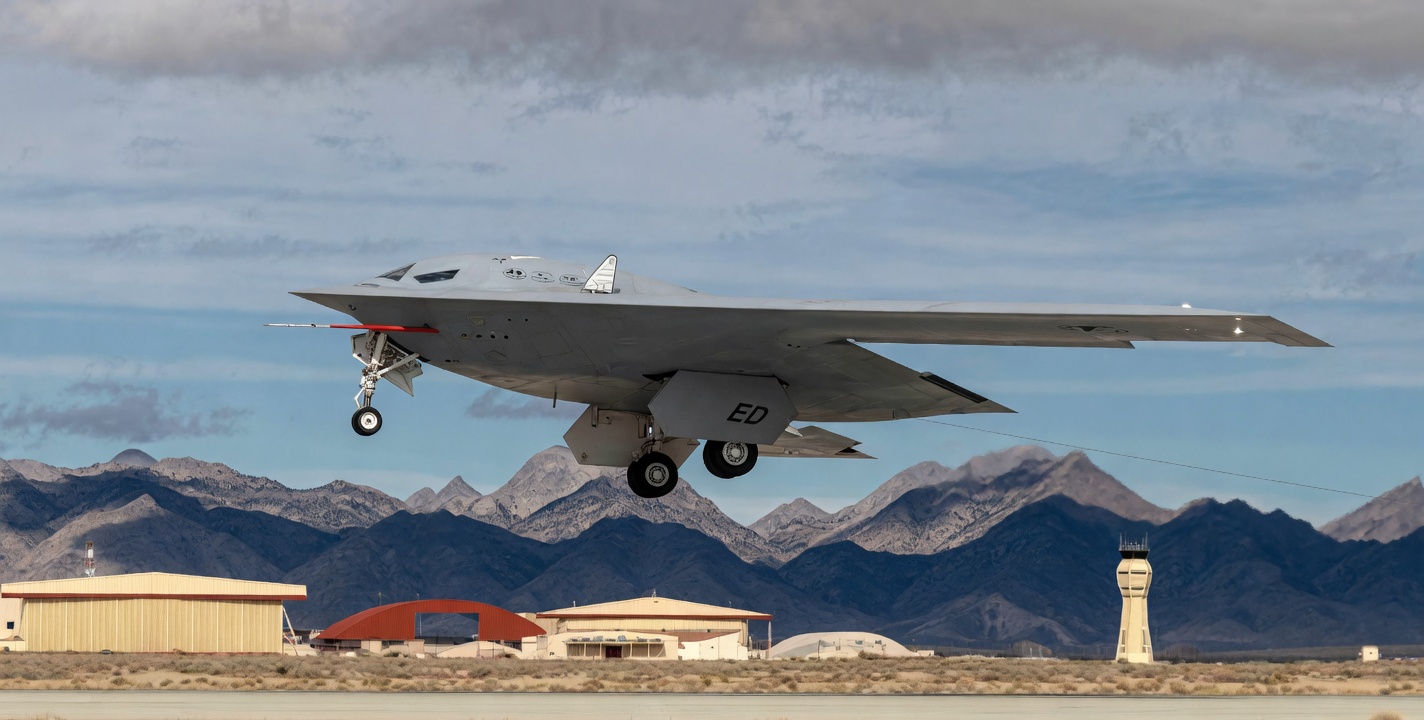
The US Air Force (USAF) is evaluating its bombers, including the next-generation B-21 Raider, for potential air-to-air combat roles, and they could also operate alongside Collaborative Combat Aircraft (CCA) drones.
So far, the USAF has used its bombers, including the B-52 Stratofortress, B-1B Lancer, and B-2 Spirit, for a variety of missions, including conventional ground strikes, nuclear deterrence, maritime anti-ship operations, and close air support roles.
However, adding air-to-air missiles to bombers and pairing them with CCAs would also enable them to perform air-superiority missions in a contested environment.
The plans are part of the USAF’s latest fighter force structure report, submitted to the US Congress for approval earlier this month.
The report, titled “Long-Term USAF Fighter Force Structure,” also envisions a combat-coded fleet of 1,509 fighters by 2035, along with at least 500 CCAs.
The plan calls for adding hundreds of new fighters as the USAF increases its current fighter fleet from 1,288 aircraft, while also accounting for hundreds of F-16s, older F-15s, and F-22 Raptors due for retirement in the coming years.
The 2035 plan envisions a 60% stealth force, including 40% F-35A Joint Strike Fighters, 20% F-47s and F-22 Raptors, and 40% upgraded fourth-generation fighters, with an even mix of F-16s and F-15EXs.
The USAF will build the new fleet by procuring Lockheed Martin’s F-35s and Boeing’s F-47 and F-15EX fighters.
However, the report acknowledges that meeting its ambitious fighter procurement targets may not be achievable because of “fiscal realities and industrial production limitations.”
To meet the 2035 target, the USAF will need to add more than 70 fighters to its fleet each year for the next ten years.
The report therefore discusses other recapitalization options for the USAF, including acquiring an entirely new fighter, relying more on semi-autonomous drone fighters known as Collaborative Combat Aircraft, and giving bombers air-to-air roles and capabilities, Air & Space Force Magazine said after reviewing the report, which has not been released in the media.
“Accordingly, the USAF is also evaluating additional recapitalization options, including a new capacity fighter, increased reliance on CCAs, and developing air-to-air capabilities on bombers.”
As EurAsian Times reported last week, the new fighter could be Lockheed Martin’s upgraded F-16, termed F-16G, or Boeing’s already-in-production F-15EX variant. Lockheed Martin is also discussing adding new sixth-generation capabilities to the F-35 fighter.
However, the report’s most unusual suggestion is to add new air-combat munitions to the USAF’s bomber fleet, including the under-development B-21 Raider stealth bomber.
Air-To-Air Missiles For Bombers
The USAF’s fighters have long carried air-to-ground munitions, such as precision-guided JDAMs, laser-guided bombs, and Small Diameter Bombs (SDBs).
Bombers, however, have traditionally not carried air-to-air missiles, severely limiting their ability to conduct air-to-air missions.
For instance, during the recent Operation Epic Fury, the USAF employed B-2 Spirit, B-1B Lancer, and B-52H Stratofortress Bombers, but used them exclusively for long-range standoff ground strikes, penetrating stealth strikes, or stand-in ground strikes once Iranian air defenses were sufficiently suppressed.
These bombers therefore mostly flew in strike packages with F-35s and F-22s, as well as F-15s and F-16s, tackling aerial threats and conducting air superiority and SEAD/DEAD missions.
Adding air-to-air capability will allow USAF bombers to support air superiority missions.
Additionally, pairing them with CCAs will let the bombers serve as airborne nerve centers and communication nodes for a networked strike package, with a bomber aircraft at the center controlling multiple combat and reconnaissance drones.
The USAF plans to have at least 500 CCA drones in service by 2032.
The bombers, including the B-21 Raider, could therefore be programmed to launch air-to-air missiles and drones. Some of these drones could launch air-to-air missiles themselves, thereby greatly extending bombers’ combat range.
Given bombers’ size, payload capacity, and range, a single bomber could carry multiple air-to-air and air-to-ground missiles, as well as drones, a capability that could be crucial over the long distances of the Pacific theatre.
For instance, a B-2 Spirit bomber could carry over 27,000 kg of weapons payload, more than three times the F-35’s maximum payload capacity (8,200 kg).

Similarly, the B-2 Spirit’s unrefueled range of 6,000 nautical miles is nearly five times that of the F-35 (1,200 nautical miles).
Adding long-range air-to-air missiles and pairing combat drones with bombers will further extend their combat range.
Notably, the US is already developing several very long-range air-to-air missiles.
The US Navy has already fielded the AIM-174B air-launched version of the Standard Missile-6 (SM-6).
While the exact range of the AIM-174B is classified, widely cited estimates put it at 130 to 250 miles.
Separately, the US is also developing another very long-range AAM missile, the AIM-424 Malice, expected to reach over 250 miles.
In June, the USAF issued a call for a new anti-air missile with a range of at least 1,000 nautical miles.
Integrating such very long-range AAMs with bombers could redefine air warfare.
In addition, the Defense Advanced Research Projects Agency (DARPA) is working on the LongShot program to test the feasibility of an air-launched drone that can launch air-to-air missiles.
The air-to-air capability of the bombers could also include self-protection systems, such as carrying air-launched anti-missile interceptors. In fact, Northrop Grumman, the B-21’s prime contractor, has already patented an anti-missile defense system for stealthy aircraft that fires hard-kill interceptors.
Notably, this is not the first time the USAF has explored adding air-to-air munitions to its bomber fleet.
Former Air Force Chief of Staff Gen. David Allvin signaled in October 2024 that the B-21 Raider stealth bomber could play a greater role in the service’s air-dominance plans.
At the time, the USAF was reviewing its Next Generation Air Dominance (NGAD) fighter program, which Boeing eventually won in 2025 and named the F-47.
When asked whether the air superiority review could give the B-21 a more prominent role, Allvin said, “We have not taken that off the table.”
However, the USAF force structure report has not detailed what the bomber fleet’s potential air-to-air role would entail. Nor has it specified which USAF Bombers will be programmed for air-to-air combat roles.
However, because the B-21 Raider is still in early production, the bomber is best suited to be paired with AAM and CCA drones.
While the USAF initially planned to buy 100 B-21 Raiders, later reports suggested the force could increase that number to 140.
Besides, the USAF also has about 76 B-52 Stratofortresses, 44 B-1B Lancers, and nearly 19 B-2 Spirits.
The 2035 Force Structure Report suggests that the USAF is hedging on multiple options to maintain its dominance and fighter numbers, including buying a new aircraft (possibly F-16G), “increased reliance on CCAs,” and considering new air-to-air roles for bombers.
All these plans will compete for US funding. The US Congress will only know which programs are approved and funded when it approves the Force Structure Report.
- Sumit Ahlawat has over a decade of experience in news media. He has worked with Press Trust of India, Times Now, Zee News, Economic Times, and Microsoft News. He holds a Master’s Degree in International Media and Modern History from the University of Sheffield, UK.
- He can be reached at ahlawat.sumit85 (at) gmail.com