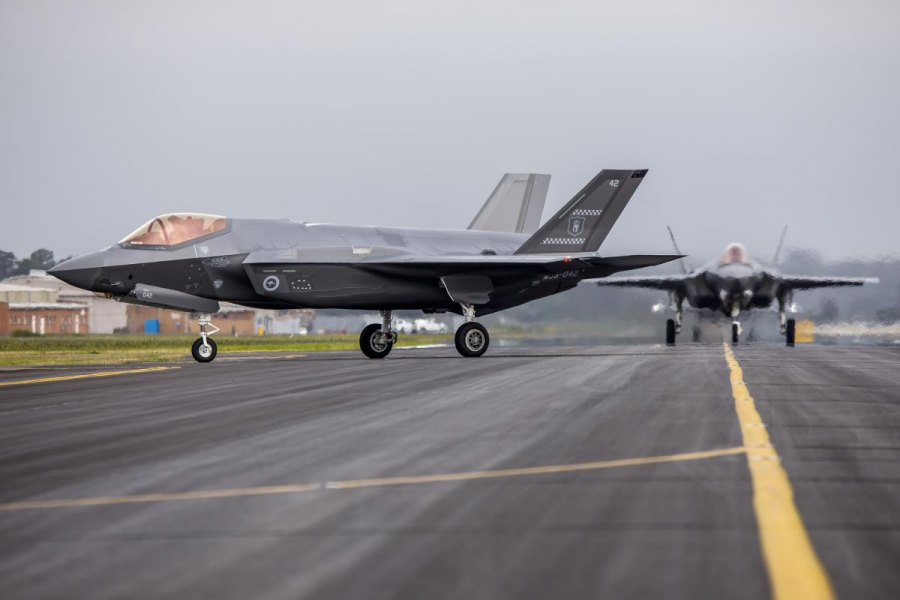
As the Air Forces of India and Japan fly side by side for the first time on Indian soil, satellite imagery from a remote Chinese desert shows full-scale mockups of Japanese and American warplanes.
India and Japan kicked off the Exercise Veer Guardian-2026 at Jodhpur Air Force Station on September 9, 2026. The two-week exercise, which ends on September 22, has reportedly focused on advanced operational missions, mission planning, and professional exchanges to enhance interoperability.
Notably, this marks the first time Japanese fighters have operated from Indian soil. For the exercise, the Japan Air Self-Defense Force (JASDF) deployed its F-2A fighter jet and other support aircraft, whereas the Indian Air Force (IAF) deployed the Light Combat Aircraft (LCA) Tejas, Su-30MKI, and Rafale jets.
On 20 September, Air Chief Marshal A.P. Singh and JASDF Chief of Staff General Takehiro Morita flew a short Tejas formation sortie over Air Force Station Jodhpur. Singh flew a Tejas as Eagle One and led the formation. Morita flew in the twin-seat Tejas trainer with Group Captain I. Samrat, commanding officer of the Tejas squadron, as captain. The two aircraft circled the airfield and peeled off to land.
After the flight, Morita thanked the IAF for the opportunity and praised the aircraft as a symbol of India’s indigenous capabilities and the “Make in India” initiative.
Meanwhile, ACM Singh stated that joint exercises allow the two air forces to train together, share expertise, and improve operational capabilities: “When we do exercises together, we learn from each other. We fly together. We train together. So both sides improve together.” Further, He added that such drills help both sides understand each other’s procedures.
Although neither side has published detailed information, the Japanese F-2 may have practiced air combat against the Indian Su-30MKI.
This would have been a win-win situation for both sides, as the Japanese pilots would get rare exposure to a heavy, thrust-vectoring Flanker-type platform, which may help them better understand Chinese J-16 aircraft. Meanwhile, IAF pilots could practice against a more sophisticated version of the F-16 (flown by Pakistan), as previously explained in detail by the EurAsian Times.
The ongoing drills coincide with a major transformation in Japan’s military and strategic policy, which China has repeatedly flagged as a provocation. In fact, China views Japan’s increased military cooperation with India as an attempt to “revive militarism,” extend its military reach beyond the neighborhood, and enlist India in an anti-China alliance.

While the images of Japanese and Indian Air Force chiefs taking a sortie together have become symbolic of this growing cooperation between two regional powers, another set of images has surfaced online that show that the Chinese People’s Liberation Army (PLA) is preparing for a potential conflict in the region and honing its own tactics.
Japanese, US Aircraft Mockups in China
Brady Africk, a geospatial and open-source intelligence (OSINT) analyst, published a set of satellite images and spotted Japanese and US military aircraft and air defense systems at a site in Xinjiang, China.
As seen in the images, full-scale or near full-scale models of a Japanese E-767 airborne early warning and control aircraft, F-35 and F-16 fighter jets, and Patriot air defense systems surfaced in the western Chinese desert (in Xinjiang) at a site built just last year.
One satellite image, dated 25 January 2026, captured mock-ups of F-35 fighters, an E-767, and air-defense equipment.
China has built mockups of American-made fighter jets and air defenses deep in its western desert, satellite imagery from @vantortech shows. One of them imitates an E-767 radar plane, which is flown only by Japan.
See more analysis and imagery here: https://t.co/LqsOaLrulq pic.twitter.com/5QId3iqQ6f
— Brady Africk (@bradyafr) September 20, 2026
The report also presents two additional satellite images—one from November 2025 showing the E-767 under construction, and another from February 2026 in which the aircraft appears fully assembled.
The US and China could get embroiled in a conflict in the Indo-Pacific, likely to be triggered by the invasion of Taiwan, which Beijing has vowed to occupy. Japan is likely to be dragged into the conflict because of its proximity to Taiwan and its status as a staunch ally of the US and Taiwan. Japan is also home to a massive US military, which could make it a legitimate target during a war.
Moreover, China and Japan remain locked in a territorial dispute over the Senkaku (Diaoyu) Islands in the East China Sea, though it is not expected to escalate into a full-scale conflict.
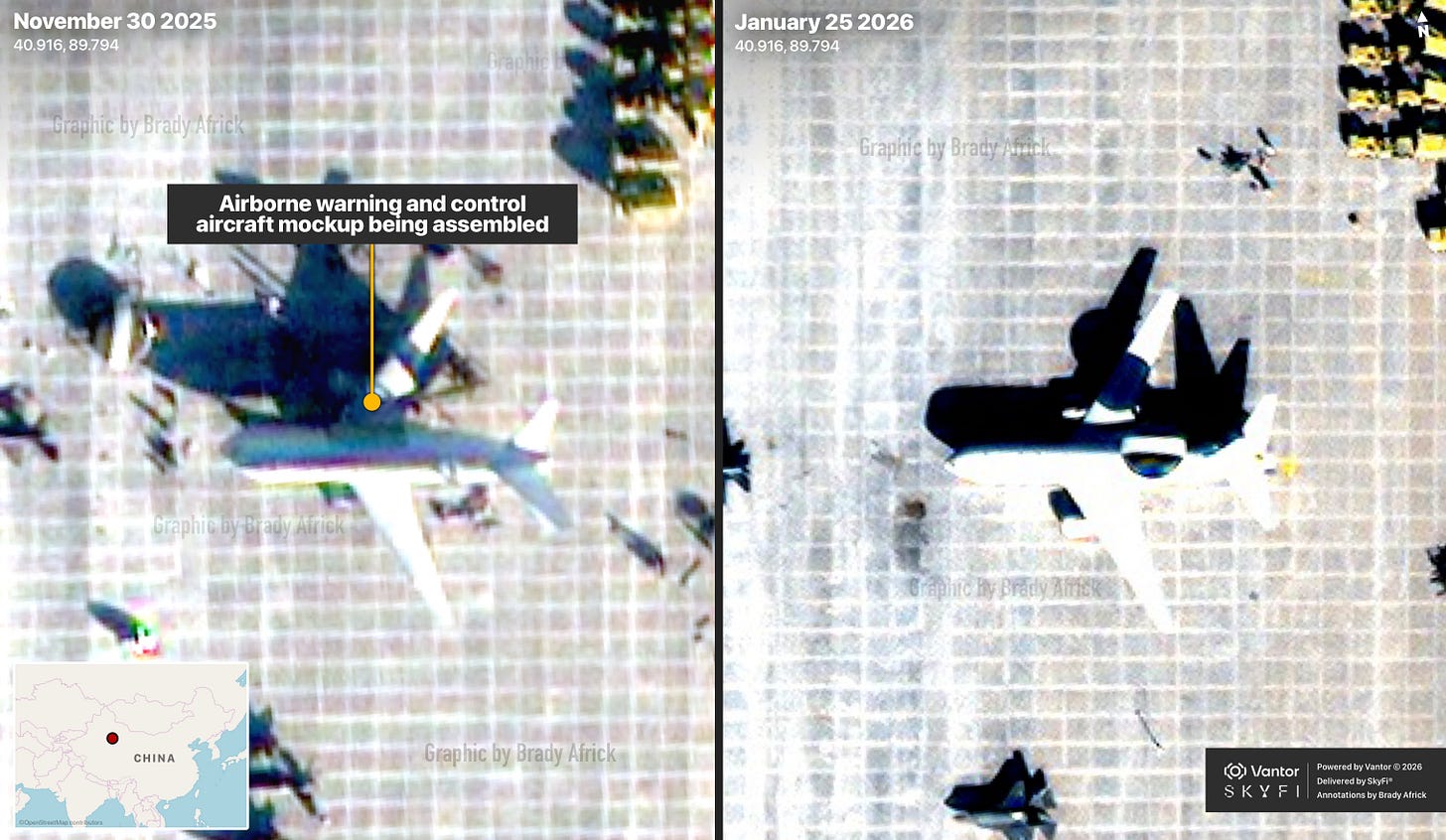
Against that backdrop, the JASDF’s E-767 early-warning aircraft is particularly noteworthy. It is a Japan-only platform and points directly to China’s combat focus on Japanese forces, as part of broader preparations for a potential conflict.
The E-767 is a high-value “flying command post” that carries a powerful radar capable of detecting and tracking aircraft and missiles over long ranges, including low-flying targets. It also directs friendly fighters and shares situational awareness. In a potential contingency, these aircraft would be critical for Japan’s ability to monitor airspace and respond.
The E-767s are hard to shoot down once airborne, so they are most vulnerable on the ground at their bases—which makes mockups more intriguing.
Earlier, China built an E-767 mockup in 2021, which was reportedly destroyed in July 2022, likely in a missile strike— the first known case of a Japan Self-Defense Force aircraft mockup being struck. The reappearance of a new mockup in the 2026 imagery shows that China is keen on targeting the Japanese aircraft, should hostilities ever break out.
“These new mockups do not appear damaged in recent satellite images, and some have moved since first being placed at the site,” Brady Africk said of the E-767.
The F-35 fighter jet mockups are equally significant given that the US and its regional allies operate the stealth fighter. In fact, China has been making F-35 replicas for years.
In 2021, satellite imagery showed scale models of F-35s at the PLA Rocket Force’s Korla shooting range in Xinjiang. Similarly, in July 2024, satellite imagery showed the purported aftermath of a Chinese military attack on American stealth aircraft, a conclusion drawn based on the scorched F-35s and F-22s stationed at one end of a long runway.
The mock-ups of Patriot air defense systems are significant since they are among the most advanced missile defense systems in the US arsenal, alongside the THAAD (Terminal High Altitude Area Defense). According to previous reports, the PLA Rocket Force (PLARF) struck down a mock-up of a THAAD site during a 2017 exercise.
The latest disclosure about the mock-ups came months after a structure resembling a US Navy Arleigh Burke-class guided-missile destroyer was spotted at Ruoqiang Test Range in China’s Taklamakan Desert, Xinjiang, as the EurAsian Times reported earlier.
Earlier, satellite images from January 2024 showed a full-scale black silhouette about 1,085 feet long, shaped like the US Navy’s USS Gerald R. Ford aircraft carrier.
Beyond American weapon systems, China has also erected full-scale replicas of key Taiwanese buildings and installations—territory it claims as its own and seeks to control. These include a detailed mock-up of Taipei, complete with the presidential office, foreign ministry, and other government structures, as well as two separate military bases. In fact, 2015 CCTV News footage captured PLA troops demolishing a structure modeled on Taipei’s presidential office during a live-fire exercise.
Analysts believe these full-scale mock-ups are designed to hone China’s image-recognition seekers, preparing the PLA for combat against the US and its allies in the Indo-Pacific—and enabling more precise missile strikes on specific systems to maximize damage.
- Contact the author at sakshi.tiwari13 (at) outlook.com
- Follow EurAsian Times on Google News