

The proliferation of cheap, one-way attack drones has dramatically changed the modern-day battlefield. In response, Germany has launched a program to integrate laser weapons into its combat jets and save its expensive missiles.
Germany has tapped MBDA Deutschland to develop a pod-based airborne laser weapon demonstrator. The program will examine whether such a weapon can be integrated into an aircraft and could lay the technical foundation for a future Luftwaffe (the German Air Force) capability.
“MBDA in Germany has received an order from the procurement office of the Bundeswehr Federal Office for Equipment, Information Technology and Use of the Bundeswehr (BAAINBw) to build a demonstrator for an airborne laser. The goal is to create the technological foundations for future laser weapons on board aircraft,” the company said in an official press release on November 2, 2026.
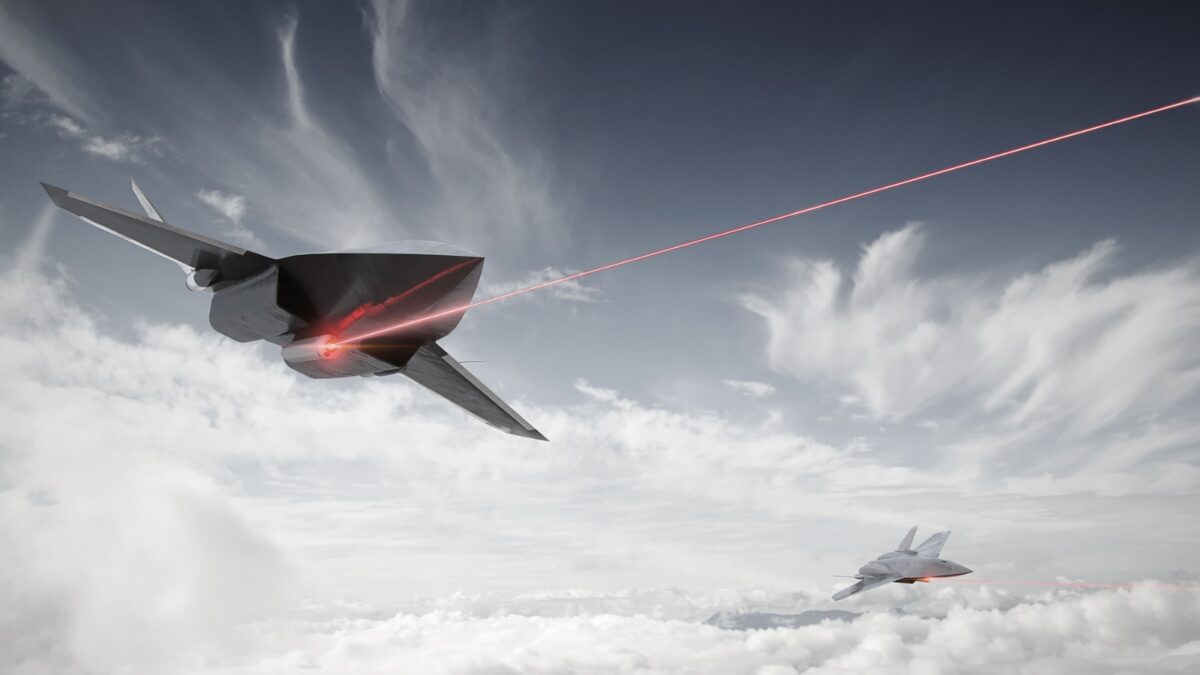
The company did not disclose the contract value or timelines, and also stopped short of publicizing the laser’s power output or which aircraft it will be equipped on. However, the rendering accompanying the release shows two large, unmanned, fighter-like aircraft with laser pods beneath the fuselage, hinting that it could be adopted for use on unmanned jets.
The Luftwaffe has a massive fleet of Eurofighter Typhoons that could benefit from integrating a laser weapon pod, and it is acquiring F-35A stealth jets from the US.
“The order now issued provides that essential components of the so-called laser pod are already designed for later flight operations. This is intended to test the feasibility of an air-based laser weapon and to lay the foundation for future operational capability in the Air Force,” MBDA stated.
The company described the development as the “supreme discipline” of laser weapon technology, due to stringent requirements for weight, size, and resistance to flight-related stresses.
More notably, though, it emphasized that the long-term goal is to create an aerial laser capability that could be used to “repel drones and cruise missiles.”
This is particularly important given that there has been a massive proliferation of cheap, one-way attack drones as demonstrated in wars in Ukraine and Iran. These drones pose a massive threat to military and civilian assets and are not feasible to take down using expensive missiles.
Several countries have turned to the Advanced Precision Kill Weapon System (APKWS-II) laser-guided rockets in recent years. The US Air Force and the Royal Air Force have already integrated the weapon into their F-15s and Eurofighters, respectively. Meanwhile, Saudi Arabia—which operates Eurofighters and F-15SA—has acquired authorization to acquire these rockets, as the EurAsian Times also reported.
France, on the other hand, joined the bandwagon by equipping its Rafale fighter jets with a 68mm laser-guided rocket for counter-drone roles.
However, unlike these laser-guided rockets, Berlin’s recent contract is for a true airborne laser weapon that will use a focused high-power laser beam to destroy targets by heating, burning, or disrupting them at the speed of light.
Germany has treated high-energy lasers as a strategic priority and national key technology since 2019, although the airborne component may have received more attention as Berlin modernizes its military on a war footing to counter potential security risks on the European continent.
“Since 2019, laser technology has been considered a strategic key topic of German research and development as well as a national key technology within the framework of the SVI strategy of the Federal Government and the Federal Ministry of Defense. MBDA positions itself as a long-standing development partner for laser effectors and weapons in all sub-forces. In recent years, MBDA has continuously developed the necessary technologies for laser effectors through significant self-investments and has built up and tested various demonstrators,” MBDA noted in the statement.
The program reportedly prioritizes German suppliers and know-how, reducing reliance on foreign systems and building on MBDA’s and Rheinmetall’s prior naval laser work.
However, airborne integration is widely regarded as one of the hardest challenges in laser weapon technology, with size, weight, and power posing fundamental problems.
For one, a high-energy laser needs substantial electrical power and generates significant waste heat.
Typically, on a ship or a similar fixed site, large generators, batteries, or even grid connections can supply this energy, and bulky cooling systems can reject the heat. However, a tactical fighter has severe limits on available electrical power from its engines and generators, as well as strict restrictions on payload and volume.
Furthermore, moisture, dust, and turbulence can reduce the laser energy that reaches a target through absorption, scattering, or distortion, adding another challenge. At the same time, engineers must consider and optimize beam quality, tracking precision, engagement range, climatic conditions, and the dwell time needed to achieve a kill at different distances.
Therefore, the German industry would have to ensure that everything, including the laser source, power conditioning, energy storage, cooling, beam director, and tracking systems, fits into a compact pod or internal bay while remaining light enough not to cripple the aircraft’s performance, range, or maneuverability.
Other countries have also attempted to develop and integrate airborne laser weapons.
For example, the US was developing a Self-Protect High Energy Laser Demonstrator pod, or SHiELD. “The SHiELD program is developing a directed energy laser system that will reside in an aircraft pod, to demonstrate defensive capabilities of aircraft against surface-to-air (SAM) and air-to-air (AAM) missiles,” the US Air Force Laboratory (ARFL) stated earlier.
Additionally, it was developing the Airborne High Energy Laser, or AHEL, for deployment aboard an AC-130J.

However, none of these programs reached their logical conclusion, and the USAF has yet to deploy an airborne laser, although it has conducted some of the world’s most significant airborne laser weapon demonstrations. Similarly, Chinese media earlier reported that the country intended to equip its J-20 stealth fighter with laser weapons. However, no such integration has been confirmed, possibly because of the challenges involved.
How Will Lasers Bolster the Luftwaffe?
The new airborne laser weapon will give German pilots a more proportionate alternative for swatting drones, while letting them reserve expensive interceptors for faster, more sophisticated threats on a dynamic battlefield. This could be particularly crucial when dealing with large-scale drone attacks or swarms.
Typically, air-to-air missiles, such as the Meteor or the AIM-120 AMRAAM, cost hundreds of thousands to over a million euros each.
In fact, even lower-cost guided rockets like the APKWS II involve a physical munition that must be produced, stockpiled, and expended, adding to costs.
In contrast, the marginal cost of each shot from a high-energy laser is essentially the electricity used, often said to be a few dollars, plus any associated cooling or wear and tear on the power system.
In high-intensity or sustained operations against massed, low-cost drone or cruise missile threats, laser weapons would let German pilots defend without “burning through” their primary air-to-air loadouts, reserving those missiles for higher-end threats such as enemy aircraft or advanced missiles.
A major advantage of laser weapons is unlimited magazine depth.
Instead of physical rounds, a laser is limited mainly by available electrical power, thermal management or cooling capacity, and dwell time on target. The system can keep firing as long as the aircraft’s generators and cooling systems can support it, providing a major advantage against drone swarms or sustained cruise-missile salvos, where kinetic weapons run out after a limited number of shots.
More importantly, lasers enable high-value engagements at the speed of light. The laser beam essentially travels at the speed of light, eliminating the flight time of a missile or rocket. This removes the need for lead calculations against maneuvering targets, and engagement can begin almost instantly once tracking is locked. This is particularly valuable for defending against fast-closing threats in combat.
Moreover, laser weapons—in general—eliminate the possibility of causing collateral damage. Lasers can focus energy on a small spot to disable critical components, such as sensors, motors, batteries, control surfaces, or warheads, without requiring a high-explosive detonation, which often causes casualties from falling missile debris.
Thus, laser weapons greatly reduce the risk of collateral damage compared with explosive munitions and can be useful in contested or sensitive airspace.
Furthermore, an airborne laser would complement ground- and ship-based lasers, kinetic interceptors, and electronic warfare, creating a more resilient multi-domain counter-drone or missile capability for the German Armed Forces.
- Contact the author at sakshi.tiwari13 (at) outlook.com
- Follow EurAsian Times on Google News