Shield AI has unveiled the first prototype of the X-BAT, an aspirational, fighter-sized, AI-piloted aircraft that can take off and land vertically, and plans to conduct the maiden flight of this “fighter drone” soon.
With serial number 001 and civil registration N228XB, the prototype rollout coincided with the International Fighter Conference in Munich, Germany.
Unveiled in October 2025, the X-Bat is akin to a fighter drone that can take off and land vertically, travel long distances, and carry weapons and sophisticated sensors. It essentially combines a fighter jet’s speed and combat payload with a vertical-takeoff aircraft’s operational flexibility. It is intended to operate from ships, islands, and remote locations.
The aircraft is currently being transported from the company’s main development site in Frisco, Texas, to its X-Forge 2 flight-test facility at Newton City-County Airport in Kansas, near Wichita. Ryan Tseng, president and co-founder of Shield AI, said at a news conference that the company expects to unveil two more prototypes soon.
However, engineers will assess its vertical-flight capability and propulsion system before attempting untethered flight. The company reportedly aims to accelerate the flight-test program ahead of low-rate production around 2028 and an initial operational capability in 2029.
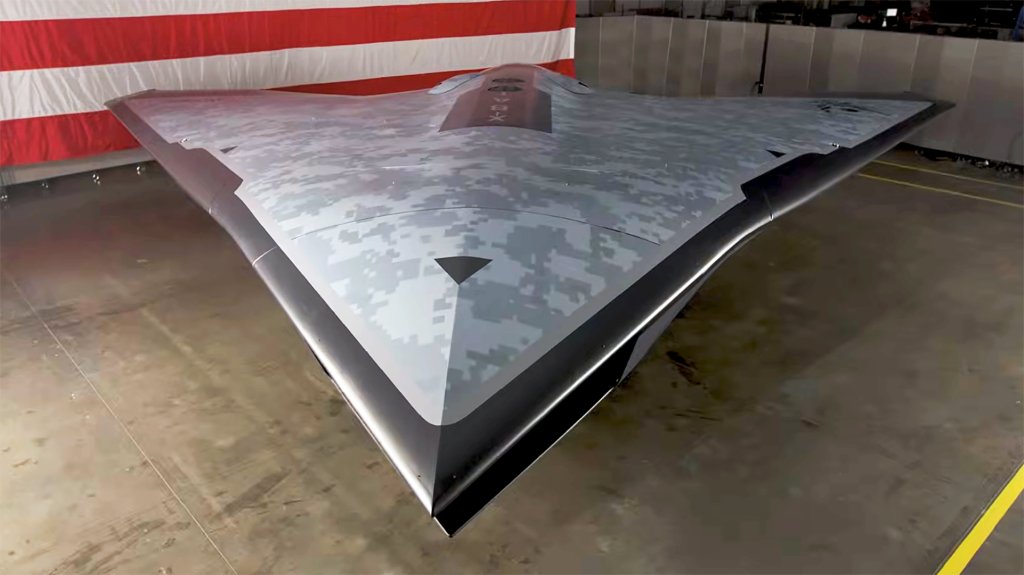
Tseng said that Shield AI started validating the design earlier than anticipated because the prototype was completed ahead of the company’s original schedule.
The X-BAT is a development aircraft, and its technology and design have already undergone substantial changes since its unveiling and could be further refined.
The new footage of X-BAT 001 shows several variations from previous design versions. For instance, it now has a thrust-vectoring exhaust nozzle that extends well past the back corners of its wings, compared with the more recessed arrangement seen in previous renderings.
Two prominent structures sit on either side of the aircraft’s main dorsal spine, each with a small forward-facing opening. Meanwhile, two additional circular apertures sit atop the spine and are covered by mesh screens, though no information indicates their purpose.
For now, we know the fundamental X-BAT concept—vertical takeoff and landing of a fighter-sized, jet-powered, autonomous combat aircraft—still requires validation before any projected operational capabilities can be considered demonstrated.
What Do We Know About X-BAT?
The X-BAT is an aspirational aircraft designed to combine the capabilities of a stealth fighter, a long-range military aircraft, and an autonomous drone.
Its unique ability to take off and land vertically like the F-35B, without a conventional runway, is meant to let it operate from aircraft carriers, amphibious assault ships, remote islands, and temporary military bases.
It relies on Shield AI’s Hivemind autonomy software for navigation, mission execution, and operations in environments where GPS or communications may be denied or degraded. This may be particularly relevant in modern military conflicts, where electronic warfare is deployed to interfere with satellite navigation and communications.
The aircraft is expected to operate both independently and collaboratively with crewed fighters and other autonomous systems.
The aircraft has a distinctive tailless, arrowhead-shaped design, with swept wings and a single jet engine. It uses a tail-sitting configuration, meaning it is designed to take off vertically while positioned upright, with its nose pointing towards the sky.
Once airborne, it transitions to horizontal flight. The X-Bat’s recovery mechanism is a high-angle-of-attack, Cobra-like maneuver that returns the aircraft to a vertical attitude, with roll controls and wingtip jets helping position the aircraft for landing. This is a challenging concept because the aircraft must maintain stability and control during the transition between vertical and horizontal flight.
A GE Aerospace F110-GE-129E fighter-class engine powers it, but X-BAT needs special thrust-vectoring tech to redirect the engine exhaust and generate the control needed for vertical flight. GE Aerospace and Shield AI successfully completed integration, actuation, and engine light-off testing of the advanced Axisymmetric Vectoring Exhaust Nozzle (AVEN) for X-BAT in July 2026, a critical milestone for vertical flight.
Shield AI states that the aircraft’s maximum range is more than 2,000 nautical miles and its combat radius is about 1,000 nautical miles. Moreover, its intended service ceiling is 50,000 feet. However, these are development specifications and company targets, not demonstrated operational performance figures.
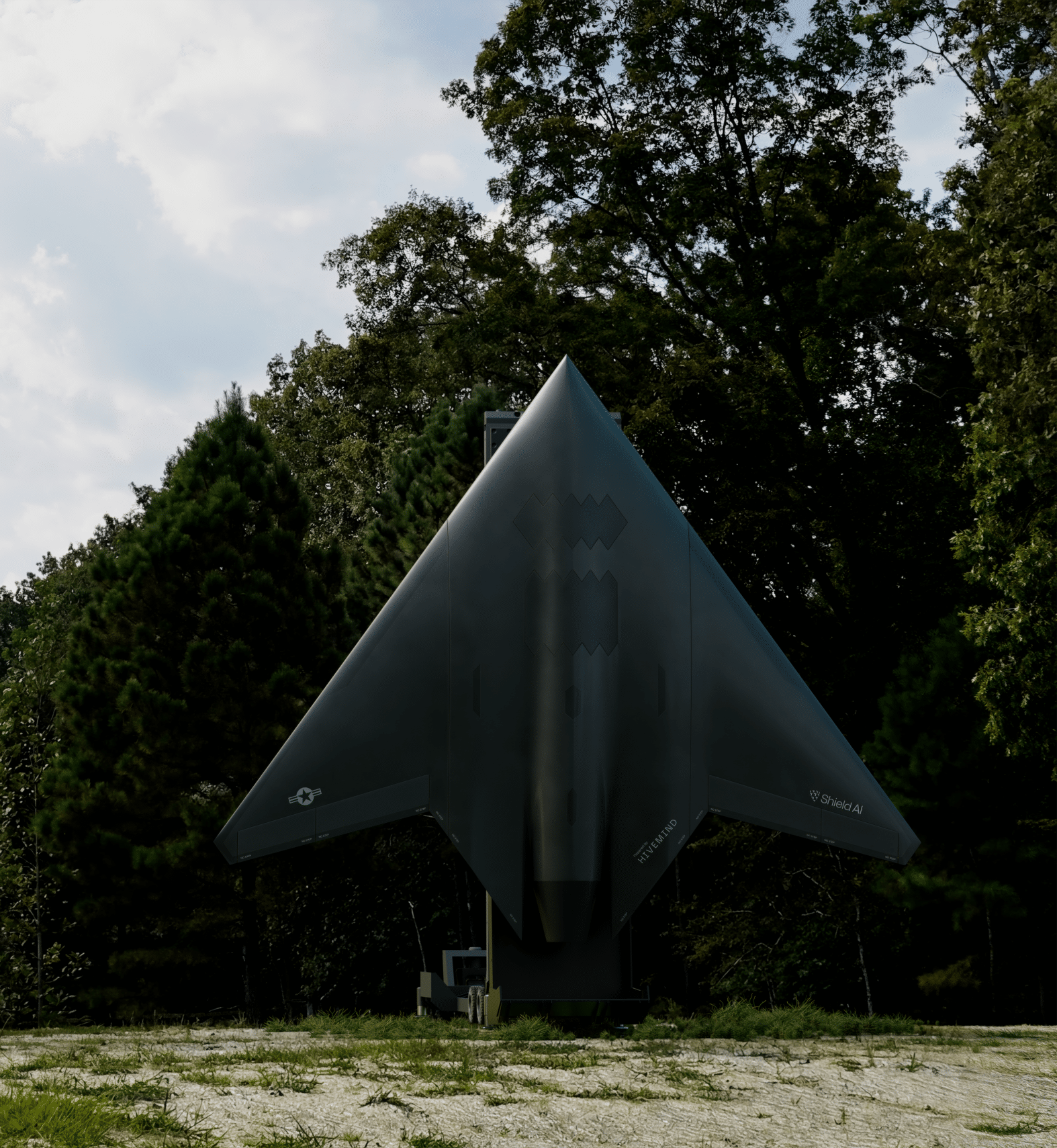
X-BAT is being developed as a multirole combat aircraft capable of performing air-to-air, air-to-ground, maritime strike, electronic warfare, and intelligence, surveillance, and reconnaissance missions—at a fraction of the acquisition and lifecycle cost of crewed fifth-generation fighters, such as the F-35 Lightning II.
This low-observable, or stealthy, unmanned aircraft can carry both air-to-air and air-to-surface weapons in its internal bays. It can also carry large strike weapons on its external hardpoints. In fact, earlier illustrations showed the aircraft carrying the AGM-154 Joint Standoff Weapon and AGM-158C Long Range Anti-Ship Missile.
Notably, the X-BAT differs from the two US Collaborative Combat Aircraft—the YFQ-44A and YFQ-42A—which are designed around conventional runway operations. Instead, it has been envisioned as a more advanced complement to CCAs that will expand options for combatant commanders—providing geographically distributed long-range effects, force multiplication at lower cost and risk, and resilience against anti-access/area-denial threats.
The X-BAT would primarily help the US Air Force in combat by solving the vulnerability of fixed runways and large air bases while delivering affordable mass, extended reach, and reduced risk to pilots. This could be particularly useful in the Indo-Pacific region, where military operations against an adversary like China are likely to involve enormous distances and where major airbases and aircraft carriers could become high-priority targets.
X-BAT’s long combat radius will reduce reliance on tankers and forward basing, while Hivemind autonomy will support operations in communications-denied environments. Moreover, its affordable unit costs and attritable design will allow commanders to produce more platforms and deploy them on high-threat missions.
This will essentially free high-value manned jets like the F-22, the F-35, and the next-generation F-47 sixth-generation fighter for command, complex decision-making, or lower-risk roles.
In the Indo-Pacific theater, the X-BAT could address the core problem of concentrated, highly vulnerable Western Pacific bases. Using X-BAT for dispersed operations from islands, expeditionary sites, or allied ships would complicate adversaries’ targeting, sustain sortie generation after initial attacks, and enable long-range strikes or air-to-air engagements without constant tanker dependence.
In theatres like the Middle East, X-BAT’s autonomy will allow the US military to undertake high-risk penetration or maintain persistent presence over heavily defended areas without risking the lives of its crew. It would, in fact, help the US avoid the F-15E-like shootdown by enemies like Iran, which triggered a major search and rescue operation and caused cascading losses.
The aircraft could also have considerable implications for the US Navy. This is because the X-BAT is intended to operate large aircraft carriers, catapult launch systems, arresting equipment, or prepared runways, unlike conventional aircraft. This essentially means that it would allow the use of naval vessels, including amphibious assault ships, and remote expeditionary locations to support autonomous combat aviation.
The program has received strong backing despite its ambitious scope.
On October 8, 2026, the company announced that total government and company commitments towards X-BAT had reached $400 million. Meanwhile, since July 2026, the US Navy’s Runway Independent Maritime Expeditionary Strike effort and related Other Transaction agreements have provided roughly $200 million, matched by Shield AI capital.
Nevertheless, several challenges remain in developing and testing the X-BAT, particularly because vertical flight for a fighter-sized aircraft is far more complicated than vertical flight for a small drone.
The aircraft must manage engine thrust, thermal conditions, aerodynamic stability, and control during its transition between flight modes, and its autonomous software must demonstrate sufficient reliability in complex military environments. It must also validate stealth, weapons integration, maintenance requirements, and production costs through extensive testing.
Until it demonstrates these capabilities, the aircraft remains a work in progress.
- Contact the author at sakshi.tiwari13 (at) outlook.com
- Follow EurAsian Times on Google News