Donald Trump has lost midterm elections, and the day before that, the United States carried out “defensive strikes” against targets on Iran’s strategically vital Qeshm Island.
Trump acknowledged the strikes and said: “They have no anti-aircraft. We took some out last night… They built an anti-aircraft facility. It took them about two months. We watched it get built. As soon as it was completed—we hit it.”
Notably, the strikes took place against a backdrop of repeated Iranian attacks on commercial vessels attempting to transit the Strait of Hormuz, which Tehran has kept under de facto restrictions since the early weeks of the conflict.
“The Iranian nation will not surrender to the enemy’s threats and military actions,” said Mohammad Bagher Ghalibaf, the Iranian parliamentary speaker and chief negotiator with the US, on November 3. Further, he warned that the country’s “military and strategic response to any enemy miscalculation will be unpredictable.”
Qeshm Island: Why It’s Vital For Iran
Qeshm’s geography is the main reason for its strategic importance to Tehran.
Qeshm is Iran’s largest island in the Persian Gulf—roughly 1,445 kilometers—and one of the most strategically vital pieces of territory for Tehran’s ability to influence or control transit in the Strait of Hormuz, the world’s most important energy chokepoint connecting the Arabian Sea and the Indian Ocean.
Qeshm lies in the Strait of Hormuz, running roughly parallel to Iran’s southern coastline in Hormozgan Province, and is separated from the Iranian mainland by the Clarence Strait (Khuran), which is 2 kilometers wide at its narrowest point.
It is not simply an island near the Strait of Hormuz, but an island situated within the maritime environment that determines access to the Strait itself. It lies about 22 kilometers south of Bandar Abbas, Iran’s primary southern maritime, economic, and military gateway. At the same time, Qeshm sits near the western and central approaches to the Strait of Hormuz, alongside other Iranian islands such as Larak and Hormuz, giving Iran a geographically advantageous position to observe activity in the surrounding waters.
The island is elongated, measuring 135 kilometers long and 40 kilometers wide at its widest point. Its position and size give whoever controls it major leverage over traffic through one of the world’s most critical energy chokepoints. About 20% of global petroleum liquids and crude oil (about 20 million barrels per day) and 20% to 25% of global liquefied natural gas (LNG) trade passed through the Strait of Hormuz before its closure.
Qeshm Island’s size and position allow Iran to control access to the Persian Gulf through the Strait of Hormuz. Commercial vessels traveling between the Persian Gulf and the Indian Ocean pass through waters relatively close to the island. Against this background, Qeshm has been instrumental in Iran imposing and maintaining restrictions on the Strait of Hormuz, an action that has disrupted the global economy and influenced war outcomes.
Qeshm is a crucial part of Iran’s military planning because it helps the country defend its southern maritime approaches. Tehran does not have a conventional blue-water navy comparable to the United States’. Thus, Iran’s approach to maritime security has historically emphasized coastal defense, naval forces operating close to shore, small and fast naval vessels, anti-ship missile capabilities, surveillance and reconnaissance, dispersed military infrastructure, and, most importantly, asymmetric warfare. Qeshm fits squarely within this military framework.
To maintain its control over the Strait of Hormuz and use it as leverage in the war with the United States, Iran has used the island as a forward base with naval facilities, surveillance radars, unmanned aerial vehicle (UAV) sites, coastal batteries, and reported underground missile infrastructure to monitor, interdict, or selectively control vessels transiting the waterway. Iran treats Qeshm as an “unsinkable aircraft carrier” and a primary platform for its asymmetric naval strategy.
The island extends Iran’s military and surveillance presence into the maritime environment by providing additional locations for observing maritime activity, supporting a broader coastal-defense network, creating additional infrastructure options for military logistics, and increasing the geographical complexity facing foreign forces operating in the area.
Qeshm Island serves as a forward base for Iran, alongside other islands such as Larak and Abu Musa.
According to open-source reporting, Qeshm houses underground anti-ship missile facilities, coastal anti-ship missile systems, fast attack and missile-equipped naval vessels, naval bases and support facilities, cutting-edge air-defense systems, radar and coastal surveillance infrastructure, drone-related facilities, and electronic warfare capabilities, among other advanced military systems built by the country
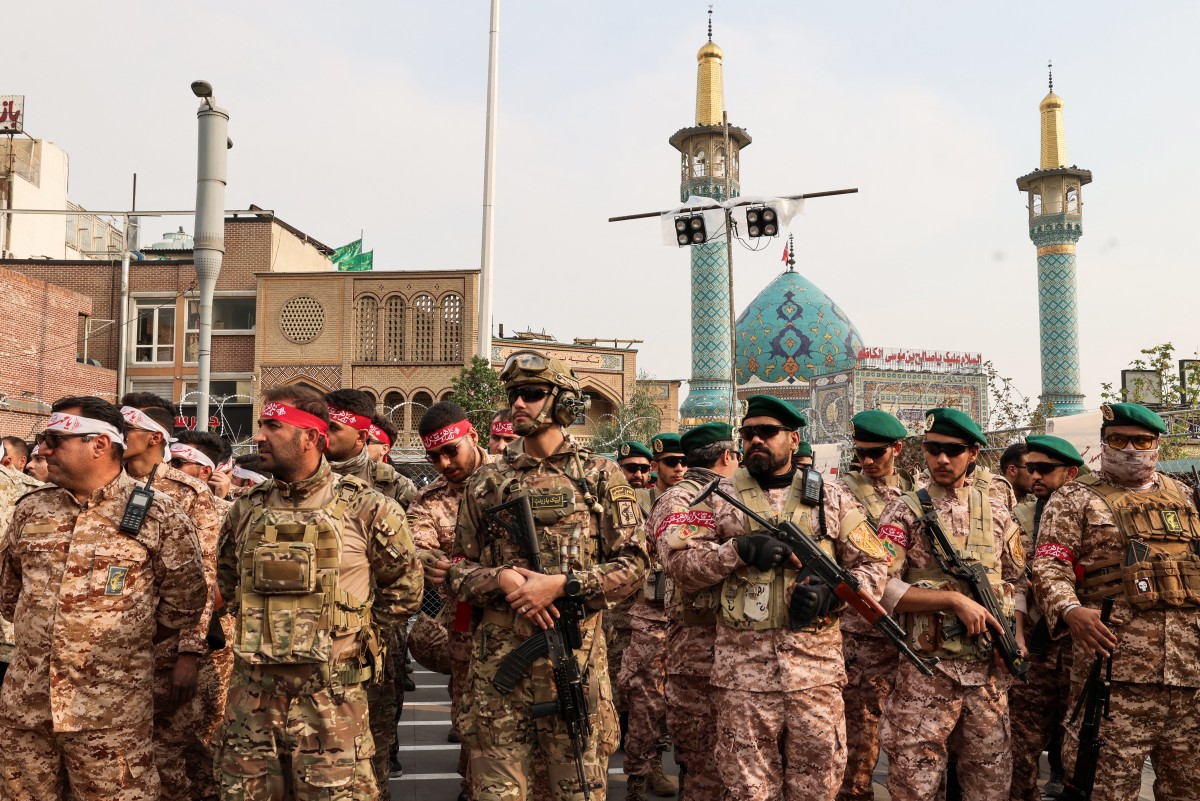
Additionally, Qeshm Island hosts ports, marinas, and concealed bases for fast-attack craft, swarm tactics, mining operations, and potentially submarines or underwater systems.
The IRGC heavily utilizes swarms of fast-attack craft and loitering munitions. The island’s jagged coastlines, mangrove swamps, and hidden coves provide perfect radar shadows for launching hit-and-run guerrilla naval strikes.
Reports suggest the Islamic Republic has been operating a de facto “toll booth” or permit system via routes near Qeshm and Larak.
The island allegedly houses an extensive underground network for storing and launching anti-ship missiles, coastal batteries, and related systems. Retired Lebanese Brigadier-General Hassan Jouni, a military and strategic analyst, told Al Jazeera in March this year that Qeshm contains “striking Iranian capabilities” inside an underground complex that is typically known as a subterranean “missile city.” These are designed to survive air strikes and enable rapid strikes on shipping or naval forces in the strait.
The island reportedly hosts a variety of weapons, including the Chinese-origin HY-2 “Silkworm” and longer-range systems like Ghadir variants, which are anti-ship missiles used to strike vessels in the Hormuz Strait. The island also hosts Qiam-1, Khaybar Shekan, Ghadr, and Emad, all potent ballistic missiles developed by Tehran.
Not just this, the IRGC has deployed a host of precision-guided munitions at Qeshm, claiming thousands of advanced strike systems capable of evading electronic warfare.
These capabilities underpin Iran’s anti-access and area-denial approach. Combined with coastal batteries on the mainland and assets on other islands such as Larak, Qeshm helps Iran threaten or interdict vessels with missiles, drones, mines, and boats.
With these capabilities, Iran is in a position to disrupt traffic, raise insurance costs, force detours or permissions, or threaten closure without needing a conventional navy.
Besides threatening the ships passing through Hormuz, Qeshm has been used by Iran to threaten US military aircraft and drones flying in the region. The IRGC has a variety of short- and medium-range air defense systems and surface-to-air missile launchers at Qeshm, although which systems have been deployed at the island could not be confirmed.
Some of Iran’s most commonly used air defense systems are Bavar-373, the Soviet-origin S-300PMU-2, Khordad-15, 3rd Khordad, Raad, Tor-M1, and several Man-Portable Air Defense Systems (MANPADS). The IRGC most likely operates some of these from Qeshm.
In fact, multiple Reaper drones have allegedly been downed by anti-aircraft missiles deployed on the island, which may explain the recent strikes, as underscored by Trump.
Due to its strategic location and proximity to Hormuz, Qeshm also hosts several coastal surveillance radars, air-surveillance radars, and maritime monitoring and tracking systems. The US military has targeted many of these in multiple strikes.
Besides missiles, radars, and air defenses, Qeshm also hosts drones, which have invariably emerged as the most significant assets in combat. Although it is hard to say which drones the IRGC has deployed to the island, the Shahed-class, Mohajer-class, and Ababil-class are the most commonly used.
Earlier this year, as the US mobilized troops to the Middle East amid escalation in the region, there were speculations that Trump was potentially planning a ground invasion of Qeshm and Kharg islands. However, Qeshm is large, so seizing it would require substantial forces and would face constant threats from the nearby Iranian shore, making the operation costly and difficult.
The island’s strategic location may be why the US struck it at what is perhaps the most crucial moment in its domestic politics.
- Contact the author at sakshi.tiwari13 (at) outlook.com
- Follow EurAsian Times on Google News