Japan is poised to deploy its fighter jets to India for the first time as the two countries—committed to the “Free and Open Indo-Pacific” — bolster interoperability and strengthen defense relations.
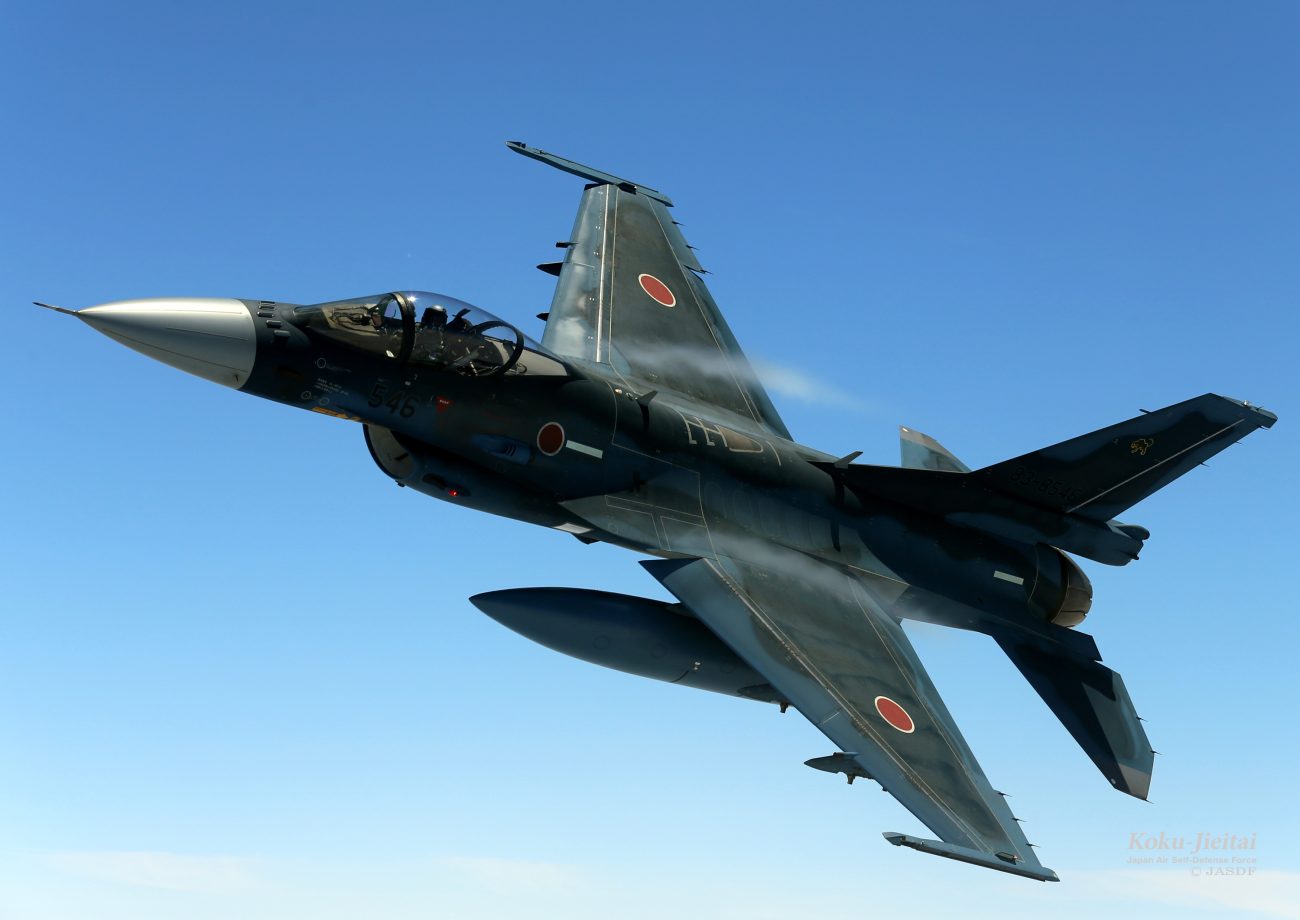
Japan Air Self-Defence Force (JASDF) will deploy three F-2 fighter jets along with 110 troops from the Eighth Air Wing based at Tsuiki Airbase in southwestern Japan’s Fukuoka Prefecture to India for the “Veer Guardian 2026” exercise, the JASDF said in an announcement last week.
The jets will fly from Tsuiki to Jodhpur via Naha Air Base in Okinawa and a stop in Thailand, with U.S. Air Force support including aerial refueling on the long haul. The exercise is due to begin at Jodhpur Air Force Station in Rajasthan on September 9 and run through September 21, 2026.
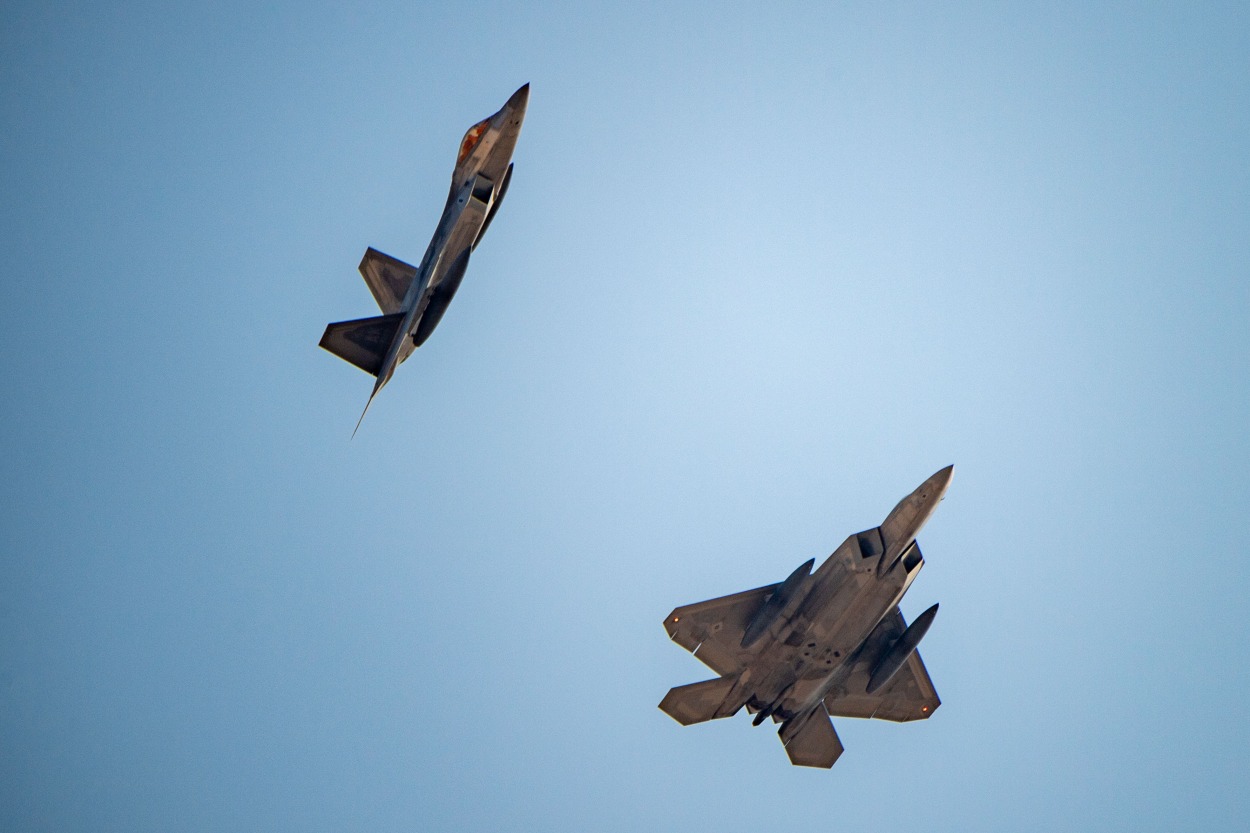
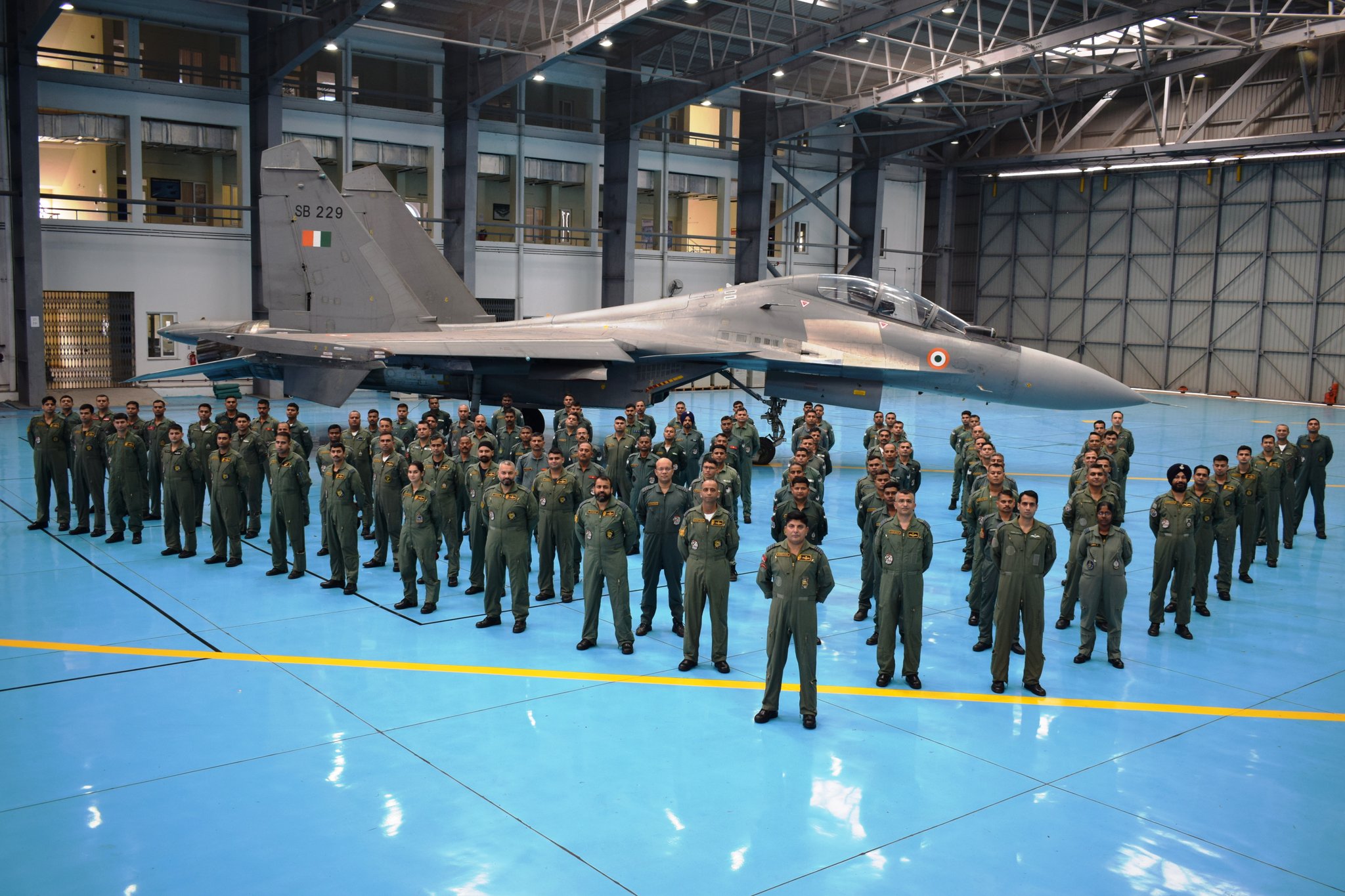
The drills are expected to focus on air combat training, including F-22-versus-Su-30MKI exercises, to improve tactical skills, mutual understanding, and interoperability. “This will be a valuable opportunity to enhance mutual understanding and trust,” Takehiro Morita, chief of staff of the JASDF, stated.
This marks another bilateral fighter exercise between the two air forces and the first time Japanese fighters will operate from Indian soil. In January 2023, the Indian Air Force (IAF) deployed four Su-30MKIs against four JASDF F-2s and four F-15s, as the EurAsian Times reported at the time.
The F-2, nicknamed “Viper Zero,” is a Japanese-developed multirole fighter based on the F-16 but significantly modified with larger composite wings, indigenous AESA radar, advanced Japanese avionics, and a strong anti-ship emphasis, among other things. It was developed primarily for the JASDF to address threats posed by regional adversaries such as North Korea and China, and has been a cornerstone of the Japanese defense forces alongside the F-15Js since entering service in the early 2000s.
The F-2’s deployment to India marks a clear upgrade from earlier limited interactions to more complex, reciprocal air combat training on Indian soil.
Notably, the IAF’s fleet deployment for the drills is unclear at this moment, but the service is likely to pull out its Su-30MKI fighters. For now, the Rafale jets are not expected to participate in the drills.
The deployment of Su-30MKIs will create high-value dissimilar training and give Japanese pilots rare exposure to a heavy, thrust-vectoring Flanker-type platform, which may help them better understand Chinese J-16 aircraft. Meanwhile, the IAF pilots will train against an advanced derivative of the F-16 (also operated by Pakistan) with distinct radar characteristics, electronic warfare systems, flight-control philosophy, and multi-role tactics.
Such training typically improves pilot skills in both Beyond-Visual-Range and Within-Visual-Range engagements and exposes both sides to unfamiliar sensors and weapons.
The drills come at a time when Japan’s military and strategic policy is undergoing a major transformation.
For the first time in the last eight decades, Japan is looking beyond the US for security and enhancing defense capabilities, and actively seeking new security partners in the Indo-Pacific, with India emerging as a key player for deeper defense cooperation, joint industrial projects, and regional deterrence, as the EurAsian Times earlier explained in a detailed report.
Japan and India have launched a slew of diplomatic and defense initiatives to strengthen cooperation and interoperability. For example, the joint military exercise, named the ”Dharma Guardian,” was conducted from February 24 to March 9, 2026, in Chaubattia, Uttarakhand, India.
“Free Ride is Over”: Japan’s Big Message to U.S. as Tokyo Gets Ready to Defend Itself Against China
Last month, Indian Defense Minister Rajnath Singh and Japanese Defense Minister Shinjiro Koizumi signed a Memorandum of Arrangement on Maritime Security Cooperation in New Delhi—the first document focused specifically on maritime security that Japan’s Ministry of Defense has concluded with any country.
It provides for enhanced information sharing on maritime domain awareness; closer coordination on search-and-rescue and humanitarian assistance/disaster relief; mutual ship visits; joint exercises; personnel and subject-matter expert exchanges; and logistical support, including use of ports and repair facilities.
The two sides have also agreed to explore joint development under the framing “Design with Japan, Make in India,” leveraging Japanese technology with Indian production capacity.
Additionally, both sides decided to establish a new Working Group at the Director-General/Joint Secretary level to coordinate cooperation across the operational, intelligence, equipment, technology, and industrial domains, while continuing to use the 2020 Acquisition and Cross-Servicing Agreement and to expand logistics arrangements.
In April this year, Japan enacted a historic overhaul of its defense export policies, formally ending decades-old post-WWII restrictions that had limited military shipments to non-combat categories. At the time, India welcomed the move, with the Ministry of External Affairs (MEA) saying that defense and security cooperation forms an important pillar of the India-Japan Special Strategic and Global Partnership.
The new guideline paves the way for arms sales, including Japanese-developed warships, combat drones, and other weapons.
Japan pitched the Global Combat Aircraft Program (GCAP), a sixth-generation fighter, to India last year. For now, India appears to have shortlisted the France-led FCAS for further discussions. Meanwhile, Indian reports indicate that New Delhi is now a dialogue partner for GCAP, which means doors could still be open to both 6th-gen jets.
The two nations also signed a Memorandum of Intent in November 2024 to “co-develop” the UNICORN (Unified Complex Radio Antenna) mast, a conical structure that enhances a warship’s communications and stealth capabilities. The MoU stated that the co-development will take place under the India-Japan Defense Technology Cooperation.
Subsequently, India and Japan announced their first-ever cooperative defense co-development project to produce the UNICORN jointly at the 16th India–Japan Annual Summit in New Delhi in July 2026.
Japan & India Confronted With The China Challenge
Japan encounters hostile PLA activity in the East China Sea, around the Senkaku Islands, and near Taiwan. Meanwhile, India is locked in a border dispute with China in the Himalayas. Beijing is also a leading arms supplier to India’s arch-rival Pakistan and is building close links with Bangladesh, Sri Lanka and Nepal, all of India’s neighbors.
Although neither country is expected to come to the other’s aid in a conflict with China, closer air-force interoperability, joint exercises, and logistics experience may raise the cost and complexity of Chinese coercion, analysts say. Moreover, the joint exercise builds practical interoperability and experience that could matter in a potential military contingency, while advertising that Japan and India can work together.
Moreover, analysts believe that a strong defense axis between India and Japan may also create two-front pressure on Beijing, with the geography apparently working against it. India borders China to the west, whereas Japan lies off China’s eastern maritime approaches near key population and economic centers.
Unsurprisingly, this collaboration has sent alarm bells ringing in China, which frequently accuses Japan of provocation and militarism in the region.
China considers the enhanced military cooperation between India and Japan an attempt by Tokyo to “revive militarism,” expand its military reach across the region, and pull India into an anti-China coalition. Beijing has criticized the expanding cooperation in a language similar to its critique of the Quad, which includes India, Japan, the US, and Australia.
Since the Quad has been diluted as the US has prioritized other interests in recent years, bilateral cooperation between Tokyo and New Delhi may help sustain the grouping’s strategy, even if on a smaller scale.
After Japan scrapped a ban on lethal weapons export in April 2026, an article published in the state-owned Global Times stated, “Japan is ignoring today’s geopolitical realities in the Asia-Pacific by seeking to revise its pacifist framework, opening lethal weapons exports, recklessly provoking confrontation with China, and even attempting to return to the old road of militarism.” Furthermore, it urged India to “not to forget history or seek strategic balancing by loosening constraints on Japan.”
Meanwhile, Japan continues to build up its capabilities against China. In fact, it called Beijing’s military actions and external posture a “matter of serious concern” for both Japan and the international community in a white paper released last month. It also said China’s actions posed an “unprecedented” strategic threat.
While reaffirming the strategic importance of the US, the paper emphasized that Japan must strengthen its own capabilities and forge partnerships with like-minded countries in the Indo-Pacific, including India, Australia, and the Philippines.
Veer Guardian 2026 could be a major step in that direction—building practical interoperability and reinforcing the strategic convergence between New Delhi and Tokyo.
- Contact the author at sakshi.tiwari13 (at) outlook.com
- Follow EurAsian Times on Google News