China may have gained access to sensitive F-35 jet technology, as parts of the cutting-edge stealth aircraft were mysteriously diverted to Hong Kong, China. Importantly, this may not be the first time!
A shipment of F-35 parts bound for maintenance in the US was diverted while traveling across the Pacific Ocean from Australia, Politico claimed on September 18, 2026, citing sources familiar with the matter. Interestingly, Politico is one of three media houses that US President Donald Trump is aiming to ban at white house, apart from CNN and MS Now.
The parts were being transported to the US on behalf of Lockheed Martin, the stealth fighter’s manufacturer, but somehow ended up in Hong Kong, the report claimed.
The incident—previously not acknowledged by the authorities—sparked a series of briefings for congressional staff on key national security committees. Sources cited by the publication said that the congressional national-security committee staff received initial briefings from State Department and Pentagon officials in June 2026, with several additional briefings expected in the coming weeks.
The Pentagon’s F-35 Joint Program Office (JPO) has reportedly acknowledged the unprecedented rerouting, saying that it was “aware of a shipment issue of unserviceable F-35 Lightning II components.”
The JPO is working with US authorities and industry partners “to retrieve these components, investigate the incident, and place safeguards to avoid a future occurrence,” the official Pentagon statement noted.
Hong Kong remains a Special Administrative Region of China under the “One Country, Two Systems” principle, but the territory is now subject to Beijing’s national-security structures and political oversight, so any sensitive military parts that reach Hong Kong come under the practical reach of Chinese authorities.
Although no public evidence currently confirms that Chinese authorities obtained, inspected, or exploited the specific components, that risk cannot be totally eliminated.
China Could Access F-35’s Canopy
With access to actual components, China could study their materials, construction, and radar-absorbent coating. This could help verify, refine, or complement intelligence already gathered through other means such as cyber espionage, posing a major threat to the US F-35, which is expected to be deployed extensively in a potential conflict with Beijing.
Two sources cited by Politico said the shipment contained one of the jet’s canopies, which covers the cockpit and features stealth technology available only to the US and its allies.
If an adversary got one of the canopies, it could examine the components and possibly reverse-engineer the valuable technology for use in its own stealth fighter programs.
The F-35 canopy is coated with a thin layer of specialized transparent radar-absorbent material (RAM) or conductive coating, often involving materials like indium tin oxide or similar compounds.
This coating serves two critical functions: 1) It makes the canopy electrically conductive enough to reflect radar waves at the surface, preventing them from entering the cockpit cavity, which would otherwise act as a strong radar reflector due to the pilot, instruments, and seat; 2) It contributes to the aircraft’s overall low-observable shaping by controlling electromagnetic reflections in a prominent area of the airframe.
Even a worn-out or damaged canopy retains value for an adversary, as it could be used to study degradation patterns, coating-thickness variations, and bonding methods. In fact, environmental wear can reveal how the material performs, ages, and fails under real operational conditions.
Chinese labs could subject the canopy to advanced testing through microscopy, spectroscopy, chemical analysis, thickness measurement, thermal testing, and controlled radar illumination, among other things. Such data could help Chinese engineers improve radar-absorbent materials for the J-20 and J-35 fighters, which still allegedly face challenges with coating durability and low-frequency absorption compared with US systems.
Studying degradation on a used canopy could provide clues about the aircraft’s real-world performance and potentially inform Chinese efforts to model F-35 radar signatures more accurately, develop better counter-stealth detection methods, or identify potential weak points for targeting. This could be detrimental to the Pentagon, which has been especially wary of adversaries finding different ways to obtain F-35’s sensitive technology.
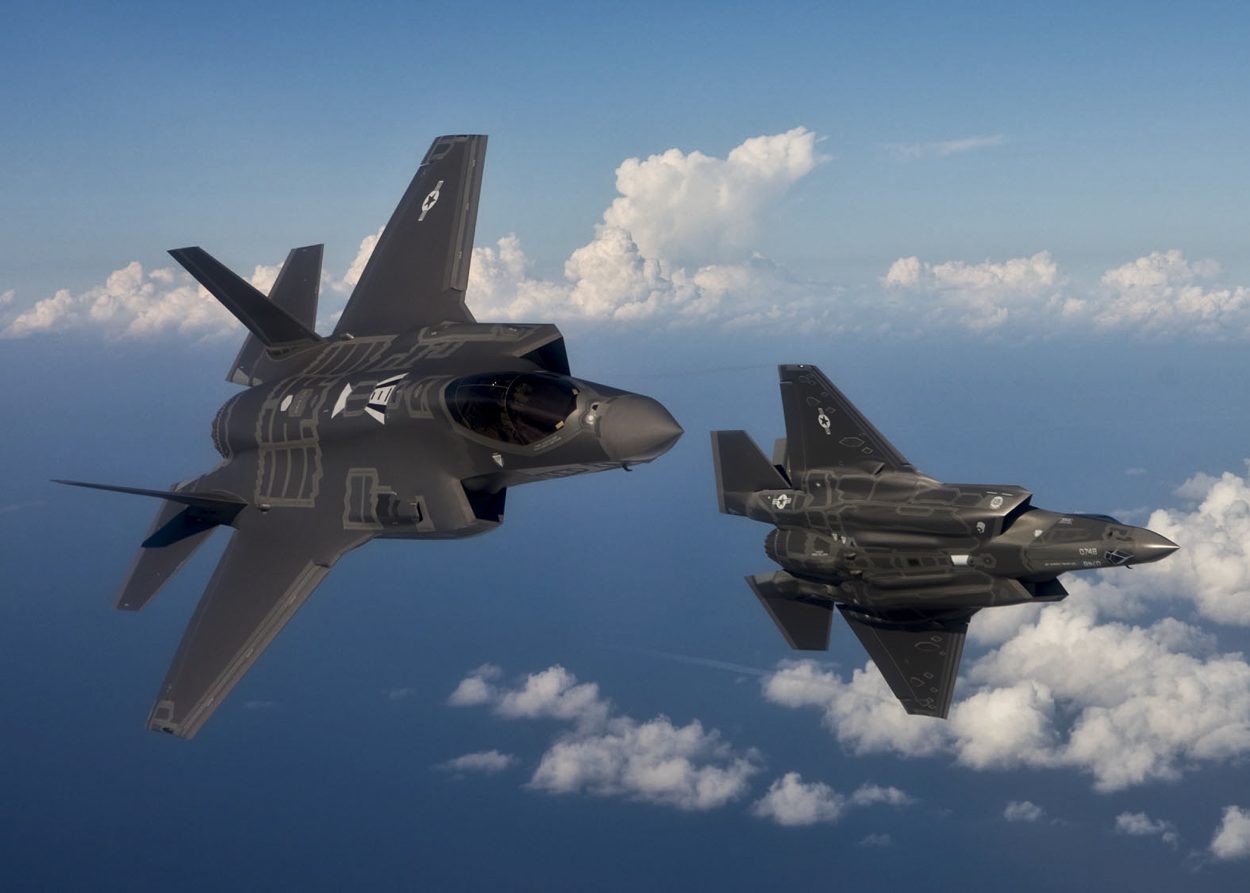
Notably, the international F-35 supply chain depends on facilities across several nations to transport and maintain the stealth aircraft parts. Although Australia has jet maintenance facilities, none of them are equipped to fix canopies.
The F-35 program manages aircraft spare parts through a distinctive global system in which participating nations draw from a shared inventory of components stored worldwide.
These parts remain under Defense Department ownership until they are installed on an aircraft. However, despite increased Defense Department scrutiny of the F-35 supply chain in recent years, the department itself does not track the spare parts held in this pool—Lockheed Martin does.
The 2023 Government Accountability Office report revealed that more than one million F-35 spare parts disappeared over the preceding five years.
The GAO found it could not fully examine losses valued at tens of millions of dollars because Lockheed controls the underlying data, oversees the program’s entire supply chain, and ships parts via commercial carriers.
In a statement to Politico, Lockheed said it complies with all US requirements for delivering aircraft components but could not disclose the status of shipments because of security concerns.“Our teams handle every shipment with the utmost diligence and safeguards to ensure the integrity of the F-35 program and the security of our allied partners,” it said.
China Stole Sensitive Stealth Fighter Data?
Suspicion of China’s role in stealing F-35 information first surfaced publicly after former US National Security Agency contractor Edward Snowden allegedly leaked classified papers to a German publication in 2015. The leaked data showed the full extent of China’s cyber-espionage attempts.
Documents provided to Der Spiegel showed that Chinese hackers had obtained highly classified details on the F-35 Lightning II joint strike fighter. Sources said the intrusion occurred in 2007 at the program’s primary contractor, Lockheed Martin.
Separately, in 2019, John Bolton—then serving as National Security Adviser in the Trump administration—publicly charged China with stealing American technology to develop its own stealth fighter.
Additionally, many terabytes of data related to the F-35 program are believed to have been stolen by Chinese hackers, including information on the F-35’s radar design – such as the number and types of modules used by the system – and its engine, including the method used for cooling gases, leading and trailing edge treatments, and aft deck heating contour maps. They also allegedly stole data on the F-22 Raptor and the B-2 bomber.
US officials have linked these intrusions—including the theft of F-35 data—to a broader Chinese cyber-espionage effort known as “Byzantine Hades.” The operation is believed to have started around 2006 and has been traced to Technical Reconnaissance Bureaus within the People’s Liberation Army’s Third Department. The Chinese hackers reportedly preferred “spear-phishing” approaches to access confidential material, which involved compromising email accounts and passwords to enter secure networks.
In March 2016, Chinese national Su Bin pleaded guilty to charges stemming from what the US Justice Department called a multi-year conspiracy. Working with senior members of the Chinese military, he helped steal American military secrets, focusing on designs for the F-22 and F-35, as detailed in a previous EurAsian Times report.
Since then, it is believed that China’s leading stealth fighters—the operational Chengdu J-20 and the J-35A—draw on design features from existing American aircraft.
On 1 August 2018, China marked the founding anniversary of the People’s Liberation Army by intentionally releasing high-resolution images of its next-generation J-20 stealth fighter to the press. Additional J-20 photographs that appeared in 2019 offered a detailed view of the aircraft’s fuselage and showed a sensor installation that closely matched the Lockheed Martin Electro-Optical Targeting System (EOTS) fitted to the F-35’s nose.
Similarly, when China unveiled the J-35A in 2024, the then-US Air Force Chief of Staff Gen. David W. Allvin said China’s new stealth fighter has one unique feature: it seems modeled after the F-35.
“It’s still fairly new. But yes, it’s pretty clear; you could put it side by side and see, at least, where we believe they got their blueprints from, if you will,” he stated.
That said, having a physical component would be a higher-fidelity source than digital data alone. It could allow Chinese engineers to cross-check specifications against real hardware and observe how materials perform under operational stress.
- Contact the author at sakshi.tiwari13 (at) outlook.com
- Follow EurAsian Times on Google News