The Chinese military seems to be practicing blowing up full-scale replicas of the US Navy’s Arleigh Burke-class destroyers, the backbone of American naval power projection in the region.
A structure resembling a US Navy Arleigh Burke-class guided-missile destroyer has been spotted at Ruoqiang Test Range in China’s Taklamakan Desert, located in the far-western Xinjiang region. The structure — a full-scale replica of the US destroyer —was reportedly seen in satellite images of the facility, first identified by Joseph Wu, co-founder of the Taiwan Defense Studies Initiative.
Some reports, citing open-source intelligence trackers, stated that a hull (probably of the same replica) was earlier spotted in satellite imagery in January this year. However, they noted that the recent imagery shows significant advancements, with the warship’s main elements finally beginning to take shape.
For example, the deck arrangement more closely mimics that of an operating Arleigh Burke-class destroyer, and metal frames have allegedly been used to build the bridge, funnel, and main gun position.
These claims could not be independently corroborated by the EurAsian Times. However, we know that the Arleigh Burke-class destroyers serve as the backbone of US Navy surface operations and will most certainly be part of any prospective conflict between China and the US in the Indo-Pacific.
Boasting a large missile capacity and the cutting-edge Aegis Combat System, these warships are designed for integrated air defense, ballistic missile defense, anti-submarine, and anti-surface warfare.
Satellite imagery suggests China placed a mock-up of a U.S. Arleigh Burke-class destroyer at a missile test range in the Taklamakan Desert, where the PLA Rocket Force is believed to be practicing precision ballistic missile strikes. (Army Recognition)
The message is clear:… pic.twitter.com/Uk1EQgq3XR
— Ababeel (@AbabeelMilitary) June 20, 2026
In fact, Arleigh Burke-class guided-missile destroyers frequently transit the Taiwan Strait to demonstrate the US commitment to a free and open Indo-Pacific, a move China fiercely condemns and classifies as “provocative.”
Earlier, satellite imagery in 2021 spotted mock-ups of an American aircraft carrier and two Arleigh Burke-class destroyers at the same testing range. Similarly, satellite images from January 2024 showed a full-scale black silhouette about 1,085 feet long, shaped like the newest US Navy aircraft carrier, the USS Gerald R. Ford.
An analysis at the time revealed that work on the target carrier began in November 2023.
China has also allegedly practiced destroying American stealth fighters, F-35 Lightning II and F-22 Raptors. In July 2024, satellite imagery showed what was believed to be the aftermath of a Chinese military attack on American stealth aircraft, a conclusion drawn based on the scorched F-35s and F-22s stationed at one end of a long runway. The site also reportedly had mock-ups of the P-8A Poseidon and the U-2 reconnaissance plane.

In addition to US weapon systems, China has also constructed replicas of crucial buildings and facilities of Taiwan, which it claims as its own territory and wants to occupy. For instance, it built a mockup of Taiwan’s capital city, Taipei, including its presidential office, foreign office, and other government buildings, as well as two different military bases.
In fact, a CCTV News footage in 2015 showed PLA forces destroying a building resembling Taipei’s presidential office during a live-fire drill.
Analysts surmise that these life-size mock-ups are meant to help China refine its seekers with image-recognition capabilities in preparation for an actual combat with the United States in the Indo-Pacific. This is intended to help the Chinese People’s Liberation Army (PLA) target specific warships with missiles to inflict maximum damage.
In fact, the latest reports about the Arleigh Burke replica state that another set of satellite imagery showed debris from missile strikes around the mock-up, suggesting that the replica was constructed by China to test its growing arsenal of anti-ship weapons.
China’s Growing Arsenal Of Anti-Ship Weapons
China is adding anti-access and area-denial weapons to its arsenal at a breakneck speed, with an emphasis on anti-ship capabilities, especially since any potential conflict between Beijing and its adversaries would most likely be fought at sea.
China has developed one of the world’s most extensive and advanced anti-ship missile arsenals, including anti-ship cruise missiles (ASCMs) and anti-ship ballistic missiles (ASBMs), focused on anti-access/area denial (A2/AD) strategies in the Western Pacific, particularly against US carrier strike groups.
The main anti-ship missiles in China’s arsenal include the YJ-12, YJ-18, YJ-83, and the recently unveiled YJ-15.
China’s surface and air forces have extensively used the YJ-83, a small, short-range anti-ship missile not compatible with vertical launch cells. It is usually stored in box launchers on Chinese corvettes, frigates, and small missile boats. This missile is the primary anti-ship weapon for non-bomber PLA aircraft, both land-based and carrier-based.
The YJ-18 is a Chinese cruise missile designed for both anti-ship and land-attack roles with a range of about 220 to 540 kilometres. It entered service around 2014 and is purportedly derived from the Russian 3M-54E “Klub” missile. According to reports, it has been installed on China’s large surface combatants, including the Type 52D destroyer and the Type 55 cruiser. A version compatible with torpedo tubes is being deployed on PLA subs.

Meanwhile, YJ-12 is a supersonic long-range anti-ship cruise missile with a range of about 400 kilometres. It is carried by H-6 bombers, ships, and ground launchers and features sea-skimming flight, active radar seeker, and high manoeuvrability in the terminal phase. The versatility of this missile allows it to play a significant role in China’s capability to engage warships from long distances from the mainland.
China also unveiled a host of new anti-ship cruise missiles during the Victory Day Parade in September 2025, including the YJ-15 and YJ-19.
The YJ-15 reportedly shares some similarities with the YJ-12, according to state media reports. It is a supersonic anti-ship cruise missile with a flat warhead and apparently adopts a boost-glide waverider configuration, which gives it some hypersonic characteristics. It can be carried by multiple platforms such as shipborne aircraft, surface vessels, and submarines, and has a range of about 1,000 to 1,500 kilometers.
The YJ-19, on the other hand, sports a waverider configuration and reportedly has an air inlet beneath the missile body, characteristics that point to the missile being an air-breathing hypersonic weapon. Like the YJ-15, it can also be carried by shipborne aircraft, surface vessels, and submarines.
In addition to these, the PLA also has a variety of deadly anti-ship ballistic missiles, many of which have earned the moniker of “carrier killers.”
The DF-26 IRBM (Intermediate-Range ballistic missile), which has a range of about 4,000 kilometres and the capability to carry both nuclear and conventional warheads, is also designed for anti-ship roles. In fact, it has enhanced precision for striking moving naval targets, including US aircraft carriers and destroyers.
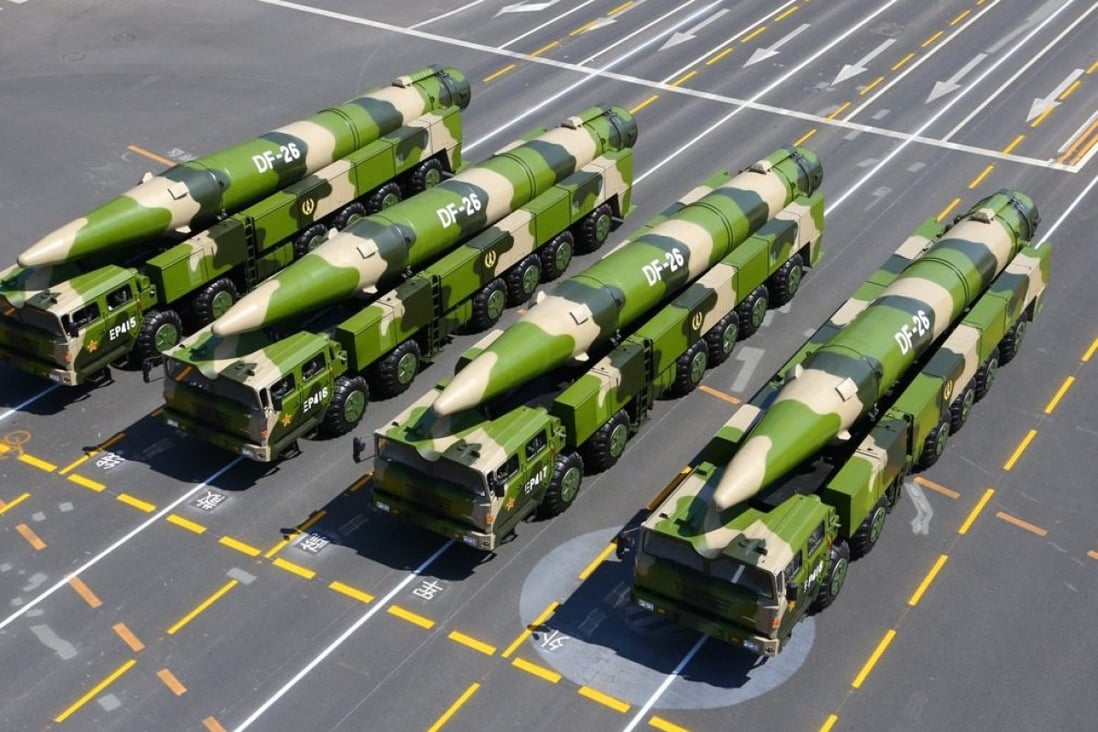
The DF-21D, on the other hand, is a medium-range, road-mobile ballistic missile introduced in 1991. Operational since 2012, the DF-21D is the world’s first anti-ship ballistic missile (ASBM), specifically targeting ships at sea. It reaches hypersonic speeds of up to Mach 10 during the terminal phase, making it the fastest Chinese MRBM to date. It can overcome existing US missile defense systems, such as the sea-based AEGIS ballistic missile defense (BMD) system, according to the Missile Defense Advocacy Alliance. Furthermore, this missile has a range of over 2,000 kilometers.
In addition to these deadly Dongfeng ballistic missiles, China has also reportedly developed the DF-27—a longer-range, potentially intercontinental reach for maritime targets, including at the US West Coast. It is speculated to have a range of about 5,000 to 8,000 kilometers. A map published by the Pentagon in December 2025 depicted DF-27 coverage across the entire Indo-Pacific region and much of the West Coast.
As it expands its inventory of anti-ship missiles as a tool of deniability against US forces, China has developed and inducted an array of air-launched anti-ship ballistic missiles.
This includes the formidable YJ-21 anti-ship ballistic missile, a hypersonic ASBM with a range of about 1,500-2,000 kilometres. It could be launched from Type 055 cruisers or H-6K bombers, and is considered a “carrier-killer” missile that can dynamically manoeuvre during reentry, enabling it to strike large vessels during the terminal phase of flight.
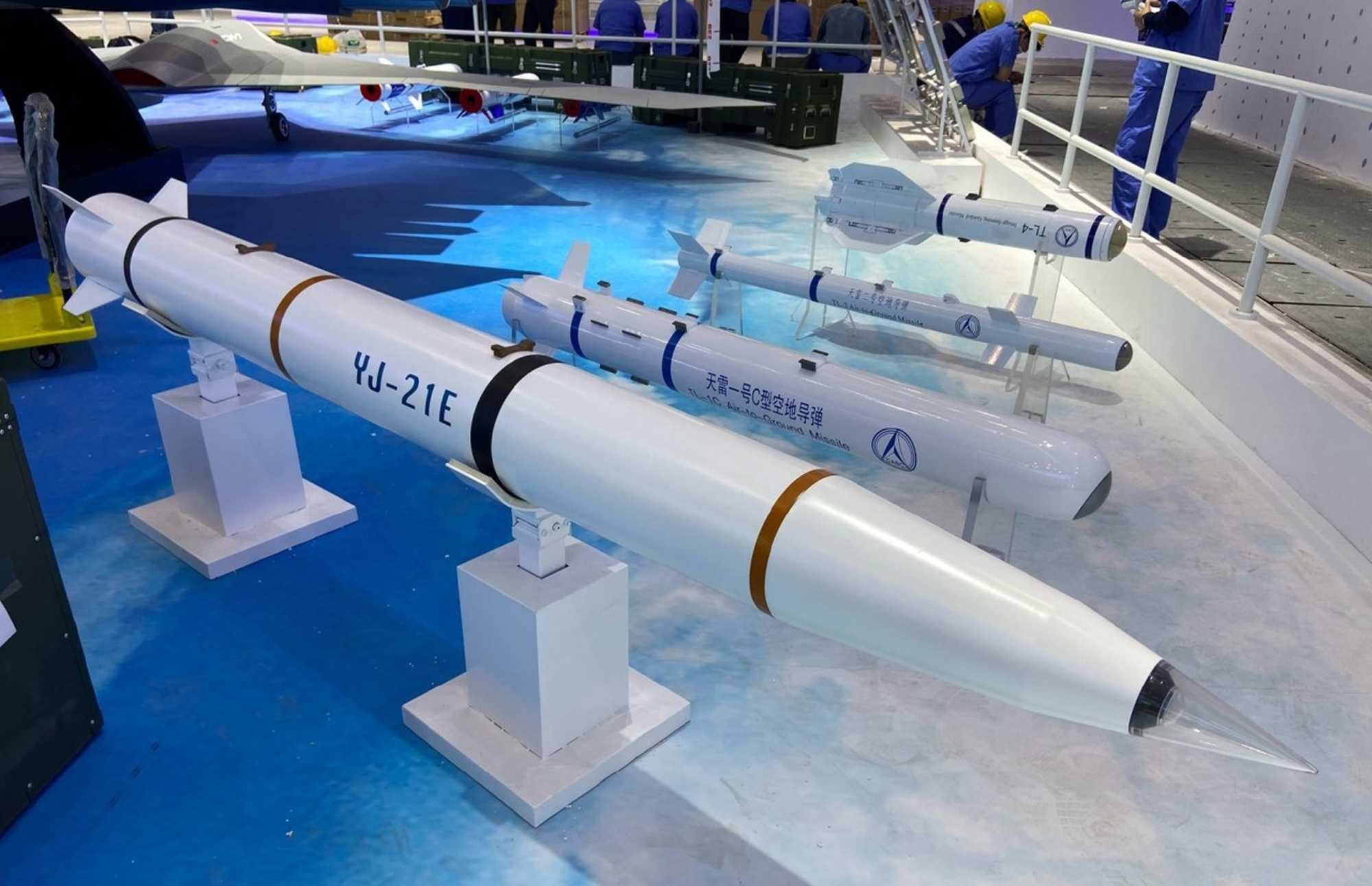
China unveiled two air-launched anti-ship ballistic missiles during the Victory Day Parade last year: the YJ-17 and the YJ-20.
While official details are obscured, military experts cited by Chinese state media stated that YJ-17, which has a glider and a booster, is more maneuverable than conventional ballistic missiles and can use aerodynamics to make large lateral and longitudinal maneuvers in the atmosphere, making it challenging for hostile air defense systems to estimate its flight path. It can reportedly be deployed on surface ships, ground-based launchers, and submarines.
Meanwhile, the YJ-20 is believed to be China’s first sea-based hypersonic anti-ship ballistic missile designed to strike high-value naval targets like aircraft carriers and heavily defended surface combatants deep within the Pacific.
It must be noted that this is an incomplete list of some of the most advanced Chinese anti-ship weapons publicly unveiled, with the Chinese anti-ship arsenal expected to see an unprecedented rise in the future, commensurate with its overall maritime capability.
And, Beijing may build more full-scale replicas in the future, to test these missiles against targets and refine their precision.
- Contact the author at sakshi.tiwari13 (at) outlook.com
- Follow EurAsian Times on Google News