
Amid the rapid proliferation of cheap drones, the US Army is increasingly turning towards laser weapons to reduce the cost of downing these threats– from millions of dollars per shot to just a few dollars.
The US Army awarded AeroVironment (AV) a $464.8 million Other Transaction Agreement (OTA) for the Enduring-High Energy Laser (E-HEL) program, as announced in an official statement on September 2, 2026.
The E-HEL program is meant to counter unmanned aerial systems (UAS) “while offering a low cost-per-shot and a magazine that regenerates with the system’s power supply,” according to the Army.
“This first-of-its-kind directed energy program will enable our formations to defeat unmanned systems and dominate from the outset. Pairing human ingenuity with advanced technology is what ensures our Army will continue to outpace America’s adversaries,” General Christopher LaNeve, Vice Chief of Staff of the Army, was quoted as saying.
This is the US military’s first production contract for a high-energy laser weapon system, marking the transition of directed-energy technology from prototypes to series production.
Under the agreement, AV will deliver dozens of LOCUST X3 laser weapon systems over the coming years, as noted by John Garrity, AV’s vice president of directed-energy systems. Furthermore, Garrity told reporters that the company will deliver “initial capabilities” within the year, adding that it can now scale “into the 20s per year” as opposed to 10s earlier. “We’ll be scaling well beyond that here in the coming, you know, 12 to 18 to 24 months.”
Unveiled in March 2026, the LOCUST X3 is a 30-kilowatt-class high-energy laser weapon system that was designed with E-HEL needs in mind. The X3 is designed to neutralize Group 3 drones—which weigh up to 600 kilograms—but could be scaled to target smaller drones as well. This means that the US Army is procuring the same kind of Shahed-like drone that it has been facing in its nearly six-month-old war with Iran.
“LOCUST X3 is intended to be the Group 3 killer,” Garrity told reporters on August 7, 2026. “When we talk about Group 3, that’s just one of the more prevalent threats that you see in warfare today, seen in conflicts in Iran and in Ukraine with Shahed drones.”
Staring at an ever-increasing threat presented by cheap drones, the US Army will gain a scalable, affordable, and reusable hard-kill counter-drone capability through LOCUST X3.
Typically, laser weapons could be highly effective for short-range air defense missions, countering unmanned aerial vehicles, helicopters, and low-flying aircraft, and intercepting incoming rockets, artillery, and mortars. These weapons produce a large amount of energy to excite photons, which are then focused onto a particular target.

Lasers can target a drone’s weak spots—motors, sensors, or wings—while the rest of the drone remains intact, minimizing debris and risk to nearby infrastructure or people.
“When the system detects an incoming drone, it locks on and directs the beam precisely at a weak point—the motor, battery pack, or onboard sensor. In a matter of seconds, the heat disables the drone, causing it to crash or burn out mid-air,” Group Captain M.J. Augustine Vinod (retd) earlier told EurAsian Times.
The LOCUST X3 will essentially fill a critical gap between point defenses optimized for tiny commercial drones and higher-end air defenses meant for larger aircraft or missiles.
A laser weapon can arm a force with unlimited magazine depth. A laser weapon like LOCUST X3 can keep firing as long as the weapon has power and isn’t overheated. This could be vital in swarm scenarios where dozens or hundreds of drones may attack at once. Additionally, laser weapons can strike near-instantaneously, preventing the hostile target from making the first hit.
These weapons provide an economical and effective substitute for missile interceptors, especially amid the rapid proliferation of drones. For example, a single engagement with a laser weapon is expected to cost about five dollars per shot, compared to about $4 million with a PAC-3MSE interceptor.
“Space Dogfight”: U.S. & UK Conduct First Joint Maneuver as Chinese Spy Satellite Passes 83 km Below
This could greatly improve the economics of war for the US Army, particularly as adversaries resort to swarm tactics and use drones to overwhelm air defenses and inflict painful attrition on interceptors.
For these reasons, all major military powers are developing laser weapons for integration across services. For example, the primary US adversary, China, has developed the Silent Hunter, Shennong, OW5, and LY-1 laser weapons, to name a few. Meanwhile, the UK has developed the DragonFire, Israel has fielded the Iron Beam, and France seems to have developed HELMA-P, as previously noted by the EurAsian Times.
The Pentagon itself has launched major laser weapon programs across all three of its services, many of which are in different stages of development, testing, and deployment. The LOCUST-family of laser weapons is just one of these programs.
LOCUST X3 To Give New Teeth To US Firepower
The LOCUST X3 is AeroVironment’s third-generation high-energy laser weapon system, specifically developed as a modular, platform-agnostic directed-energy solution for countering unmanned aircraft systems.
At its core, the LOCUST X3 features a scalable high-energy laser (30 KW) and incorporates a modular beam director with a wider exit aperture than previous versions, extending engagement range and improving lethality against more robust targets.
According to the manufacturer, the LOCUST X3 uses cutting-edge artificial intelligence algorithms, such as the AV_Halo PINPOINT, to enhance precision in acquisition, tracking, and automated engagement, and to enable stable energy delivery against maneuvering threats. Additionally, it employs a Modular Open Systems Approach with several primary interfaces, enabling easy pairing with external cueing sources such as Forward Area Air Defense sensors, sensor-agnostic integration, and quick upgrades.
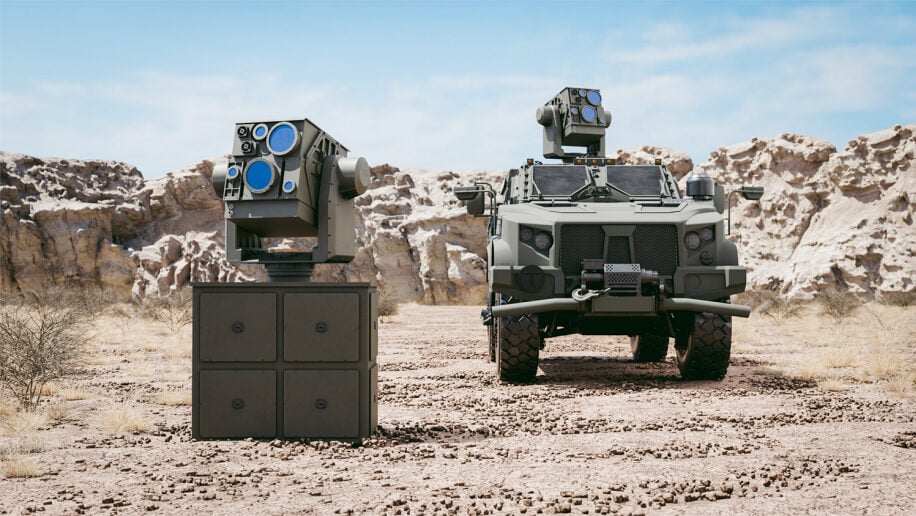
The LOCUST X3 can be integrated onto the Army’s Joint Light Tactical Vehicle and deployed in palletized, fixed, or semi-fixed configurations. It is also being evaluated for the Infantry Squad Vehicle. The compact design of LOCUST X3 supports C-17 transportability and ground mobility, allowing use across fixed bases, tactical sites, and maneuver forces.
Earlier, Garrity said the system could later be mounted onto heavier platforms like Strykers. Since the technology is “platform agnostic,” he said he anticipates the LOCUST X3 will someday be integrated into tanks, robots, ships, and other platforms.
The core of the LOCUST family of laser weapon systems is a laser directed-energy weapon housed in a turret equipped with integrated infrared and electro-optical cameras for tracking and target acquisition. Tertiary sensors provide additional cueing, including passive radio-frequency detectors and compact high-frequency radars.
LOCUST family of weapon systems executes a full kill chain: sensors first detect and cue incoming threats; electro-optic or infrared sensors then precisely cue the targets; AI acquires and tracks maneuvering targets even in cluttered environments; and the high-energy laser finally delivers focused energy to heat and disable critical components—plastics, electronics, or the airframe itself.
At the time of the unveiling of X3, Aaron Westman, senior director of business development at AV, said, “The earlier versions of LOCUST were developed and fielded, and we put them in the hands of soldiers. We got a lot of feedback from them on improvements that they’d like, different enhancements, and we took all that feedback, and X3 is the result of that.”
LOCUST originated in the US Army’s Palletized High-Energy Laser (P-HEL) program in the early 2020s. The first Palletized High-Energy Laser (P-HEL) system was delivered to the US Army in 2022 and quickly entered operational deployment overseas, where it has been known to engage real-world UAS threats with high availability.
This eventually laid the foundation for the Army Multi-Purpose High Energy Laser (AMP-HEL) prototyping program. In September 2025, AeroVironment delivered the first two prototype 20 kW-class LOCUST Laser Weapon Systems (LWS) to the US Army’s Rapid Capabilities and Critical Technologies Office. These initial systems were integrated onto the General Motors Defense Infantry Squad Vehicle (ISV) platform, the lightweight, air-transportable M1301 ISV 4×4 vehicle.
By December 2025, AeroVironment delivered two Joint Light Tactical Vehicle (JLTV)-mounted mobile C-UAS Laser Weapon Systems (LWS) to the US Army as part of the second increment of the Army Multi-Purpose High Energy Laser (AMP-HEL) prototyping effort.
In February 2026, the US Army was down for seven hours near El Paso International Airport after deploying a new advanced LOCUST laser counter-drone weapon system.
Later, in April 2026, the LOCUST laser weapon system (LWS) was tested aboard the Nimitz-class aircraft carrier USS George H.W. Bush, as the EurAsian Times previously reported. “During the live-fire event, LOCUST LWS effectively detected, tracked, engaged, and neutralized multiple unmanned aerial vehicles, marking a milestone toward fielding operational directed energy capabilities,” the US Navy had stated at the time.
The operational maturity of the LOCUST resulted from significant prior testing, including live-fire exercises at White Sands Missile Range, in collaboration with the Federal Aviation Administration and Joint Interagency Task Force 401.
These demonstrations have validated safe and effective performance in complex US airspace and essentially paved the way for the latest contract.
- Contact the author at sakshi.tiwari13 (at) outlook.com
- Follow EurAsian Times on Google News