US President Donald Trump’s unprecedented trade tariffs on Canada and the unilateral renaming of Lake Ontario, coupled with intimidation and mockery of Canadian leadership, have drawn severe criticism from the neighboring country and could jeopardize the F-35 deal.
Although the US and Canada have remained on a collision course since Donald Trump became President, tensions peaked last month when Washington imposed 50% tariffs on about $20 billion in Canadian goods on August 22 after trade talks collapsed. In response, Canada hit back with retaliatory tariffs on about $20 billion in annual US imports.
Subsequently, US President Donald Trump sparked another controversy by renaming Lake Ontario as Lake America.
Days later, tensions have continued to simmer, giving way to a war of words between the two sides. “A lot of people ask, who is the toughest one to deal with? Is it China? Vietnam? Actually, it’s Canada,” US President Donald Trump said this week.
Separately, Canadian Prime Minister Mark Carney–responding to US officials alleging that Canada walked away from the deal for political reasons– said, “I don’t think, with all respect, appointed, unelected cabinet members in the United States are experts on Canadian politics.”
He spoke from a dais labeled “Build Canadian.”
The tensions between the two North American allies began in January 2025, when Trump became President, slapped unprecedented tariffs on Ottawa, and repeatedly called it the 51st state of the United States. However, the latest flare-up and the tit-for-tat tariffs have sparked concerns about an all-out trade war.
Carney put the F-35 purchase under review in March 2025 amid increased tensions with Washington: the country is to receive the 16 F-35As already paid for, while it decides on the future of the remaining 72.
Shortly after this, it was offered the Gripen-E/F fighter from the Swedish manufacturer SAAB, along with provisions for local manufacturing.
The political sensitivity around the F-35 deal has increased significantly amid the latest trade tensions, sparking concerns that Ottawa may nip it in the bud.
Canada’s F-35 Quandary Set To Intensify?
In a recent media interaction, the head of the Defense Investment Agency said the Canadian public would not welcome sole-source military contracts awarded to American companies under the current conditions.
“That’s just me reading the room,” Stephen Fuhr, secretary of state for defense procurement, said in an interview. “I think that would be a very difficult thing to do, especially after this last week. I think that people would not be happy about that.”
Canada did not target the US defense industry in its retaliatory tariffs, but Fuhr’s remarks point to a growing reluctance to purchase American military equipment.
Although Fuhr still views the US as a vital defense ally, he emphasized that Canada has realized the dangers of “putting all our eggs in one basket” and said Ottawa must build new strategic partnerships or become more independent in military manufacturing.
Fuhr did not name any specific military project that could be affected by the ongoing trade tensions, but the F-35 deal hangs in the balance.
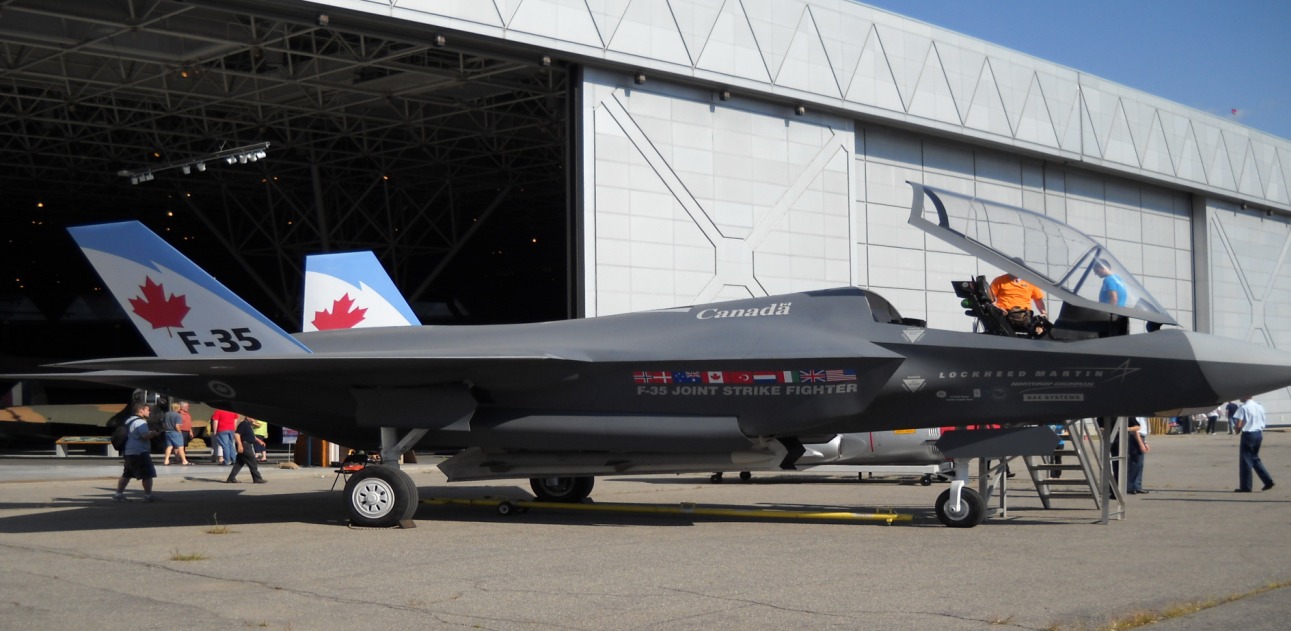
Moreover, both Canadian politicians and citizens—feeling betrayed by the US— believe that spending billions of dollars with a government that openly opposes its economy and is headed by a president who disregards its sovereignty makes little sense for Canada.
For example, British Columbia Premier David Eby has been open about his resistance to the country’s F-35 deal. “When your friend kicks you in the back, one of the first rules is you don’t then go and buy $12 billion of fighter jets from that person,” he said on August 25. “It makes absolutely no sense.”
Canadian citizens are also openly calling for abandoning the F-35 purchase and choosing the Saab Gripen instead.
Riley Donovan, a freelance journalist and self-styled Canadian nationalist, said: “Why would Canada buy planes from the country that is waging a trade war against us and which is arguably our greatest long-term military threat? Sweden promises to set up production here and give us 12,000+ jobs if we buy Gripen jets. Cancel the F-35s. Go with the Gripen.”
In addition to the attack on its sovereignty, Canadians are concerned that the US could weaponize its control over the F-35 platform in the event of a diplomatic standoff, fuelling sentiment in Canada to diversify its fighter procurement.
Saab, on its part, had earlier offered a package comprising 72 Gripen E/F fighters and 6 GlobalEye surveillance aircraft, along with local manufacturing, full technology transfer (ToT), source code access to mission systems, sovereign data control, and full independent upgrade and maintenance capability for the RCAF.
Eyeing a perfect opportunity to sway the wind in its favor amid current tensions, Saab has even intensified the appeal of its offer. It has told Canada it plans to use a network of about 250 suppliers across multiple provinces and about 10 prime partners to produce the fighter jets in Canada —from parts to finished aircraft, the Globe and Mail has reported.
Saab officials have stated that Canada will host the first assembly line outside Sweden if the order is big enough to warrant it. Additionally, they have extended an option to Canada to join Saab’s next-generation fighter jet program if Canada proceeds with the Gripen purchase.
Although the status of talks between the two sides is unknown, Saab appears hopeful. In Saab’s Gripen final-assembly hall in Linköping, flags of its eight customer nations hang above the line—plus a ninth white banner marked “RESERVED,” the report noted.
Canada Still Indecisive Over F-35
Despite the ongoing hullabaloo, Canadian Defense Minister David McGuinty pushed back against the suggestion that the government must forfeit the F-35 deal due to rising anti-US sentiment, according to reports in Canadian media. “Canada has a responsibility to obtain an appropriate fighter jet fleet for our own responsibilities, to acquit ourselves of our responsibilities domestically, continentally, and internationally,” McGuinty said. “And I would say to Canadians that we continue to examine this issue very carefully.”
He said the government’s review covers a wide range of factors, including potential industrial advantages for Canada, the aircraft’s compatibility with NATO and NORAD allies, and its integration with current radar and missile defense systems. “There are a whole series of factors that play into this massive and important decision,” McGuinty said.
Gen. Jennie Carignan, Canada’s chief of the defense staff, echoed the view, saying the review is continuing despite external pressures.
Notably, the Canadian Air Force—with its aging CF-18 fighter jets— is in dire need of modernization, and the F-35 is one of the most lethal fighters and the only stealth fighter available for purchase at the moment. Moreover, the top leadership of the Royal Canadian Air Force (RCAF) views the F-35 as the only credible counter to adversaries such as China and Russia, both of which field stealth fighters.
The pro-F-35 lobby in Canada frequently cites a 2021 evaluation conducted by Canada’s Department of National Defense, in which the F-35 received a 95% score for military capabilities and the Gripen-E received a 33% rating. Meanwhile, some analysts have expressed concern that the US could block the Gripen purchase because the aircraft is powered by American engines, should Canada choose the Gripen over the F-35.
The US has been arm-twisting Canada into going through with the F-35 deal. Earlier, Trump’s envoy to Canada warned there would be “significant consequences” for the continental defense alliance, NORAD (North American Air Defense), if Canada does not complete the purchase of 88 F-35As as initially planned.
For Canada, NORAD is extremely consequential for its national security, and Ottawa understands that if it decides to scuttle the deal, it could face blowback on a host of issues, including NORAD and intelligence sharing.
Several analysts have even thrown their weight behind a mixed fleet, urging Ottawa to purchase both the F-35 and the Gripen-E despite the many logistical hurdles and maintenance costs. In fact, a report in Canadian media earlier this year stated that the country could buy 72 F-35s and 72 Gripen-E/F jets, bringing its fighter-jet purchases beyond 88 and suggesting that Ottawa was unlikely to abandon the US stealth fighter.
However, a lot has changed since.
In July 2026, for instance, Canada was welcomed into the next-generation Global Combat Air Program (GCAP) as an observer, a move that could eventually pave the way for the aircraft’s purchase, as the EurAsian Times explained earlier.
While conducting recent trade talks, the US purportedly told Canada to complete its F-35 purchase, buy American radar planes as part of joining the Golden Dome missile defense project, and grant the US a right of first refusal on Canadian critical minerals.
With the talks now collapsed and the US going all guns blazing against Canada, the Carney government could shelve the F-35 purchase.
Previously, analysts reckoned that putting the F-35 under review was merely a “smokescreen,” adding that Carney was merely playing hardball with Washington amid trade tensions. However, with the two sides now progressing towards an all-out trade war, the conclusion of the deal appears to be more at risk than ever.
For now, it remains to be seen whether the pros of acquiring the F-35 will outweigh the anti-US sentiment.
- Contact the author at sakshi.tiwari13 (at) outlook.com
- Follow EurAsian Times on Google News