OP-ED by Dr. Imran Khurshid
The SCO remains a critical theater where geopolitical rivalry, regional cooperation, and competing ambitions intersect. For India, the Bishkek summit offered important diplomatic gains while highlighting the growing challenge of China’s influence and the need to prepare for Pakistan’s upcoming presidency.
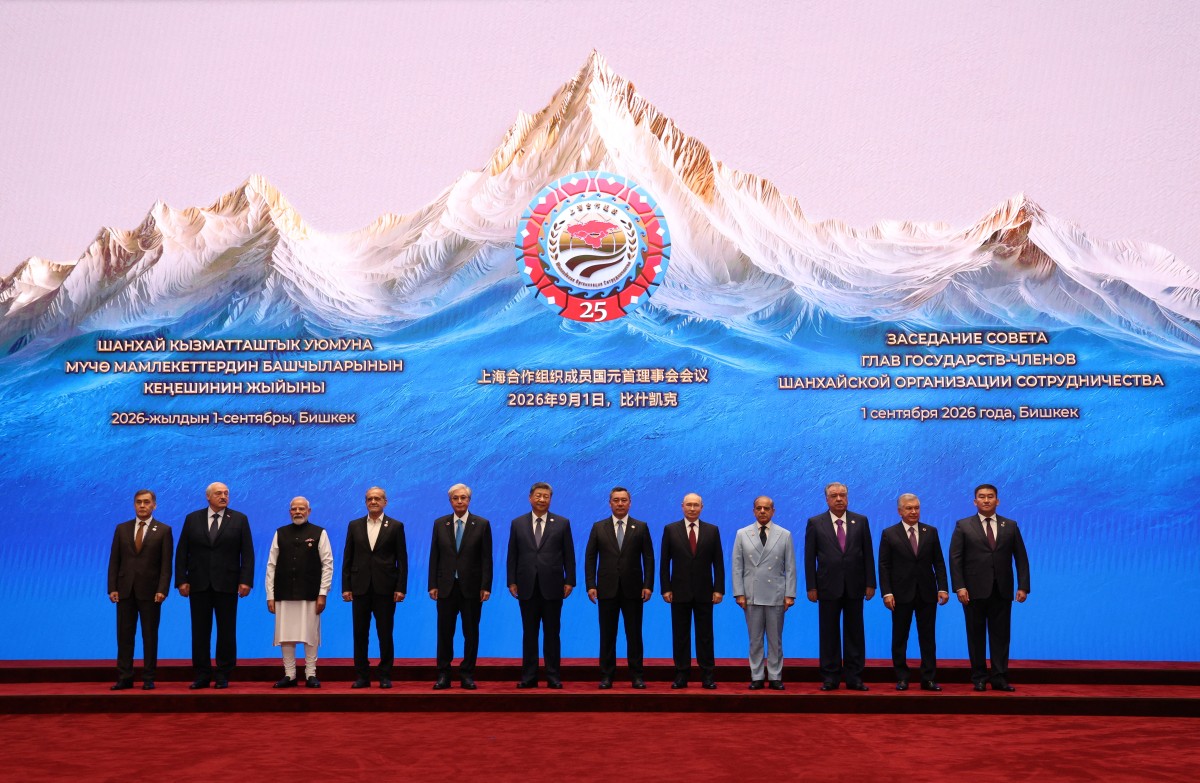
This year, the SCO summit took place in Bishkek, the capital of Kyrgyzstan, under the theme “25 Years of the SCO: Together for Sustainable Peace, Development and Prosperity.”
The theme reflected the summit’s focus and priorities and was also significant because 2026 marked the SCO’s 25th anniversary, formed in 2001.
The summit was also the 26th Meeting of the Council of Heads of State of the SCO and was chaired by Kyrgyz President Sadyr Japarov. It also marked the end of Kyrgyzstan’s 2025–26 chairmanship, with Pakistan taking over for the next year.
SCO Summit Amid Global Turbulence and Geopolitical Uncertainty
This summit came at an important time, amid considerable turbulence in the global geopolitical landscape.
The world is engulfed in different wars, from the Middle East to Europe, while tensions in many other regions remain high, with the possibility that new theatres of conflict could open up at any time.
Countries have been exposed to dependencies and vulnerabilities, with supply chains facing increasing challenges. Energy and food security have become increasingly important, and countries are now seeking greater resilience. They are focusing on reducing vulnerabilities and strengthening security.
Central Asia itself is at an important geopolitical crossroads. The Middle East crisis and the war in Ukraine are relatively close to the region, and Central Asian countries need to protect themselves from possible spillover and engulfment by these conflicts.
This was an important summit because it was attended by major global leaders such as Chinese President Xi Jinping, Russian President Vladimir Putin, and Indian Prime Minister Narendra Modi, among others.
It was also different because of the visible bonhomie and cordial atmosphere among the three leaders and the way they interacted with each other. Modi and Xi also interacted, shaking hands and speaking briefly during the summit. This was particularly significant given the recent reduction in tensions between India and China and the agreements recently reached between the two countries.
The Bishkek Declaration was adopted, which focused on the peaceful settlement of disputes. It also condemned the US attacks on Iran and, importantly, called for avoiding double standards on terrorism. India strongly put forward its position that there should be the complete elimination of the terrorism ecosystem, from recruitment to financing and everything in between. Besides, India did not endorse China’s BRI, as it considers it unsustainable, non-transparent, and believes that it compromises sovereignty and territorial integrity.
India also adopted strong language on terrorism. This is a big win for India. Before this summit, Prime Minister Narendra Modi visited Uzbekistan, an important Central Asian country, where several agreements were reached. One key development was Uzbekistan’s endorsement of India’s strong language on cross-border terrorism. Similarly, at the SCO summit, India once again pushed for strong language on terrorism.
China’s Strategic Ambitions in Central Asia
In the SCO, China has greater influence, reflected even in the organization’s name, which is based in Shanghai, a Chinese city. China’s predominance in this organization is substantial, allowing it to influence the agenda and other important aspects of the organization.
China is now also aggressively expanding its influence in the Central Asian countries. These countries were traditionally part of the Soviet Union and remained under Moscow’s sphere of influence for decades. However, China’s influence in the region has been expanding, especially after the war in Ukraine, which has left Russia facing increasing problems and retreating from many strategic areas because of a lack of resources and the pressure of the war.
This also relates to Xi Jinping and his ambition to make China a great power and achieve the objectives associated with the Chinese Dream. After Xi became the General Secretary of the Chinese Communist Party in 2012 and later became China’s president in 2013, China increasingly expanded its influence in Central Asian countries through various global initiatives, dual-use infrastructure projects, and, especially, the BRI.
The BRI is not simply an economic or infrastructure initiative. It is also a geostrategic project through which China seeks to shape the global strategic environment around its interests. It was also launched in Kazakhstan, a Central Asian country, in 2013, highlighting the importance China attaches to the region.
Beijing sees this region through the prism of great-power rivalry and understands Central Asia’s strategic significance. The region provides China with avenues for expanding its influence into other regions because of its geostrategic location. Central Asia has often been described as a geopolitical heartland, and controlling or influencing it can have implications for adjoining areas.
This shows China’s interests in the region and how it sees itself and its role there. Russia’s entrenchment in Ukraine has made it easier for China to expand into areas that were traditionally part of Russia’s strategic space. If the Russia-Ukraine war continues, China could eventually become the sole dominant power in the region.
India, Russia and the SCO
In this context, in 2017, and largely because of Russia’s support, India became a member of the SCO. Russia wanted to dilute China’s expanding influence in the SCO and in the Central Asian region, and India’s entry provided Moscow with an important strategic counterbalance. Similarly, China pushed for Pakistan’s entry into the organization to dilute India’s influence.
Importantly, India and Russia have common interests in Central Asian countries, including Afghanistan. Right now, the Russia-China relationship may appear to be a “no-limits partnership,” but this is largely because of Western pressure and sanctions, which have made Russia increasingly dependent on China. Deep inside, Russia and its intelligence agencies remain suspicious of China and are concerned about China’s expanding influence around Russia’s periphery, from the Arctic to Central Asia and along Russia’s borders.
In this context, India also becomes important for Russia as a counterweight to China. India can help dilute China’s overwhelming role around Russia’s old strategic periphery, which has become increasingly difficult for Moscow to manage because of the Ukraine war. If the existing war continues, Russia will gradually lose strategic space and could eventually reach a point of no return.
Sharif’s Summit Optics and the Search for Visibility
This summit also drew attention for the moments and optics surrounding the leaders. There were many interesting moments. Shehbaz Sharif appeared to make considerable efforts to get the attention of Russian President Vladimir Putin. After the official group photograph, when Putin began walking away from the podium, Sharif was seen quickly following him and appearing to stop him by holding his hand before starting a brief conversation, which became an awkward moment and was widely noticed.
Importantly, while most of the leaders wore black or dark suits, Shehbaz Sharif wore a white suit. He appeared to be trying to draw attention and project the image that Pakistan is a different and global peacemaker, particularly because Pakistan had recently tried to portray itself as having played a role in facilitating a ceasefire between Iran and the United States
However, the joint statement and the major leaders showed little appreciation for this role. On the contrary, Iranian President Masoud Pezeshkian, who met Prime Minister Modi on the sidelines of the summit, was seen interacting with Modi with smiles and warmth, which also generated considerable discussion in Pakistan.
Shehbaz Sharif also tried to attract attention through photographs. His office shared a cropped version of the SCO leaders’ group photograph in which several leaders, including Prime Minister Narendra Modi and Iranian President Masoud Pezeshkian, were removed, making Sharif appear prominently at the center alongside Chinese President Xi Jinping and Russian President Vladimir Putin.
The original photograph, however, showed Sharif standing fourth from the right. After the cropped photograph attracted criticism and controversy, Sharif subsequently shared the full, original photograph on his X account. Pakistan’s official social-media account was also reported to have cropped Modi out of a video showing the SCO leaders at the roundtable.
These moments, together with his attempts to engage Putin and his distinctive choice of attire, added to the perception that Sharif was consciously seeking visibility and attention at the summit.
These optics may seem minor, but they matter for understanding how Pakistan uses major international gatherings for diplomatic grandstanding and image-building. In many ways, this episode also explains an important feature of Pakistan’s foreign policy: a strong emphasis on optics, visibility, and diplomatic grandstanding rather than sustained and substantive diplomatic engagement
India’s Diplomatic Gains and the Changing SCO Dynamics
The SCO summit was good for India for several reasons. India put strong language on terrorism and pushed for language addressing the entire terrorism ecosystem, from financing to recruitment and radicalization. This is an important diplomatic success for India because New Delhi has consistently argued that terrorism must be eliminated in its entirety rather than being selectively condemned.
The summit was also important for India because Prime Minister Modi met Iranian President Masoud Pezeshkian. This sent a message that India-Iran ties remain steadfast despite the ongoing tensions between Iran and the United States.
Importantly, Pezeshkian also asked Modi to play a greater role in resolving the existing crisis between Iran and the United States. This shows Iran’s confidence in India’s diplomatic role and its ability to engage with different sides.
The summit was also different because Modi, Xi, and Putin appeared much more comfortable with each other. Modi and Xi, in particular, appeared more at ease than in previous years, especially after the 2020 Galwan crisis, which had engulfed India-China relations.
This improved atmosphere is also linked to recent agreements between India and China aimed at reducing tensions and stabilizing the relationship.
China has also recently removed or changed some of its senior military leadership. Importantly, General Zhao Zongqi, who headed the PLA’s Western Theatre Command during the Doklam standoff and the period of the 2020 Galwan crisis, was recently removed from China’s top political advisory body.
While the exact reasons for these changes remain unclear and could be related to China’s internal politics or other factors, they have nevertheless sent a message to India about possible changes within China’s military establishment.
Another important feature of this summit was its focus on development and the problems faced by member countries, rather than simply serving as a platform for anti-Western rhetoric. This matters because the SCO needs to remain relevant by addressing the practical challenges its members face, including terrorism, economic vulnerabilities, energy security, food security, connectivity, and regional instability.
The Next Challenge for India
Now, the next SCO summit will take place in Pakistan. Pakistan will do its best to promote and use the summit for its own grandstanding, as it tends to use such international platforms for optics and image-building. It may also try to use the forum against India and push its own narrative.
However, the SCO’s mechanisms, which are not supposed to let bilateral issues dominate the organization’s agenda, provide some limitations. Moreover, with Russia, China, and other countries present, Pakistan will not have complete freedom to use the organization for its own objectives.
Still, India needs to plan for this carefully.
New Delhi needs to anticipate how Pakistan could use the summit, what narrative it may push against India, and how it could use diplomatic optics to project itself. India therefore needs to prepare well in advance for the next SCO summit in Pakistan. It should ensure that the organization remains focused on its core priorities and does not become a platform for Pakistan to internationalize bilateral issues.
For India, the SCO remains both a challenge and an opportunity. China’s growing influence and Russia’s declining strategic space create challenges, but India’s growing engagement with Central Asia, its relationship with Russia, its ties with Iran, and its improving engagement with China also provide opportunities.
The Bishkek summit showed that the SCO remains an important platform at a time when the global geopolitical landscape is becoming increasingly uncertain. For India, the key will be to use this platform to strengthen its strategic interests while ensuring that terrorism, regional stability, connectivity, energy security, and resilience remain at the center of the agenda.
- Dr. Imran Khurshid is an Associate Research Fellow at the International Center for Peace Studies (ICPS), New Delhi. He specializes in India-US relations, Indo-Pacific studies, and South Asian security issues.
- VIEWS PERSONAL OF THE AUTHOR