The world’s first supersonic passenger airliner—the Soviet Tu-144—may have become history after a brief but troubled stint that ended in commercial failure. However, some Russian volunteers refuse to let it vanish into oblivion and are reportedly advancing efforts to restore the aircraft for static display.
At the height of the Cold War, the Tu-144 “Concordski” was seen as an answer to the Anglo-French supersonic aircraft, Concorde.
The Russian airliner beat the Concorde in the skies twice: first with its maiden flight on December 31, 1968, two months before Concorde, and second with its first supersonic flight in June 1969, about four months before Concorde.
To preserve this legacy, a group of Russian volunteers has spent years coaxing life back into a Tu-144 airframe on the shared grounds of the Gromov Flight Research Institute and Zhukovsky Airport.
Interestingly, though, these volunteers are neither engineers from Russia’s state design bureau nor museum-paid technicians, but enthusiasts with limited resources aiming to restore a retired Tupolev Tu-144D.
The aircraft in question is the Tu-144D registered CCCP-77115, parked on the shared grounds of the Gromov Flight Research Institute and Zhukovsky Airport outside Moscow. It served as a static exhibit at the MAKS air show for several years, but its fate remains unclear, as the air show has been suspended since 2021 due to the war in Ukraine.
Passionate volunteers have carried out extensive external and internal restoration work on the aircraft. One volunteer involved, Pavel Efter, has posted videos of the work on both airplanes on his YouTube channel, “Restorer144,” since 2023.
In the videos, volunteers can be seen turning on the electrical power supply and batteries, testing the fuel gauge, fuel pump, and fuel pressure indicator in the cockpit, checking the landing gear lights and inflating the tires, testing the cabin lighting, repairing the analog navigation system, examining the electrical schematics, cleaning the outside of the aircraft, inspecting the SSP-2A fire detection system and smoke sensors, raising and lowering the nose, testing the retractable canards, testing the APU’s bay doors beneath the aircraft, and actually installing the TA-6A Auxiliary Power Unit (APU).
In Instagram comments, Efter told enthusiasts and followers that the Tu-144D is being refurbished only for static exhibition and will not return to flight.
Notably, the TA-6A and other mechanical and electrical modifications to the Tu-144D (as seen in the video above) have recently been made, sparking rumors that the volunteers may be preparing the aircraft for another static exhibition at MAKS, probably in 2027.
Nonetheless, the volunteers have been working on restoring the aircraft for several months. In July 2026, media reports noted that the volunteers had already started the electrical system and connected a ground power source, adding that even the well-known nose-lowering mechanism had become operational.
Another Russian state-funded news website, Mir24, provided more details on the volunteers. “There is a problem with such glass fuses now. They aren’t used anywhere; you can’t always find them in old stock. We throw out a cry on the Internet: who has something, who can help with what,” Sergey Chechetkin told the publication at the time. Sergey is a former aviation engineer who devotes all his free time to the Tu-144.
The report also noted that volunteers have completely recreated the plane’s cabin. Volunteers collected the missing devices from across the country and began restoring the aircraft by tidying the service panels and lamps and installing the original chairs. Initially, the 77115 board wasn’t a passenger deck; it served as an experimental testbed. “We find it in different places. Old blocks are transmitted at the bases; you can find something here. Here we are installing the blocks on the mounts,” a volunteer named Alexey told Mir24.
The project carries no grand political statement. The volunteers do not frame their work as resistance or protest. Instead, they speak of history. “This is not just a museum exhibit, but a legend that we should be proud of. You can still learn a lot from it; many developments aren’t available on other planes yet. It is still ahead of its time,” said Alexey Amelushkin, an engineer at the training and methodological center of PJSC Tupolev, earlier.
Needless to say, returning this legendary airframe to flight is widely regarded as impractical, especially since Kolesov RD-36-51 engines are long out of production, spare parts are scarce, and certification requirements would be formidable.
Therefore, Efter and his colleagues are only restoring the aircraft’s ability to present itself: nose down in the classic pose, canards extended, cabin lights on, systems powered by its own APU.
First Into The Air, But Not The First To Succeed
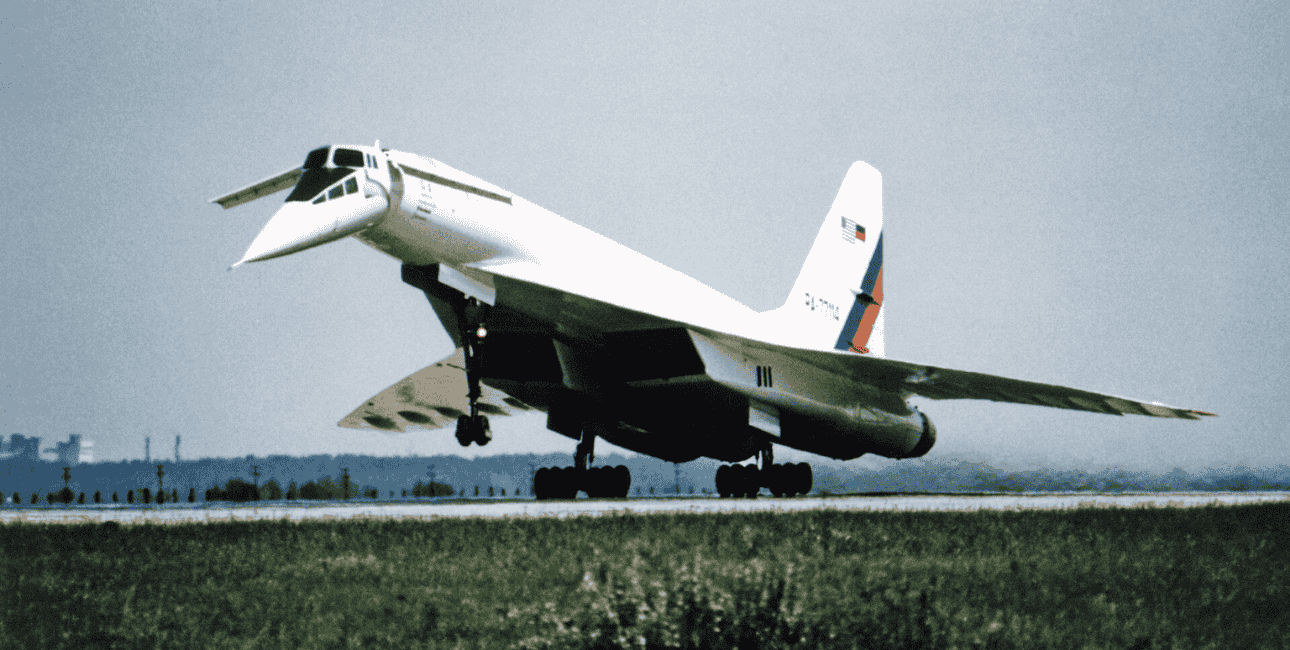
The Tupolev Tu-144 was the world’s first supersonic passenger airliner.
Designed by the Tupolev Design Bureau, the aircraft was rushed into development after the then-Soviet leader, Nikita Khrushchev, demanded a supersonic transport that would fly before its Western counterpart.
The prototype made its maiden flight on 31 December 1968 near Moscow, beating Concorde into the air by more than two months. Subsequently, the aircraft went supersonic for the first time in June 1969 and became the first commercial aircraft to reach Mach 2 in May 1970.
The Tu-144 was built to be larger and faster than Concorde, and featured a distinctive double-delta wing and a drooping nose for better landing visibility. Later models also added retractable canards to improve low-speed handling.
However, Western experts and officials claimed the Soviets stole the Concorde plans, which may have helped them build the Tupolev Tu-144 before the Concorde.
These claims reportedly stemmed (at least in part) from the uncanny design similarities between the world’s first two supersonic passenger aircraft.

Despite its early successes over the Concorde, the airplane faced technical issues.
For example, Tu-144’s early Kuznetsov NK-144 engines required constant afterburner use to sustain supersonic cruise, making it extremely noisy, fuel-thirsty, and shorter-range than Concorde, which could supercruise without afterburners. Moreover, reliability problems emerged during testing and maintenance, and the cabin was very noisy and vibrated a lot.
On June 3, 1973, during a demonstration flight at the Paris Air Show, a production Tu-144 broke apart in midair and crashed into the French village of Goussainville, killing all six crew members along with eight additional people on the ground.
Although the most widely accepted explanation is that the crew overstressed the airframe during fast maneuvers, the precise cause of this disaster remains uncertain.
The Tu-144 entered limited commercial service with Aeroflot in 1975, initially carrying mail and cargo on the Moscow–Almaty route, followed by passenger flights in Nov 1977.
However, the aircraft flew only about 55 passenger services before a second major incident. In May 1978, a fuel-line rupture and fire during a test flight claimed the lives of two crew members and formally ended passenger operations.
After this debacle, the aircraft continued brief cargo and experimental work even as its rival program—the Concorde—struggled with its own set of issues.
Both programs were eventually canceled because of poor safety records and concerns about economic viability. However, Concorde was far more successful than the Tu-144 and wasn’t discontinued until 2003.
The Soviet Union, for its part, built only 16 airframes before operations ceased in 1983. A few surviving examples later trained pilots for the Soviet Buran space shuttle, and one modified aircraft served as a flying laboratory in a joint NASA–Russian research program from 1996 to 1999, conducting its final flights in support of future supersonic transport studies, as earlier explained in detail by the EurAsian Times.
Though neither the Tu-144 nor the Concorde survived, both programs have inspired people worldwide to make supersonic commercial travel a reality. Earlier this year, United Aircraft Corporation (UAC) CEO Vadim Badekha confirmed that the Zhukovsky National Research Center is working on a supersonic airliner prototype. He said the effort had moved beyond paper studies into “hardware,” with UAC providing active support, and expressed confidence that the center would complete the work.
“Yes, such work is underway at the Zhukovsky Research Center, and we are actively assisting. The work is no longer confined to paper – it is already being carried out in hardware. A prototype of such an aircraft is under development, and we believe the Zhukovsky Research Center will successfully complete this work,” he told TASS.
Meanwhile, NASA is advancing work on the X-59, an experimental aircraft in the agency’s Quiet Supersonic Technology (Quesst) program that could go supersonic without generating a sonic boom or a loud, thunder-like sound when it exceeds the speed of sound. In addition, China is developing a supersonic passenger aircraft that could make its maiden flight by 2027. Last year, reports noted that the Chinese commercial aerospace company leading the project conducted the first test flight of a detonation ramjet engine.
As for the Tu-144, this aircraft is remembered as a bold but ultimately unsuccessful engineering achievement. It is, perhaps, for this reason that the volunteers outside the state machinery of Russia are doing everything they can to ensure that the supersonic airliner does not get lost in pages of history.
- Contact the author at sakshi.tiwari13 (at) outlook.com
- Follow EurAsian Times on Google News