After enduring nearly two years of Iranian-backed drone attacks in the Middle East, the US Navy is arming its aircraft carriers with laser weapons that can destroy hostile drones at a fraction of the cost of interceptor missiles.
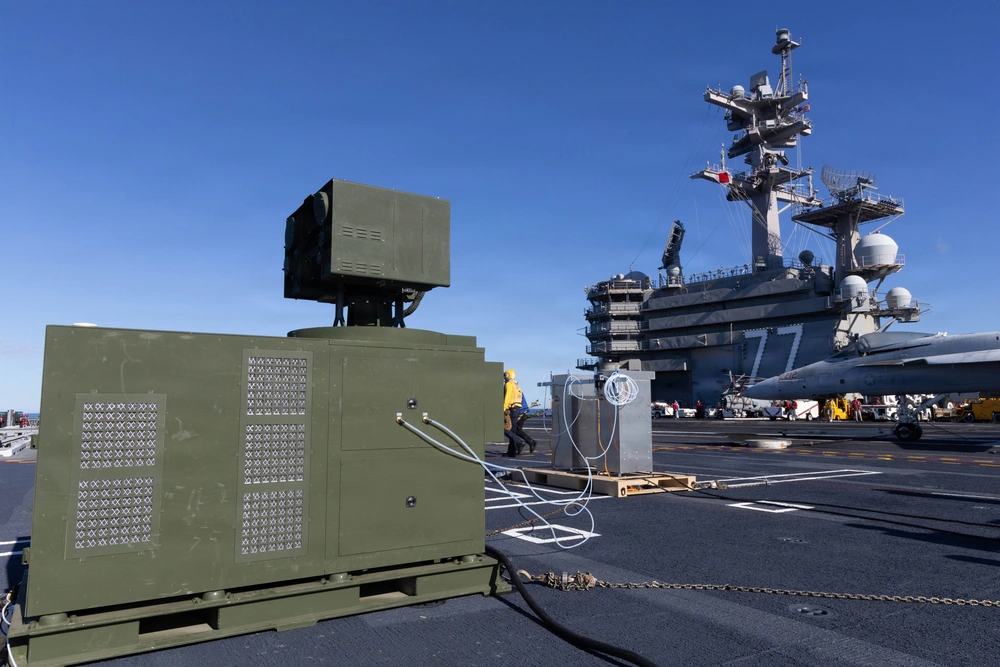
The US Navy tested the AeroVironment LOCUST laser weapon system (LWS) aboard the Nimitz-class aircraft carrier, USS George H.W. Bush. The USN released three photos of the LOCUST system aboard USS George H.W. Bush, which were reportedly taken on October 5, 2025, and published on April 20, 2026.
“During the live-fire event, LOCUST LWS effectively detected, tracked, engaged, and neutralized multiple unmanned aerial vehicles, marking a milestone toward fielding operational directed energy capabilities,” the USN stated.
The setting up of a containerized LOCUST LWS aboard USS George H.W. Bush comes amid an enhanced push by the US Navy’s top brass to arm warships with directed energy weapons, with a special emphasis on laser weapons. In February this year, the USN’s Chief of Naval Operations, Adm. Daryl Caudle, lamented the Navy’s past laser efforts for their limited scale and stated that the service had not sent a strong enough “demand signal” to industry and technologists to overcome integration challenges.
Emphasizing that he wants directed energy to be the first-line solution for any threat in line-of-sight of a ship, Caudle said, “This is my goal: If it’s in line of sight of a ship, the first solution that we’re using is directed energy,” adding that this would optimise ship loadouts by saving kinetic weapons for offensive use rather than defensive roles.
Currently, the USS Preble destroyer is the sole Navy ship equipped with the Integrated Optical-Dazzler and Surveillance (HELIOS) system, a high-intensity laser used in counter-drone operations. Additionally, the USS Dewey and the USS Stockdale are also armed with less potent Optical Dazzling Interdictor, Navy (ODIN) lasers.
The disclosure of LOCUST testing aboard USS George H.W. Bush comes as the US Navy has deployed different aircraft carriers to the Middle East since 2023 that have been forced to confront the threat from one-way attack drones deployed by Iran and its proxies, such as the Yemen-based Houthis, sometimes to specifically attack the carriers.
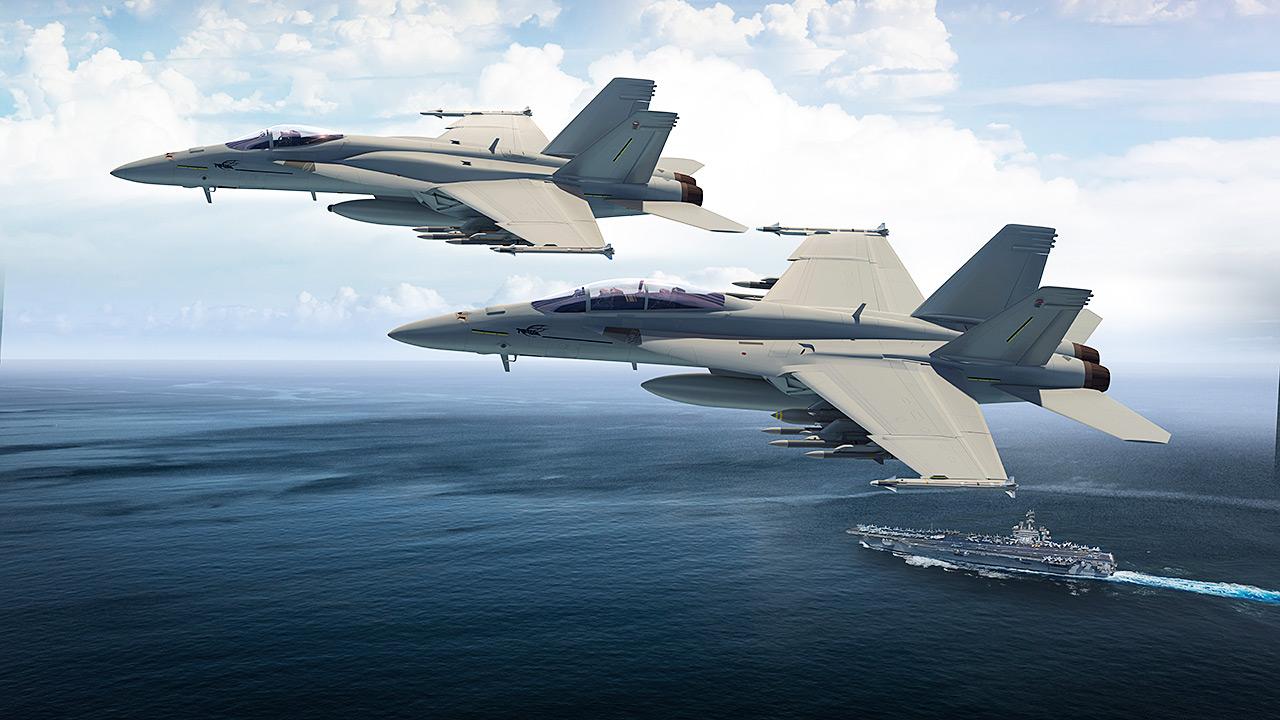
Notably, US aircraft carriers rely on fighter jets from their air wings, which typically use air-to-air weapons such as AIM-120 AMRAAM and Sidewinder missiles to neutralize drones, while the warships escorting the carrier typically employ weapons such as the SM-2 or SM-6 missiles, among others, to down incoming drones. Additionally, the carrier has its own armament, such as the Phalanx CIWS (Close-In Weapon System), which is effective only at close range and may struggle to track fast, erratic targets.
The use of these weapons to neutralize cheap, expendable drones creates a major price differential, since the service is burning through millions of dollars’ worth of interceptors to take down a drone that costs a few thousand dollars.
Typically, laser weapons could be highly effective for short-range air defense missions, countering unmanned aerial vehicles, helicopters, and low-flying aircraft, and intercepting incoming rockets, artillery, and mortars. Moreover, they are an economical and effective substitute for missile interceptors, which often take years to restock.
The renewed emphasis on arming warships, and now aircraft carriers, with laser weapons like LOCUST aligns with broader priorities for distributed lethality, counter-unmanned systems, and loadout optimization in high-threat environments, such as those in the Middle East, as well as in a potential conflict with China in the Indo-Pacific region.
What Do We Know About The LOCUST?
LOCUST (Laser-Oriented Counter-UAS System) is a family of 20 kW-class (and higher) high-energy laser (HEL) directed-energy weapon systems designed primarily as a counter-unmanned aircraft system (C-UAS) solution. The system reportedly provides a hard-kill capability against Group 1–3 UAS, which are small to medium drones, including threats like Iran’s Shahed or Russia’s Geran-type systems.
The LOCUST delivers precise, persistent point defense at the speed of light with extremely low per-shot costs, typically under $5.
The development of LOCUST traces back to the US Army’s Palletized High-Energy Laser (P-HEL) program in the early 2020s. The first Palletized High Energy Laser (P-HEL) system was delivered to the US Army in 2022 and quickly entered operational deployment overseas, where it is known to have engaged real-world UAS threats with high availability.
This paved the way for the Army Multi-Purpose High Energy Laser (AMP-HEL) prototyping effort. And, in September 2025, AeroVironment (AV) delivered the first two prototype 20kW-class LOCUST Laser Weapon Systems (LWS) to the US Army’s Rapid Capabilities and Critical Technologies Office (RCCTO). These initial systems were integrated onto the General Motors Defense Infantry Squad Vehicle (ISV) platform, the lightweight, air-transportable M1301 ISV 4×4 vehicle.
By December 2025, AeroVironment delivered two Joint Light Tactical Vehicle (JLTV)-mounted mobile C-UAS Laser Weapon Systems (LWS) to the US Army as part of the second increment of the Army Multi-Purpose High Energy Laser (AMP-HEL) prototyping effort.
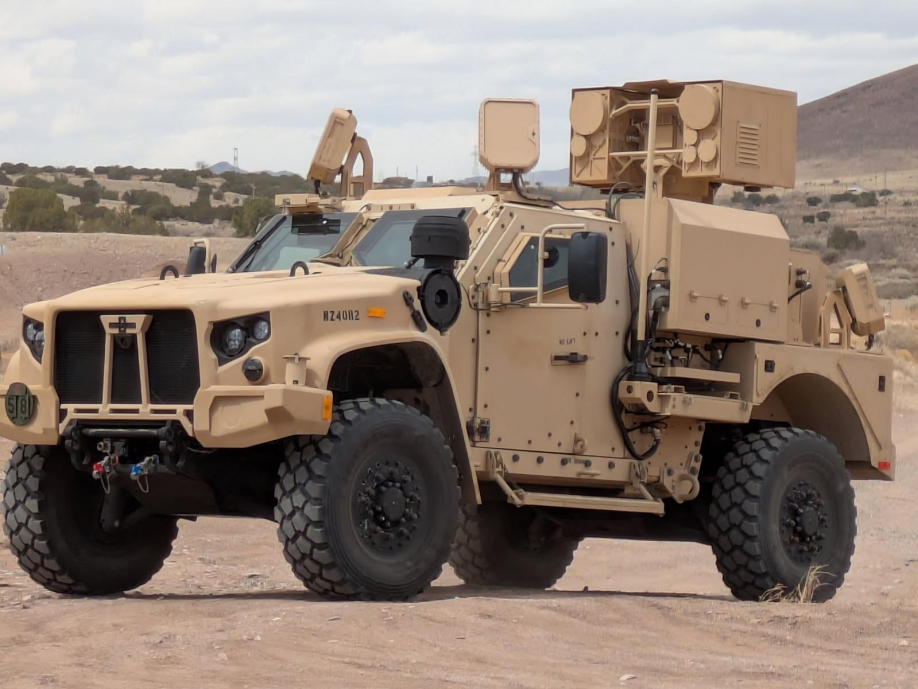
Notably, the main component of LOCUST is a laser-directed energy weapon in a turret with integrated infrared and electro-optical video cameras for tracking and target acquisition. Tertiary sensors, such as passive radio-frequency signal detection devices and small-form-factor high-frequency radars, can also cue the laser.
Radar cueing can detect threats at ranges of up to several miles, with effective laser performance typically in the “handful of miles” range for Group 1–3 UAS.
LOCUST follows a complete kill chain: sensors detect and cue threats; electro-optic or infrared sensors cue targets; AI locks on to maneuvering targets even in cluttered environments; and the high-energy laser delivers focused energy to heat and destroy components such as plastics, electronics, or the structure of the aerial object.
The LOCUST has been in the news recently. The Army shut off the airspace for seven hours near El Paso International Airport in February 2026 after deploying AeroVironment Inc.’s new advanced LOCUST laser counter-drone weapon system.
Last month, AeroVironment introduced the LOCUST X3, the most advanced version of its directed energy weapon. The X3 produces between 20 and 35 kilowatts, with a broader beam aperture for longer range, and was reportedly designed with high-volume threats like Iran’s Shahed-136 in mind.
LOCUST offers an “unlimited magazine”, which could be particularly useful when dealing with a high volume of threats in a contested environment.
The weapon system can engage a target at the speed of light, gaining the first strike advantage. Moreover, it provides accuracy with minimal collateral damage and has proven reliable in operational environments.
The LOCUST has additional advantages in terms of mobility and flexibility because it is a very compact system. The road-mobile systems could be easily deployed and redeployed to other locations in the face of evolving threats and airlifted by helicopters.
Meanwhile, the palletized configuration provides a variety of options for point-defense flexibility on land or at sea, as demonstrated by the aircraft carrier live-fire test.
Moreover, the LOCUST LWS has undergone combat testing abroad since at least 2022, demonstrating robust tracking capabilities under complex operational conditions.
The system has a few limitations, including a focus on a single target at a time, although AI enables quick switching. Additionally, it has potential for longer dwell times at lower power levels and environmental sensitivity.
Despite that, the LOCUST is considered a developed, production-ready tactical laser technology that could change the economics of short-range air defense in the face of drone proliferation, both on land and at sea.
- Contact the author at sakshi.tiwari13 (at) outlook.com
- Follow EurAsian Times on Google News