OPED by Imran Khurshid, PhD
China’s Global Times, a mouthpiece of the Chinese Communist Party, has once again published a propaganda editorial against India titled “India’s ‘Victory Narrative’ Will Only Hit a Wall on China-India Border.” The article was published on October 14, 2026.
One notable characteristic of Chinese commentaries and diplomats is that they use polite language in their statements but then, within the same text, suddenly shift to intimidating language and issue warnings.
They act like a “big brother,” offering suggestions, dictating terms, and adopting a dominant attitude toward other countries, which stems from their “Middle Kingdom syndrome”—a mindset rooted in a historical Sinocentric worldview that exhibits king-subject thinking and demands homage and subservience.
This pattern is also reflected in what is commonly described as “wolf warrior diplomacy,” in which Chinese diplomats adopt a more confrontational tone when their country’s interests or positions are challenged.
Similarly, Chinese diplomats may appear cool and calm at first, then abruptly use fierce language to assert dominance and make strong statements.
Beijing’s Revisionist Map Games
This article targets India because New Delhi has recently stepped up its “counter-cartography” policy, formally assigning standardized names to key locations along the India-China border.
This includes the Home Ministry’s October 2026 announcement standardizing 28 strategic features in Ladakh—specifically covering crucial Line of Actual Control (LAC) friction points like Gogra and Hot Springs, alongside peaks, passes, and glaciers.
It also follows India’s August 2026 mapping of 27 critical sites in Arunachal Pradesh, including historic flashpoints like Longju and Thag La. The Global Times article claims that by assigning these names, India “creates the self-delusion that its border claims have been settled.”
The text further asserts that “first comes an administrative announcement, followed by the names being entered on official maps, and then repeated amplification through the media.” It thus criticizes India’s approach; however, China does exactly the same through its own lawfare.
Beijing has repeatedly used map manipulation as a geopolitical tool to assert its claims—such as by releasing multiple rounds of standardized Mandarin names for locations in Arunachal Pradesh (which it calls Zangnan).
This is a typical Chinese way of doing things; China historically used these exact cartographic and administrative assertions before annexing Tibet in 1950, and it continues to use maps as an aggressive tool to project its territorial claims today.
It says that “India is playing games,” but this is exactly what China does in its dealings with India by failing to honor its agreements, including those reached in 1993 (Maintenance of Peace and Tranquility), 1996 (Confidence-Building Measures), and 2003/2005 (Political Parameters and Modalities).
If peace and tranquility have prevailed along the India-China border or LAC for an extended period, it is because India has unilaterally honored and abided by these agreements.
For instance, before 1962, China signed the Panchsheel Agreement (Five Principles of Peaceful Coexistence), under which Beijing promoted the narrative of mutual interests, mutual benefits, and peaceful relations through the slogan “Hindi-Chini Bhai-Bhai,” but then suddenly attacked India.
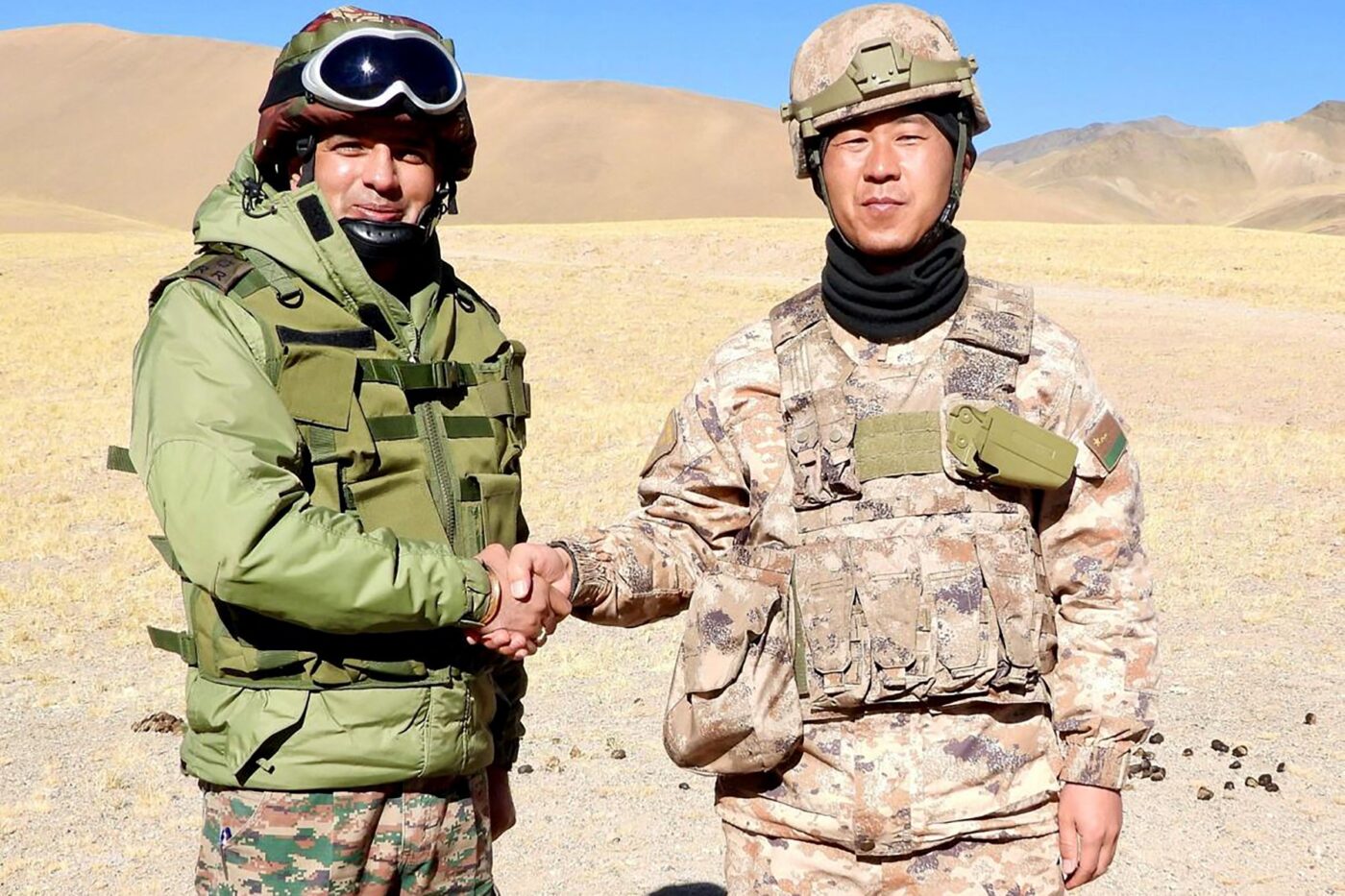
Similarly, in 2020, sensing India’s vulnerability when the country was battling one of its worst COVID-19 crises, China tried to grab more Indian land and attacked Indian soldiers in Galwan through deception, killing 20 Indian soldiers.
Cartographic Fraud
Then it says that, in 2019, “India unilaterally amended its domestic laws, revoked relevant constitutional provisions, and announced the creation of the so-called ‘Union Territory of Ladakh,’ deliberately incorporating Chinese territory in the western sector of the China-India border into its own administrative jurisdiction.”
However, when India revoked Article 370 of its Constitution and reorganized Jammu and Kashmir, it was an internal decision of India’s sovereignty, over which no foreign country has any say. India has historical claims to this region, and it has been an integral part of India for centuries.
China cannot dictate to India when it changes names, reorganizes its territories, or makes administrative changes. China has actually occupied Aksai Chin since the 1950s, consolidating its control during the 1962 war. It has also occupied the Shaksgam Valley, which it continues to hold illegally.
It then says the China-India border has historically belonged to China and that “China possesses sovereignty over the relevant areas, including the Aksai Chin region in Northwest China’s Xinjiang Uygur Autonomous Region, and has ample historical and legal grounds for its claims.” How can China claim historical ownership when it has no historical claim to these territories? This is a complete distortion of history.
In reality, China’s administrative footprint never historically extended south of the Kunlun Mountains, and its own official records contradict its claims.
For instance, the Postal Atlas of China—officially published by the Chinese government between 1917 and 1933—as well as the 1925 Peking University Atlas, explicitly marked the international boundary along the Kunlun range, placing the entire Aksai Chin plateau completely outside of China and within India.
Furthermore, India’s legitimate administrative and historical rights were formally established under the 1842 Treaty of Chushul, signed between the Dogra Kingdom of Jammu & Kashmir and Tibet/the Qing Empire, which solidified Ladakh’s traditional frontiers.
The 1865 Johnson Line precisely mapped this boundary, and the Maharaja of Kashmir even built a military fort at Shahidulla (Xaidulla) to safeguard trade routes.
China established a presence in Aksai Chin only in the 1950s by covertly building the Xinjiang-Tibet Highway (G219) across Indian territory while New Delhi focused on peaceful diplomacy, and it eventually occupied it by force during the 1962 war.
Using Multilateral Forums as Geopolitical Tools
It then says that when Prime Minister Narendra Modi met Xi Jinping, they discussed improving ties. It then gives a warning to India, a typical Chinese way of behaving: first bullying and then giving advice.
It says that “India should exercise greater restraint on border issues of this kind rather than provoke tensions.” It further says that “some Indian politicians are now keen to stage political shows over the border issue to divert attention from domestic problems and pander to nationalist sentiment.”
It thus links India’s renaming of places with an attempt to divert attention from domestic issues. However, this description fits China’s all-weather ally, Pakistan, which always seeks to externalize its internal threats toward its neighbors, particularly India and Afghanistan.
In stark contrast, India has robust political stability under a strong parliamentary mandate, a functioning electoral democracy, and the title of the world’s fastest-growing major economy, with resilient GDP growth of around 6.5% to 7% despite global slowdowns. It faces no major internal crisis that would force it to externalize its problems.
It then says that “China and India are important neighbors, major developing countries,” and that their relationship extends beyond bilateral ties to global forums, where they must cooperate through platforms such as BRICS and the United Nations to address global challenges and uphold international fairness and justice.
It says this as if India is the irritant preventing China from cooperating with it. However, China uses these forums to its advantage and sometimes directly against India. In these global forums, Beijing consistently blocks India’s rightful interests and actively seeks to constrain India’s rise.
For instance, at the UNSC, China repeatedly uses its veto to block India’s permanent seat and places technical holds to shield Pakistan-based terrorists from global sanctions. Furthermore, Beijing single-handedly blocks India’s entry into the Nuclear Suppliers Group (NSG) while using BRICS to push its own geoeconomic agendas that violate Indian sovereignty.
Then, in typical Chinese style, it concludes with another warning: “We urge India to act in the broader interests of bilateral relations, exercise prudence in both words and actions on the boundary issue, and follow the important understandings reached by the two countries’ leaders.”
Ultimately, this Global Times article stands as a textbook example of Chinese doublespeak and strategic hypocrisy. It attempts to lecture India on restraint and respect for agreements while China itself has a long, documented history of violating bilateral treaties, executing covert land-grabs, and aggressively weaponizing cartography against its neighbors.
By trying to portray India’s sovereign, internal administrative decisions as “political shows” or “provocations,” Beijing is merely projecting its own anxieties onto New Delhi. India’s robust economy, stable democracy, and firm counter-cartography policy prove that it will no longer remain passive in the face of China’s “salami-slicing” tactics and lawfare.
If China truly wants “peace and tranquility” on the border, it must shed its outdated Middle Kingdom syndrome, look at India as an equal, and stop using global forums and state media to launch malicious propaganda against Indian sovereignty,
- THIS IS AN OPINION ARTICLE. VIEWS PERSONAL OF THE AUTHOR
- Imran Khurshid is an Associate Research Fellow at the International Center for Peace Studies (ICPS), New Delhi. He specializes in India-US relations, Indo-Pacific studies, and South Asian security issues.
- Connect with the author at: khurshidimran (at) gmail.com