For some time, there has been lingering concern that China and Russia might be pulling ahead of the US in dedicated offensive space-warfare capabilities across both kinetic systems, such as direct-ascent anti-satellite missiles (DA-ASAT) and co-orbital interceptors, and non-kinetic tools, such as jamming, directed energy weapons, laser-dazzling, and cyber operations.
This is particularly concerning because space warfare is no longer a science-fiction concept but an increasingly realistic operational domain, already marked by electronic interference, close-proximity satellite maneuvers, mid-life orbital refueling of satellites, satellites with flexible robotic arms that can capture enemy satellites, and weapons designed to deny, degrade, or destroy satellites in a conflict.
This could be crucial, as military operations are increasingly dependent on satellites in orbit, as demonstrated by the wars in Ukraine and the Middle East. Everything from communication and navigation to missile and drone guidance, missile defense systems, and intelligence support depends on satellites in space.
Further, there were apprehensions that as China and Russia take a lead in this critical domain, the growth of US capabilities in space warfare is hampered by its own short-sighted, self-imposed moratorium on testing offensive anti-satellite weapons.
In 2022, then-US President Joe Biden’s administration announced a self-imposed moratorium on destructive direct-ascent ASAT weapons testing, even as China and Russia had been testing such kinetic anti-satellite weapons for the last decade-and-a-half.
Many believed that, despite the moratorium, the US had continued to advance its anti-satellite warfare capabilities clandestinely.
However, many in the U.S. strategic community have long argued that Washington should publicly demonstrate its anti-satellite capabilities to deter adversaries and dispel any illusion of a lead that could tempt them into a dangerous miscalculation.
The United States had also been practicing these maneuvers with allies, not only on its own.
According to Reuters, in a joint U.S.-British operation in September last year, U.S. space forces operating from a base in Colorado directed a U.S. military satellite to swoop close to a UK satellite, even as an advanced Chinese satellite, Shiyan 12-01, was nearby.
Close-Proximity Satellite Maneuvers: An Emerging Space Warfare Domain
In June, a secretive unmanned Chinese spaceplane, closely monitored by U.S. military analysts, released a small satellite into orbit hundreds of miles above Earth, into a region crowded with commercial and military satellites.
The object then looped around another Chinese satellite before returning towards the spaceplane, according to U.S. space-tracking firm LeoLabs.
Little is known about the secretive Chinese spaceplane, the satellite it released, or the mission objective. However, analysts believe that the mission could have been orbital refueling of a Chinese satellite to extend its orbital life, or to test close-proximity satellite maneuvers in space.
As of now, such close-proximity satellite maneuvers are non-offensive; during times of conflict, they could also be used to degrade or destroy enemy satellites.
However, China is not the only country to operate such a spaceplane.
The U.S. military operates a similarly secretive spaceplane resembling a small shuttle, also uncrewed.
These satellite-launching spaceplanes represent a rapidly evolving field of military space operations as both Beijing and Washington prepare for the possibility of a military conflict extending into the space domain.

Chinese researchers linked to the military are developing technologies ranging from satellites designed to pursue and even capture other spacecraft to systems that could extend fuel supplies while doing so, according to a Reuters review of patent-related documents, procurement notices and academic papers.
However, the US and the UK conducted their first joint military operation in space in the path of a suspected Chinese spy satellite, according to commercial space-tracking data.
“The Chinese are rapidly developing capabilities,” including ground- and space-based weapons designed to interfere with or destroy targets, U.S. Space Force’s Chief of Space Operations General Chance Saltzman said in July. The threat from China is “substantial,” added Saltzman, who is retiring.
Satellites are increasingly viewed by the military not only as platforms providing communication, navigation, surveillance, and intelligence support services, but also as potential weapons platforms in space.
In the joint U.S.-British operation last September, U.S. space forces operating from a base in Colorado directed a U.S. military satellite to swoop in close to a UK satellite as China’s Shiyan 12-01 satellite passed about 83 kilometers beneath them, according to space intelligence company Slingshot Aerospace. At that altitude, specialists consider the distance relatively close.
It was the first publicly announced UK–U.S. rendezvous and proximity operation. Washington had already disclosed similar allied maneuvers with France, so the significance was not that America had just learned to work with partners in orbit. It was that a Five Eyes partner’s satellite was the object of the inspection, and that a Chinese inspector-class satellite, Shiyan 12-01, was in the same neighborhood at the time.
The UK is not only a NATO member country, but also part of the ‘Five Eyes Alliance’ with the US.
Space experts with a military background say it appeared to be intended as a signal to Beijing.
Andrew Turner, a retired senior British air force officer who is now a space consultant, said it was “almost certainly a strategic signal to China” to demonstrate allied unity, capability and a warning to not interfere with the UK satellite.
While the US and the UK had announced the joint operation earlier, they did not disclose how close it was to the Chinese spacecraft.
U.S. Space Command said the mission demonstrated the ability to work with allies in space. Britain’s defense ministry said space is increasingly important to military operations and the UK and its partners were conducting advanced orbital operations to protect their national and military interests.
Meanwhile, Britain recently disclosed that the mission was conducted alongside a maritime deployment in the Indo-Pacific.
Notably, U.S. Space Command head General Stephen Whiting has repeatedly emphasized the importance of space to modern warfare.
For instance, last month, speaking at the annual Space & Missile Defense (SMD) Symposium in Huntsville, Alabama, Gen. Whiting explicitly called for new “integrated space fires” capabilities, including both non-kinetic and kinetic options, underlining the need for “credible, acknowledged” means of damaging and even destroying enemy space assets if a war breaks out in orbit.
“In space, there is no safe harbor. You can’t dig a trench or build a shield. Our satellites are consistently or predictably in an opponent’s weapons engagement zone. And we can build the most high-performing, exquisite satellites in human history, but if they depend on fragile, targetable supporting infrastructure, their performance will drop to zero on the first day of the next war,” he said.
Notably, Whiting has also highlighted China’s rising capabilities in this domain.
China has direct-ascent ASAT (Anti-Satellite) missiles, ground-based lasers, jammers, and maneuverable, dual-use satellites, he said.
“These developments intend to degrade our current space superiority and would potentially give China a maneuver and logistics advantage in space – something we would not accept on the land, at sea, or in the air,” Whiting said.
In 2007, China conducted its first direct ascent anti-satellite (DA-ASAT) missile test. A kinetic-kill vehicle launched on a ballistic missile destroyed an inactive Chinese weather satellite, FengYun-1C, at an altitude of about 530 miles (865 kilometers) in low Earth orbit.
China has also launched satellites with flexible robotic arms, capable of “dogfighting” or physically pulling other satellites out of orbit.
In March, a Chinese commercial company conducted an on-orbit demonstration of a flexible robotic arm, marking progress toward capabilities for satellite servicing, refueling, and debris removal.
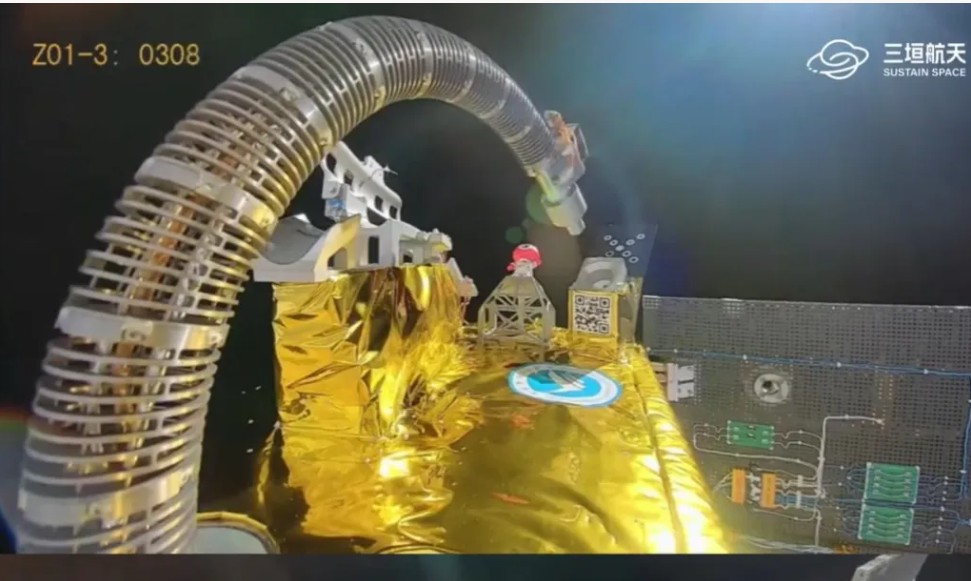
However, these satellites could also be used to attack enemy satellites or to physically push them out of orbit.
Similarly, Russia has tested Nudol (PL-19) DA-ASAT multiple times, including a successful destructive intercept of a LEO satellite in 2021. Russia has also deployed “nesting doll” designs that have shadowed high-value US satellites. Moscow is also investing in electronic weapons systems, ground-based lasers, directed-energy weapons, and cyber attack capabilities.
Last year, the Chief of U.S. Space Operations, Gen. Chance Saltzman, also warned that China is rapidly building out its arsenal of counterspace weapons.
“Aside from missiles, the PLA has fielded multiple ground-based laser weapons able to disrupt, degrade, or damage satellite sensors. By the mid-to-late 2020s, we expect them to deploy systems high enough in power that they can physically damage satellite structures,” he said.
These public demonstrations of anti-satellite warfare capabilities by Russia and China have created an impression that the US is trailing them in this critical domain.
Therefore, the joint demonstration by the United States and the United Kingdom—coordinating satellite-maneuvering operations in close proximity to a Chinese spy satellite—will send a message to Beijing that Washington possesses similar capabilities, and that any misadventure by Beijing or Moscow in space will be met with a coordinated response.
- Sumit Ahlawat has over a decade of experience in news media. He has worked with Press Trust of India, Times Now, Zee News, Economic Times, and Microsoft News. He holds a Master’s Degree in International Media and Modern History from the University of Sheffield, UK.
- He can be reached at ahlawat.sumit85 (at) gmail.com