Bulgarian Air Force scrambled its MiG-29 fighter jets to escort an Austrian Airlines flight that was diverted to Sofia, the Bulgarian capital, after a bomb threat.
The Austrian Airlines crew decided to land in Sofia after reportedly receiving a bomb threat near Romania, Bulgaria’s transport ministry said in a statement, adding that passengers were evacuated after landing.
Austrian Airlines Flight OS82 had 51 passengers and six crew members on board. It departed from Israel’s biggest and busiest airport, Ben Gurion.
The Austrian Airlines flight, cruising at around 38,000 feet near the Romanian border, declared a general emergency and reportedly transmitted squawk code 7700.
Bulgaria scrambled its aging but potent MiG-29 jets from the 3rd Air Base at Graf Ignatievo. The MiG-29s intercepted the airliner, identified it, and escorted it south to Sofia’s Vasil Levski Airport under pre-defined protocols.
Earlier, Air Force Commander Major General Nikolay Rusev said the F-16s will enter these roles once they are fully equipped and operational. Bulgarian pilots are already flying the Fighting Falcons for training, domestic exercises and intelligence-gathering missions, with the number of qualified pilots expected to reach 11 by the end of 2026.
Bulgarian officials say delivery of a second batch of eight F-16s, originally planned for 2027, has been delayed until 2030. Until the F-16s can fully take over, the Air Force continues to rely on its Soviet-era jets.
The F-16 Block 70 represents a major upgrade in sensors, weapons, and interoperability with NATO systems compared with the MiG-29. However, fully integrating a new fighter typically requires several years of pilot and ground-crew training and infrastructure readiness, which is why Bulgaria keeps the MiG-29s on the front line of its air-policing missions.
Air Force Commander Gen. Nikolay Rusev has said the MiGs will fly until their remaining service life ends around 2030 or until a second F-16 squadron fully replaces them.
For now, maintenance relies heavily on support from neighboring Poland, mainly for spare parts and engines.
This was not the first scramble by MiG-29s. Earlier, on June 30, a Bulgarian MiG-29 dashed after an Airbus A320, a LOT Polish Airlines flight from Warsaw to Tel Aviv, after the airliner signaled unlawful interference.
The airliner entered Bulgarian airspace over the Danube, and the MiG-29 intercepted it within minutes. The Bulgarian pilot identified the aircraft and escorted it south through Bulgarian airspace.
At the Turkish border, two Turkish Air Force F-16s took over the escort. The incident was later attributed to a technical fault in the aircraft’s transponder that sent a false 7500 signal. The plane eventually returned and landed safely at Burgas after a second MiG-29 scramble.
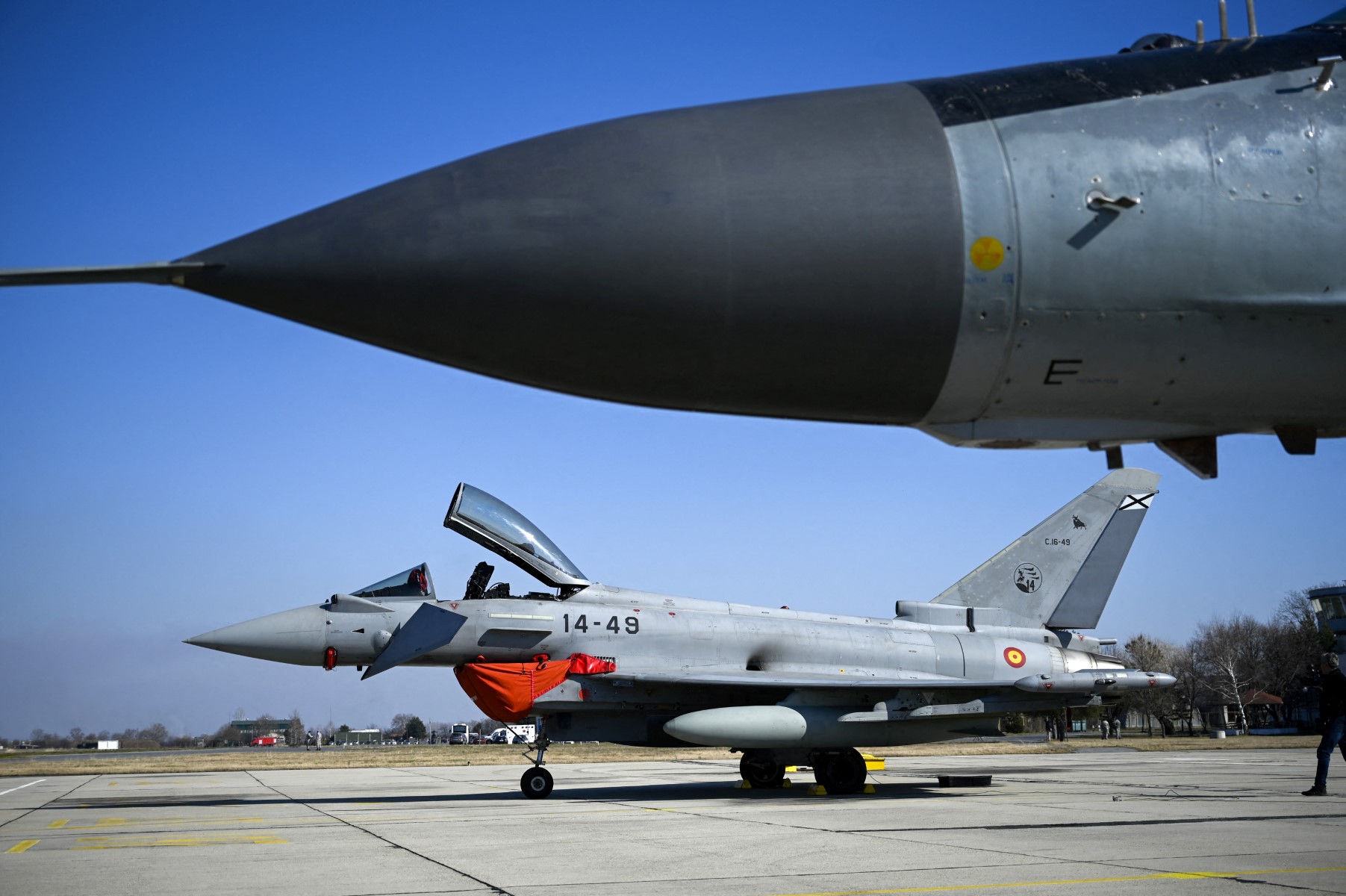
The MiG-29 jets remain Bulgaria’s key aircraft for Quick Reaction Alerts, despite being unpopular with some citizens because of their Soviet origins.
Maj. Gen. Nikolay Rusev made an interesting post in June 2026 on MiG-29 and F-16 and said: “Dear friends, followers, random passers-by and ordinary haters, I constantly try, sometimes successfully, sometimes not, to explain that we, the people with blue epaulets, are not divided into philists and phobes!
We do not belong to parties and NGOs, and we are not interested in the momentary stumbles and hesitant movements of mentally unstable individuals!
Be they various politicians or ‘understanders’… In short – we are not slaves to ideologies!
MiG-29 or F-16?! Both, grandpa, both!
They are Bulgarian and paid for with public money!
Our job is to keep them serviceable and use them until the end of their service life, as all other European countries do!
The MiG-29 will fly as much as necessary, and the F-16 will be on duty when it is ready. It has long been clear to all of us why there is this hatred and malice only towards the MiG-29 and no other older but still reliable equipment, right?! But we survived that too.”
Mikoyan MiG-29
The MiG-29 is a twin-engine fighter aircraft designed in the 1970s as an air superiority fighter. Developed alongside the larger Sukhoi Su-27, it was primarily designed to counter two US fighter jets: the F-15 Eagle and F-16 Fighting Falcon.
The MiG-29 entered service with the Soviet Air Forces in 1983, and Bulgaria began receiving deliveries in 1989. The aircraft was designed with positive but near-neutral longitudinal stability, allowing good maneuverability. The aircraft also had a high thrust-to-weight ratio, allowing high sustained turn rates.
Later variants had improved engines, glass cockpits with HOTAS-compatible flight controls, modern radar, and infrared search and track (IRST) sensors, and increased internal fuel capacity. They were equipped for aerial refueling.
The Russian Aerospace Forces wanted to upgrade its existing fleet to the modernized MiG-29SMT configuration, but financial difficulties after the Soviet Union’s dissolution slowed the process. Today, nearly 728 MiG-29 variants remain active in many air forces, making it the 6th most common active fighter jet.
Its powerful engine gave it great acceleration, and its swept wings made it difficult to catch in a chase. Later, the Soviets began developing the “Advanced Lightweight Tactical Fighter” MiG-29 to compete with the F-16.
The MiG-29 kept getting radar, avionics, and weapons upgrades. In the 1980s, the MiG-29S could carry the longer-range R-27E air-to-air missiles. It received a dorsal ‘hump’ on the upper fuselage to house a jamming system and additional fuel capacity. The weapons load was increased to 4,000 kg with airframe strengthening.
The baseline MiG-29 radar was the Phazotron N019 Sapfir S-29 look-down/shoot-down coherent pulse-Doppler radar. Later, the improved Sapfir-23ML was introduced, coupled with a new digital computer. The upgraded MiG-29M offers the N010 Zhuk-M, which has a planar array antenna rather than a dish and better processing.
The carrier-based MiG-29K was never produced in large numbers. The Indian Navy operated it only on INS Vikramaditya, and the Russian Navy on the Admiral Kuznetsov-class aircraft carriers.
The MiG-29 has two widely spaced Klimov RD-33 turbofan engines, producing up to 81.3 kN of thrust. Powerful, they were fuel guzzlers and left a thick smoke trail. The MiG-29 engine intakes were complex, with auxiliary intakes operating during takeoff, landing, and low-altitude flight to prevent ingestion of ground debris.
The MiG-29’s internal fuel capacity was rather low, limiting its range and endurance. Major modifications were needed to increase this in later models and the MiG-35. It also added an in-flight refueling probe.
Bulgaria’s new F-16 is way superior to the older MiG-29s.
While the MiG-29 is a high-agility dogfighter designed to counter the F-16, the Block 70 is a modernized version with an AESA radar, advanced electronic warfare suite, a glass cockpit, and full NATO-standard data links.
It carries cutting-edge BVR missiles like the AIM-120 AMRAAM, AIM-120C-7, and the latest AIM-120C-8 variant, and offers much greater range and endurance than Bulgaria’s older MiG-29A/UB jets.
In close-range dogfights, the MiG-29 remains competitive, but the F-16 Block 70 is far more capable for modern air-policing missions, air-defense missions, and BVR (beyond visual range) conflicts.
For now, Bulgaria’s F-16s are not ready for Air Policing and Quick Reaction Alert missions. Until then, the older MiG-29s continue to defend the country’s borders and play a vital role in NATO duties.
Mail us at: editor (at) eurasiantimes.com