

Ukraine’s military intelligence agency (HUR) claims that a Russian Sukhoi Su-57 fifth-generation fighter jet was damaged by an engine fire at Akhtubinsk airfield in Russia’s Astrakhan Oblast on Oct. 29.
HUR suggested the fire may have resulted from deteriorating jet fuel quality linked to Ukrainian long-range drone strikes on Russian oil refineries, according to a Nov. 2 social media statement.
It noted that the Sukhoi aircraft is equipped with an AL-41F1 turbofan engine, also known as “Product 117,” and said poor-quality fuel could have caused catastrophic engine failure.
“On 29 October 2026, on the territory of the Russian military airfield ‘Akhtubinsk,’ the newest multi-role fighter of the aggressor state, the Su-57, exploded — this happened during engine startup. The cost of the combat aircraft is estimated at about $150 million.”
“The Su-57 is equipped with an aviation turbofan dual-circuit engine AL-41F1 (Product 117). One of the reasons why engines of this type can explode or suffer catastrophic failure is fuel of inadequate quality.”
Earlier in August, HUR said that Russia was becoming increasingly dependent on aviation fuel imports as Ukrainian strikes disrupted domestic jet fuel production. The agency has also described Russian efforts to import fuel by sea, including from India’s Vadinar refinery operated by Nayara Energy.
Russian state-controlled oil company Rosneft holds a 49.13% stake in Nayara Energy while Kesani Enterprises and related investors, including Russia’s United Capital Partners, hold another 49.13%. The EU described the Vadinar plant as the “biggest Rosneft refinery in India.”
Other Su-57 Losses
In June 2024, Ukrainian drones struck Akhtubinsk airfield in Russia’s Astrakhan Oblast, approximately 600 km from the front line.
HUR claimed: “On June 8, 2024, a Su-57 multi-purpose fighter of the aggressor state was hit on the territory of the Akhtubinsk airfield in the Astrakhan region of the Russian Federation, located 589 kilometers from the line of combat.
The pictures show that on the seventh of June the Su-57 was standing intact, and on the eighth, there were ruptures from the explosion and characteristic spots of the fire caused by the fire damage near it.”
HUR published before-and-after satellite images showing blast craters and burn marks next to a parked Su-57. The agency called it the first known strike on a Su-57. HUR spokesperson Andriy Yusov later clarified the damage: “We can now say that one Su-57 suffered significant damage, and the other one suffered lighter damage and may be possible to restore.”
A Russian military-linked Telegram channel, Fighterbomber, known for its close association with the Russian Aerospace Forces, acknowledged the attack: “Yes, yesterday the airfield in Akhtubinsk was attacked by a UAV. Three pieces arrived. The Su-57 was damaged by shrapnel; it is now being determined whether it can be restored. If not, then this will be the first loss of the Su-57 in history.”
Fighterbomber called it the first possible loss of Su-57 aircraft in history.
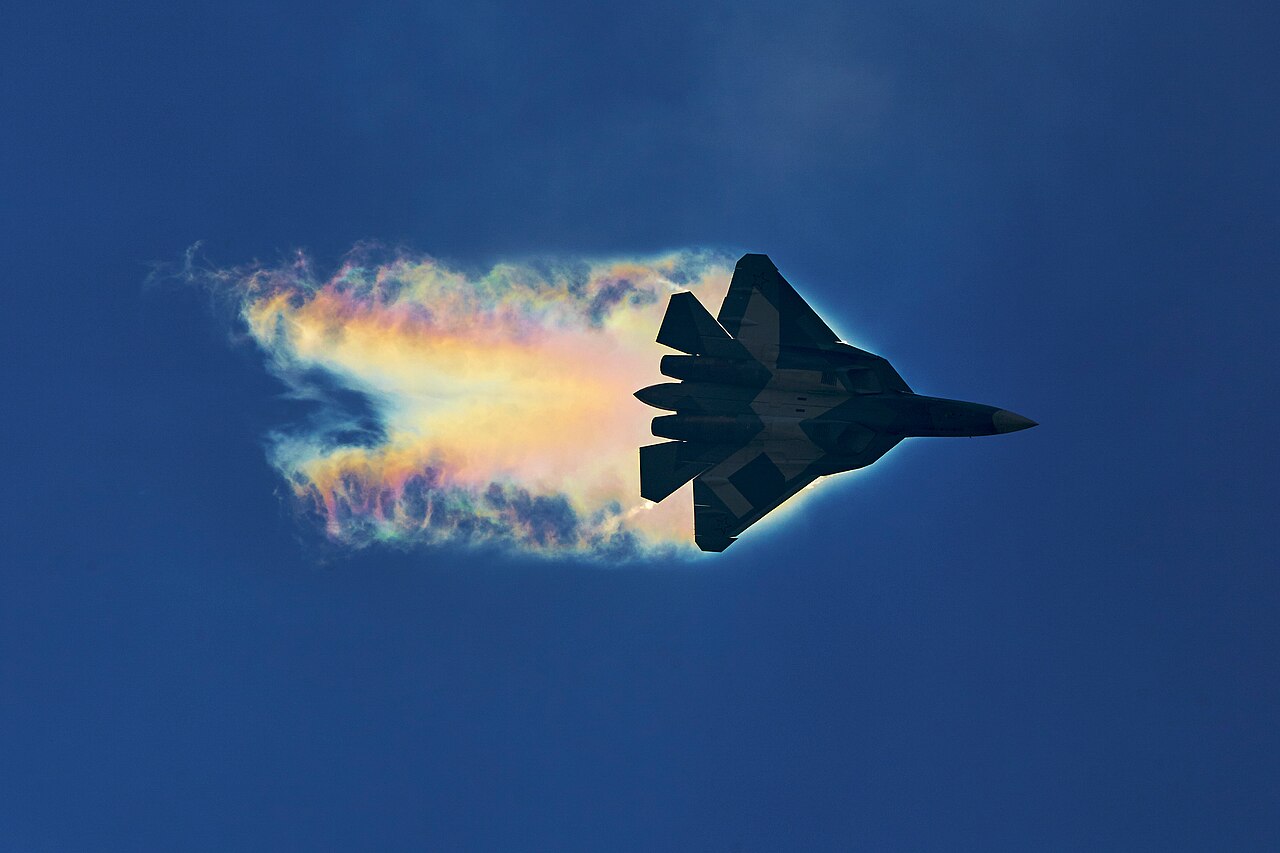
In April 2026, Ukrainian drones struck Su-57 jets at Shagol airfield in Russia’s Chelyabinsk region, according to Ukraine’s General Staff and the commander of Ukraine’s Unmanned Systems Forces. Ukrainian officials claimed several Su-57s and Su-34s were hit.
The Unmanned Systems Forces (USF), a unit of the Ukrainian Armed Forces, took responsibility for the attack in a post on X, accompanied by a video comprising satellite imagery as visual evidence, as seen below.
“Hunting for Su-34 multi-role fighter-bombers and Su-57 fifth-generation fighter jets is of critical importance for reducing the enemy’s strike potential. The Su-34, as the main strike platform, is capable of carrying a wide range of guided bombs and missiles, delivering strikes on critical infrastructure, military facilities, and civilian targets at a distance of up to 1,000 km.
Every destroyed Su-34 means fewer airstrikes, saved civilian lives, and a reduced burden on air defense systems. The Su-57, as the most modern russian fighter jet with low-observable technologies, poses a special threat to aviation and air defense systems,” —Commander of the USF Robert “Magyar” Brovdi said.
The Russian Defense Ministry reported that Ukrainian drones attacked the Chelyabinsk region on April 25. The regional governor, Alexei Texler, said drones had tried to hit “one of the infrastructure facilities” and stated there were no casualties or damage. Neither confirmed any aircraft losses.
Then on July 23 this year, a Su-57 crashed in the Moscow region during a training flight. The pilot ejected safely and survived.
“On July 23rd of this year, a training and combat aircraft crashed in the Moscow Region during takeoff. The pilot ejected safely, and his life is not in danger. The aircraft crashed in a deserted area, and there is no damage on the ground,” the Russian Ministry of Defense (RuMoD) said in a statement.
Even though Russian officials did not name the aircraft, an unidentified source told Kommersant media that “a Su-57 fighter crashed in the Odintsovo city district. The pilot managed to eject, and there were no casualties.
Russian aviation experts quickly geolocated the exact crash site. An independent Russian channel, Astra, determined the site lay roughly 6 to 7 kilometers from Zvenigorod, near the villages of Lutsino and Shikhovo.
The loss of Su-57 was unofficially confirmed.
In the latest incident, the Russian Defense Ministry and other channels have not yet commented on the possible loss of a Su-57, that too, due to poor-quality fuel.