For the first time, the South Korean KF-21 Boramae jet flew in formation with American aircraft, showcasing greater interoperability between Seoul’s most advanced indigenous fighter and the platforms of its closest ally.
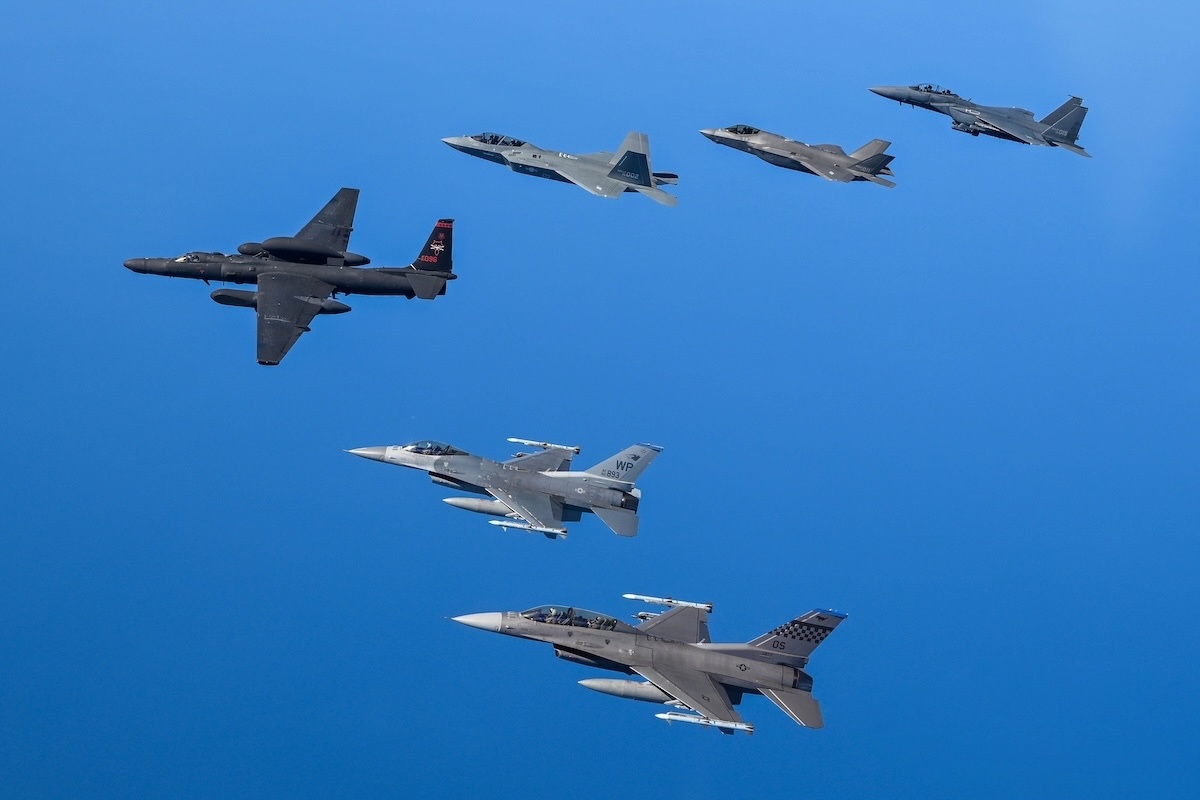
The KF-21 Boramae fighter conducted its first formation flight with US aircraft on October 23, 2026, over the Yellow Sea. The flight came ahead of the US-South Korea biannual combined air drills—Freedom Flag—which began on October 26, 2026, to enhance joint aerial interoperability.
The KF-21, assigned to the 156th Fighter Squadron of the 16th Fighter Wing, flew alongside a US U-2S Dragon Lady high-altitude reconnaissance aircraft, F-35 Lightning II stealth fighters, and the F-16 Fighting Falcons. Meanwhile, the Republic of Korea Air Force (RoKAF) package reportedly included the F-35s, F-15Ks, and FA-50s, in addition to the KF-21.
Notably, the KF-21 was not a formal participant in the drills, but took part in the formation as an observational activity.
South Korean officials said the “Friendship Flight” gave the new fighter a chance to gain experience ahead of the joint drills.
Meanwhile, the US Seventh Air Force said, “The Friendship Flight demonstrated the combined interoperability and combat readiness of the US Air Force [and Korean Air Forces] on the Korean Peninsula, showcasing how the air forces of both nations integrate directly during flying operations.”
The formation flight between the KF-21 and US fighters is particularly significant because Washington declined to transfer some crucial technologies needed to develop the Boramae more than a decade earlier.
The KF-21’s origins date back to 2001, when former South Korean President Kim Dae-jung proposed developing an indigenous combat jet. In 2015, as South Korea advanced the program, the US declined to transfer four critical technologies that Seoul had sought as part of an offset arrangement tied to its purchase of F-35A.
The list of things restricted by Washington purportedly included an active electronically scanned array (AESA) radar, an infrared search-and-track (IRST) system, an electro-optical targeting pod, and a radio-frequency jammer—which together form the core of a fighter’s sensing, targeting, and self-protection capabilities.
South Korea says it secured about 87% of the technologies needed for the KF-21, while also obtaining some additional technology from the United States.
The US refusal stemmed from export-control policy intended to protect sensitive technologies, not to disrupt Seoul’s fighter program.
However, it compelled South Korea to develop them independently.
Hanwha Systems led development of the AESA radar, while domestic firms also produced the IRST, electro-optical targeting pod, and electronic-warfare suite. This pushed the fighter’s indigenous content up by several notches, although the KF-21 is powered by twin General Electric F414 engines, meaning it still depends on the US.
Interestingly, the denial worked quite well for South Korea. Since the key mission systems are now Korean-owned, Seoul can modify, upgrade, and clear them for export customers without needing further US government approval on those components.
“The US refusal to release the KF-21’s technologies have become the aircraft’s strongest selling point. With those systems now being Korean, Seoul can modify, upgrade and clear the KF-21’s mission systems for foreign buyers without seeking another government’s approval,” GlobalData aerospace and defense analyst Udayini Aakunoor stated as GlobalData published ‘The Global Military Fixed Wing Aircraft Market 2026-2036’ report last month.
The latest formation flight is also noteworthy because the South Korean KF-21 has catapulted Seoul into the small club of countries that can build an advanced fighter jet indigenously.
The KF-21 is classified as a 4.5-generation aircraft, but KAI has consistently maintained that it is far ahead of other 4.5th-generation jets in terms of capability and just a little short of being classified as a 5th-generation aircraft.
“They say the KF-21 is a 4.5-generation fighter, but I think that’s an underestimation. Compared to the 4.5-generation French Rafale and the European Eurofighter Typhoon, its performance is superior. So, I call it a 4.9-generation fighter, which is closer to the 5th generation (a fighter with full stealth capabilities),” the KAI chief, Kang Goo-Young, a retired Republic of Korea Air Force (RoKAF) pilot, earlier said.
Moreover, the Asian defense giant plans to upgrade the KF-21 through a phased “block” development model, culminating in Block III (also referred to as KF-21EX), which will incorporate true fifth-generation stealth capabilities. Therefore, inducting the KF-21 into the RoKAF begins to narrow the capability gap with the most advanced US platforms while preserving interoperability with the United States military.
The KF-21 is expected to become a centerpiece of South Korea’s defense industry ambitions. For instance, President Lee Jae-myung earlier emphasized promoting Korea as “a contributor to world peace and development,” adding that the country “will share not only our world-class weapons systems but also our technology and development experience with partner countries.”
Whether the KF-21 can emerge as a more affordable and less restricted alternative to the F-35—which the RoKAF also operates—in the export market remains to be seen.
KF-21 Moves Fast
The latest flight formation comes weeks after the KF-21 conducted its maiden flight as part of an official ceremony marking its delivery to the RoKAF in late September, as the EurAsian Times reported.
At the time, the manufacturer, Korean Aerospace Industries (KAI), said it planned to first manufacture 40 KF-21s focused on air-to-air capabilities for delivery by 2028, followed by production of 80 jets equipped with long-range air-to-ground missiles by 2032.
Designed by KAI to bridge the gap between fourth- and fifth-generation fighters and offer advanced capabilities at a lower cost, the KF-21 is a twin-seat, 4.5-generation combat aircraft. The program launched as a South Korea-Indonesia partnership, with Jakarta holding a 20% stake, but that stake was later significantly reduced because of Jakarta’s financial constraints.
Developed as an advanced supersonic fighter, the KF-21 is expected to replace the RoKAF’s aging F-4 and F-5 jet fleet and eventually the F-16s.
It has a top speed of Mach 1.81, a range of 2,900 kilometers, and a payload of 7,700 kilograms spread across ten external hardpoints. With its stealthy airframe and built-in AESA radar, infrared search and track (IRST), and electronic warfare equipment, it outperforms the F-16 in both airframe life (34% longer) and range (50%).
The KF-21 has both single-seat and two-seat variants. The primary configuration is the single-seat version, designed for multirole operations such as air superiority and ground attack, while the two-seat variant is intended for training.
Compared with other fifth-generation programs worldwide, the KF-21 has maintained an unparalleled pace from first flight to the rollout of the first series-produced aircraft, as the EurAsian Times earlier explained in detail.
KAI rolled out the first production KF-21 aircraft on March 25, 2026. The aircraft was presented at a production facility at Sacheon, with President Lee Jae-myung in attendance. Notably, the aircraft apparently rolled out in less than 5 years after its first flight in 2022—very fast compared to American and Russian fighters.
The KF-21 still has years of operational maturation ahead. However, the aircraft’s first joint formation already illustrates the path — build independently while keeping the allies close — Seoul appears determined to follow.
- Contact the author at sakshi.tiwari13 (at) outlook.com
- Follow EurAsian Times on Google News