Lt. Col. William Henry Rankin was a decorated US Marine Corps fighter pilot who flew combat missions in World War II and the Korean War. His greatest ordeal, however, came in peacetime.
On July 26, 1959, he ejected from an F-8 Crusader straight into a massive thunderstorm. And he lived to tell the tale.
The Vought F-8 Crusader was a single-engine, supersonic, carrier-based air-superiority fighter designed for the U.S. Navy and Marine Corps. Known as the “Last of the Gunfighters,” it was the final American fighter built with guns as its primary armament at a time when missiles were rapidly taking over. The aircraft entered service in 1957.
In May 1957, Rankin took command of Marine Fighter Squadron 122 (VMF-122). The following year, it became the first Marine squadron to operate the F-8 Crusader.
In 1959, he catapulted to fame for surviving what seemed like an impossible incident with the Crusader.
The Story Of Rankin’s Riding A Thunderstorm
On the afternoon of July 26, 1959, Rankin led a two-ship flight with wingman Lt. Herbert Nolan from Naval Air Station South Weymouth, Massachusetts, back to Marine Corps Air Station Beaufort, South Carolina.
During the flight, the pilots encountered a large cumulonimbus thunderstorm.
Typically, thunderstorms pose severe threats to fighter jets, including extreme turbulence, powerful updrafts and downdrafts, hail, lightning, icing, and torrential rain. So, fighter pilots are trained to climb above the storm to prevent damage to their aircraft.
The F-8 Crusader’s strong climb performance and high service ceiling of about 50,000 feet made this a practical choice for Rankin on that fateful day.
Rankin climbed his F-8 fighter jet to 47,000 feet at a speed of Mach 0.82 over a massive cumulonimbus cloud that peaked at about 45,000 feet.
While on this quest, he suddenly heard a loud, unprecedented bump and rumble from the aircraft’s engine. He instantly knew something was wrong with his jet.
The engine immediately stopped producing power, a bit of bad news that was delivered to Rankin by a bright fire warning light.
Acting swiftly to arrest the threat, Rankin immediately pulled the lever to deploy auxiliary power, but instead of saving his jet, it snapped in his hand.

At this point, Lt. Col Rankin knew he had to eject, which was a formidable challenge without a pressure suit at that altitude.
As soon as he ejected and touched what is believed to be -58 to -60 degree air, his body started to fail. The veteran fighter pilot who had braved enemies in the wars he fought through his career was now struggling for survival—he suffered frostbite, the decompression caused his stomach to bloat, and he started to bleed from his mouth, nose, and ears. The only respite, at least initially, was that he had an emergency oxygen supply.
The chances of survival were grim, something Rankin was fully aware of.
“I was convinced I would not survive; no human could”, Rankin later wrote in his book “The Man Who Rode the Thunder”.
“The pain of ‘explosive’ decompression was unbearable,” he recalled in his book, which has been widely read by aviation enthusiasts globally. “I could feel my abdomen distending, stretching, stretching, stretching, until I thought it would burst. My eyes felt as though they were being ripped from their sockets, my head as if it were splitting into several parts, my ears bursting inside, and throughout my entire body, there were severe cramps.”
However, he also bravely emphasizes, “I was terrified, but not petrified. It’s a brave distinction of terms.”
After roughly five minutes of free fall, Rankin realized his parachute had not opened. The system was designed to deploy automatically at about 10,000 feet via a barometric switch, allowing the pilot to reach denser, breathable air before the canopy opened. The already disoriented pilot began to worry that the parachute’s auto-deployment system may have been broken, causing his only chance at survival to fail.
Unfortunately, though, he was now in for a completely different kind of challenge.
As he was passing through a massive thunderstorm with zero visibility, the parachute opened prematurely as the violent pressure fluctuations, updrafts, and turbulence inside the cumulonimbus cloud “fooled” the barometric sensor.
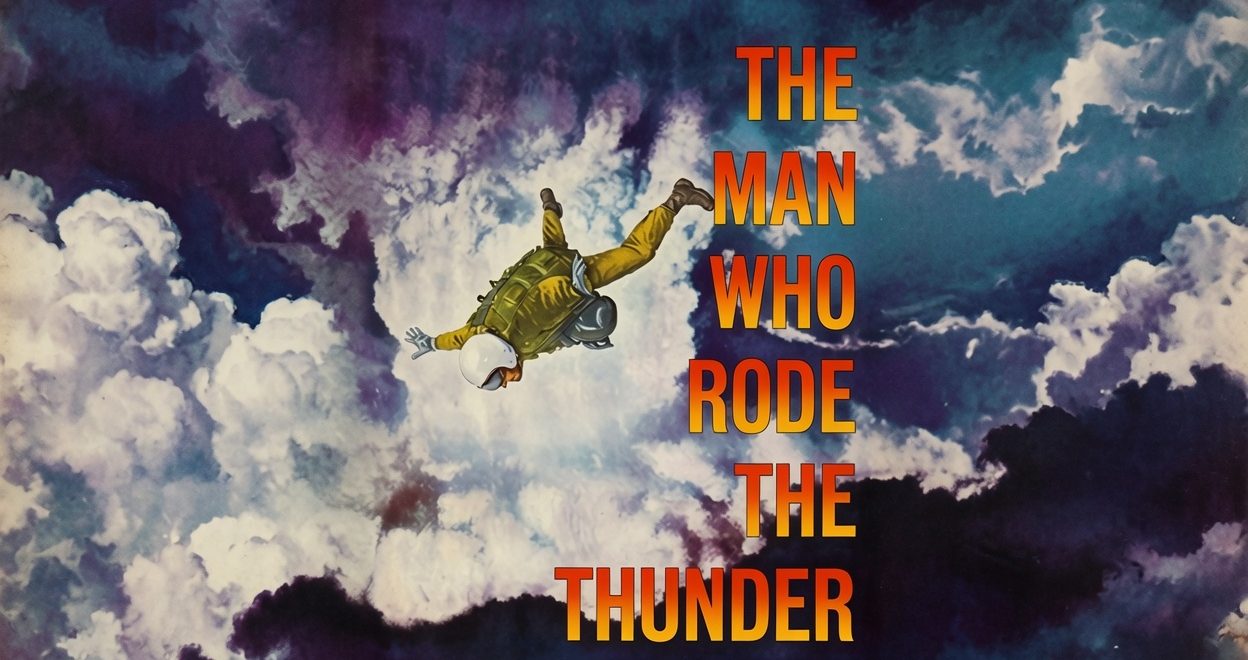
Once under the open canopy of the parachute, Rankin was far more vulnerable to the storm’s powerful vertical currents. The long descent increased the risk of his death from cold or asphyxiation. Additionally, it meant that he was dangerously caught in the up-and-down draft of the storm system, which buffeted the pilot thousands of feet into the air before dragging him back down. And that’s exactly what happened.
Ten minutes into the ordeal, he began vomiting from the violent spinning and pounding even as lightning flashed around him—later described as blue blades several feet thick.
The rain was so dense that he repeatedly inhaled or swallowed water with every breath and had to hold his breath to avoid choking. “Gasping for air, swollen, bleeding, and battered by hail, it was as though I were under a swimming pool, and I had held my breath several times,” wrote Rankin.
For Rankin, this was akin to “drowning in the sky.”
For about forty minutes, he was battered by hail, nearly drowned by torrential rain, and subjected to lightning and extreme turbulence.
“I didn’t hear the thunder, I felt it,” Rankin wrote in his book.
Thankfully, the storm’s intensity eventually decreased, allowing the pilot to finally avoid its drafts. Then, the rain that had threatened to drown him gave way to a comforting summer shower, and the air got substantially warmer.
Lt. Col Rankin and his parachute, which had endured unimaginable turbulence and the ferocity of nature, had miraculously survived the thunderstorm.
Soon, he approached the forests of North Carolina’s backcountry, got entangled in a tree, cut away from it, and landed on the ground.
Battered, frostbitten, bleeding, rain-soaked, and covered in vomit, he stumbled through the woods using a search pattern until he found a country road. “Lying on my left side. I simply could not believe that I was on the earth—that I had survived,” he later wrote.
Several cars passed before a motorist stopped, drove him to a nearby country store, and allowed him to call for an ambulance. He collapsed while waiting and was taken to a hospital in Ahoskie, North Carolina. Rankin spent several weeks recovering but sustained no permanent long-term injuries from the forty-minute ordeal and soon returned to duty.
Rankin gained widespread recognition for his iconic and unbelievable battle with the thunderstorm after he returned to active service.
Having survived a 40-minute thunderstorm in the air, he lived for 50 more years before passing away at 89 in 2009.
Nevertheless, Lt. Col Rankin is still remembered—nearly 70 years after the incident—as the only man who defeated a thunderstorm.
- Contact the author at sakshi.tiwari13 (at) outlook.com
- Follow EurAsian Times on Google News