As November 10 approaches, an important question confronts America’s strategic establishment: how will Washington preserve its naval supremacy when China threatens its ability to build the submarines that make it possible?
This leads to another question: why is November 10 important?
These two questions assume significance, as geopolitical developments in the Middle East and the South China Sea once again show the centrality of sea power in international politics.
Control of maritime routes, protection of energy supplies, deterrence of adversaries, and the ability to project military power across oceans remain indispensable to America’s global strategic position. And submarines are among the most important instruments of that power.
US President Donald Trump has made rebuilding American naval strength and restoring the country’s shipbuilding capacity a priority. His administration has taken steps to expand the naval industrial base, address chronic shipbuilding delays, and strengthen submarine construction and maintenance capabilities.
Defense Secretary Pete Hegseth has been talking of “more ships, more subs.”
In other words, US policymakers and strategic elites are clear that Washington’s strategic competition with Beijing requires not merely diplomatic posturing but tangible military and industrial capabilities.
However, a problem remains.
While America wants more submarines to counter China’s expanding maritime power, producing these sophisticated platforms depends on critical materials and components, including specialized rare-earth magnets, whose supply chains remain heavily dependent on China.
A recent analysis in the US Naval Institute’s Proceedings highlights this vulnerability. It points out that American submarine motors, actuators, and sensors depend on high-performance rare-earth magnets, particularly neodymium-iron-boron and samarium-cobalt varieties. Much of their supply chain passes through China.
This is where Beijing’s carefully constructed rare-earth export-control regime becomes far more than an ordinary trade dispute. China has shown that its dominance over critical minerals and their processing can translate into geopolitical leverage over America’s industrial and defense capabilities.
China has built its export-control regime systematically, step by step, over several years. What began as restrictions on selected critical minerals has evolved into an elaborate licensing architecture designed to give China considerable leverage over global high-technology manufacturing, defense production and the clean-energy transition.
In August 2023, China introduced rules that would require all firms to obtain legal permission before exporting gallium and germanium. These two materials are important for making semiconductors, advanced electronic devices and defense equipment. China produced about 94% of the world’s primary low-purity gallium and 83% of its refined germanium. This provided China with strong control over the global supply of these materials.
In December 2023, Beijing went a step further by prohibiting exports of technologies used to extract, separate, and process rare earths. This was noteworthy because Beijing’s advantage does not lie merely in possessing rare-earth resources; it lies in its overwhelming command of the processing and refining technologies that convert these minerals into commercially usable materials.
In December 2024, China banned the export of gallium, germanium, antimony, and certain super-hard materials to the USA. This was an undoubted escalation, with critical-mineral controls becoming an instrument of direct strategic retaliation against Washington.
In April 2025, Beijing expanded its restrictions to seven medium and heavy rare-earth elements — samarium, gadolinium, terbium, dysprosium, lutetium, scandium and yttrium — along with associated permanent magnets.
Exports became subject to licensing requirements, creating uncertainty and potential delays for manufacturers dependent on these materials.
Later in October, China announced an even more sweeping package, extending controls to additional rare earths and battery-related materials. Particularly consequential was the proposed extraterritorial provision – a foreign-made product containing even a small proportion of Chinese-origin rare-earth materials could potentially fall within China’s licensing jurisdiction.
This threatened to extend Beijing’s regulatory reach well beyond its own borders and into international supply chains.
The consequences were immediate and far-reaching.
Prices of certain critical rare-earth oxides reportedly surged several-fold, while manufacturers in Europe and elsewhere faced mounting difficulties obtaining export licenses.
The automobile industry was especially affected because rare earth materials are vital for making permanent magnets used in electric motors and many other industrial products. In 2025, Ford had to halt some production because of supply shortages temporarily. This demonstrated how a shortage of specialized materials could create major manufacturing problems.
Even after China and the US reached an agreement, the supply problem remained. China continued to export less than before, while the price per tonne increased significantly. This showed that supply remained limited and prices stayed high.
Then came what the strategic experts described as “the Busan truce”. Following the October 30, 2025 meeting between Donald Trump and Xi Jinping in Busan, South Korea, Beijing announced it would suspend key elements of its October export-control package until November 10, 2026.
China also suspended the US-specific restrictions on gallium and germanium until November 27, 2026.
But there is an important distinction between suspension and dismantling.
China did not abandon its export-control architecture. It merely agreed to put some of its most sweeping provisions on hold. Nor did it comprehensively withdraw the licensing requirements introduced in April 2025 for the seven medium and heavy rare-earth elements.
This is the strategic significance of the present situation. The United States has secured a temporary reprieve, not a permanent solution. As November 10, 2026 approaches, the question is whether Beijing will extend the suspension or allow the October restrictions to return. The same confusion also hovers over the November 27 deadline on the suspension of the US-specific gallium and germanium ban.
For Washington, therefore, the rare-earth question is no longer simply about securing supplies for its industries. It is about whether the United States can sustain the naval power on which its global strategic influence depends without remaining vulnerable to economic coercion by its principal geopolitical competitor. China is using its curbs/ restrictions as a key bargaining chip in trade talks with Washington.
In fact, these curbs are also affecting other defense technologies, including F-35 jets, Tomahawk missiles, and Predator unmanned aerial vehicles. All of these depend on China’s strategic minerals.
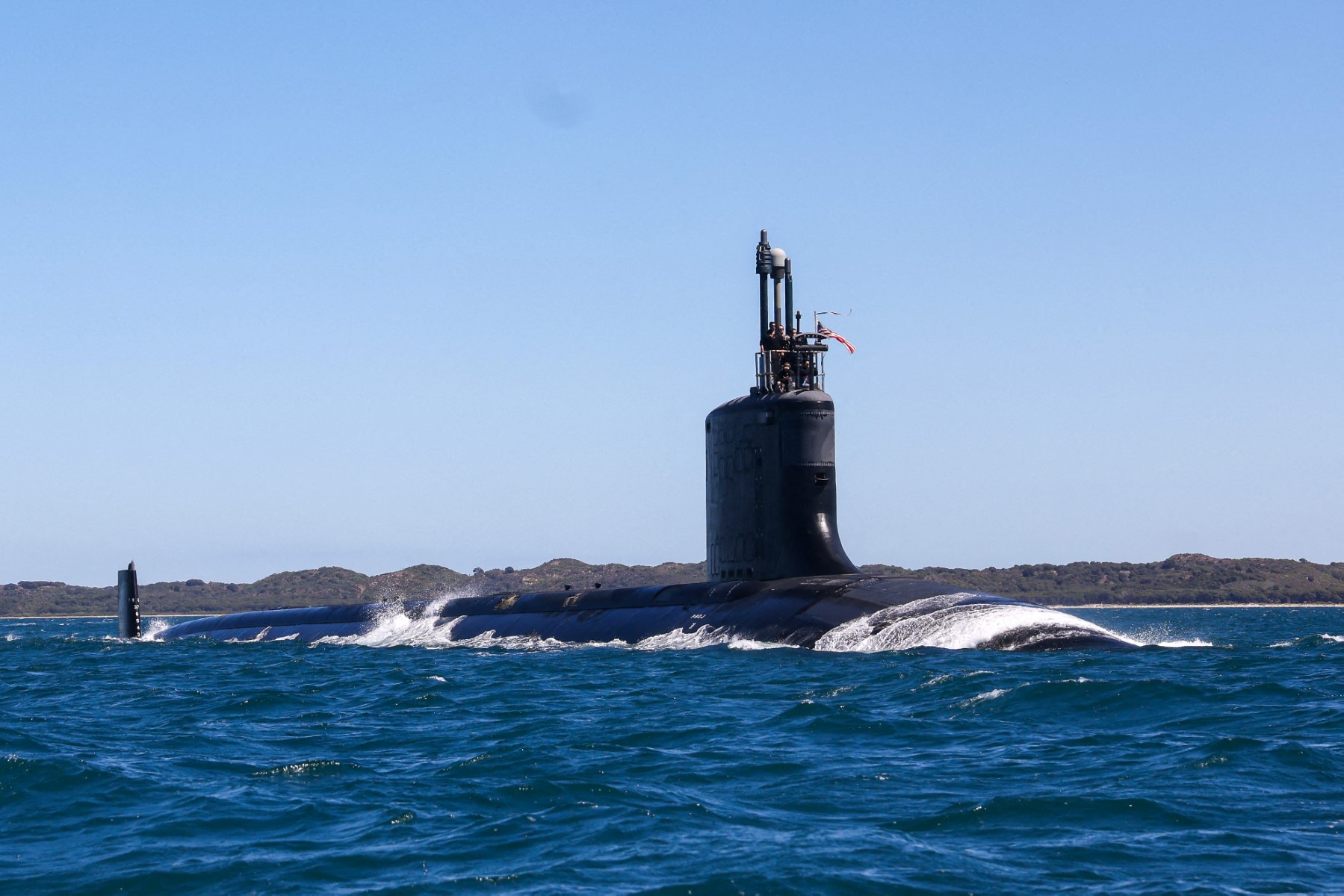
It is estimated that a Virginia-class submarine requires about 9,200 pounds of rare-earth materials, or roughly 4,600kg. A single F-35 is 920 pounds, but a submarine is ten times that. Some estimates put a next-gen destroyer at 4.5 tons and a nuclear submarine at 1.5 tons of rare earths.
Three functions are said to make rare earths irreplaceable.
First, they enable “silent propulsion.” The permanent magnets that make electric drive motors quiet and powerful are neodymium-iron-boron (NdFeB) magnets. They are the most powerful permanent magnets commercially available and are embedded in critical military systems including F-35 fighter aircraft, nuclear submarine propulsion systems, radar array components, and precision missile guidance. Without neodymium, dysprosium, and terbium to keep that magnetism at high temperature, the submarine loses efficiency and gains noise. But then a noisy submarine is a dead submarine. Second, rare earths are essential for creating high-power magnets used in electric motors and advanced propulsion of silent submarines. Samarium-cobalt magnets survive higher heat inside sonar arrays, towed arrays, and reactor coolant pumps.
Third, like F-35, missile systems, and drones, submarines depend not only on permanent magnets but also on specialty alloys, coatings, and metallurgical inputs in which rare earths enhance heat tolerance, fatigue resistance, and magnetic performance.
Viewed this way, dependence on an assured rare-earth supply is hitting submarine production in the United States. As Eurasian Times once explained, the US builds roughly 1.1 to 1.3 submarines per year, far below China’s industrial output of 6.5 to 9 hulls annually.
At present, the US Navy, which has paid for two Virginia-class attack submarines and one Columbia-class ballistic missile submarine, is not getting them. Deliveries are 2-3 years late. Admiral Daryl Caudle told the US Congress in May that the Navy won’t be in a position to get at least two subs a year until 2032.
This is a concern, as a third of the US attack fleet is in maintenance or awaiting it. The Columbia-class SSBN that must replace Ohio will not hit water until 2028.
Though the US Navy still leads with an all-nuclear fleet of 71 active submarines (including 51–53 SSNs/SSGNs), China has now surpassed Russia to command the world’s second-largest nuclear submarine fleet with an estimated 9 to 12 SSNs (such as the Type 093 and Type 093A/093B Shang-class) and 6 SSBNs (Jin-class Type 094), totaling roughly 32 active nuclear submarines across its entire naval forces that operate primarily in the Indo-Pacific region. It is producing more than 6 new subs every year to further augment its strength.
However, this is not a US-only crisis. Britain’s Dreadnought SSBN and Australia’s future SSN-AUKUS share a US supply chain for steel, propulsors, and magnets.
A recent report by the International Energy Agency warns that full Chinese control puts $6.5 trillion per year of downstream production outside China at risk — US and Europe nearly half. Following its official concerns over Taiwan, Japan also saw its current dysprosium and terbium shipments from China stop in January 2026. Japanese automakers and defense contractors felt it.
How do they break out of Chinese dominance? Efforts are underway, but timelines are important.
The Pentagon is funding rare earth processing demonstration projects within the U.S., like Mountain Pass Revival in California and Texas.
It has also signed a $96 million, four-year agreement with Australian rare-earth producer Lynas Rare Earths to supply light and heavy rare-earth oxides.
The US, Japan, and Germany are even attempting together to break China’s monopoly on rare earth magnets. USA Rare Earth, E-VAC (an American subsidiary in Germany), and Noveon Magnetics are spearheading efforts to build the first commercial, domestic rare earth magnet supply chain in the US by 2027.
Japan (Hitachi Metals/Proterial) and Germany (Vacuumschmelze) hold magnet patents and plan to enter production.
However, while these companies aim to be self-reliant, their supply chains remain heavily tied to Chinese metals and refining capacity. Beijing also retains a technology ban on exporting Chinese separation tech to build alternative plants. That means new rare-earth processing inventions require further investment.
That is why the IEA says that even after announced projects, non-China magnet output will meet well below 20% of non-China demand in 2035. New magnet plants need 18-24 months to achieve SUBSAFE qualification.
Viewed thus, China may not need to defeat the US Navy at sea in any naval competition if it can exploit America’s dependence on Chinese-controlled industrial supply chains before the ships and submarines even reach the sea.
At least, that appears to be the case now.
- Author and veteran journalist Prakash Nanda is Chairman of the Editorial Board of the EurAsian Times and has been commenting on politics, foreign policy, and strategic affairs for nearly three decades. He is a former National Fellow of the Indian Council for Historical Research and a recipient of the Seoul Peace Prize Scholarship.
- The author can be reached at prakash.nanda (at) hotmail.com