

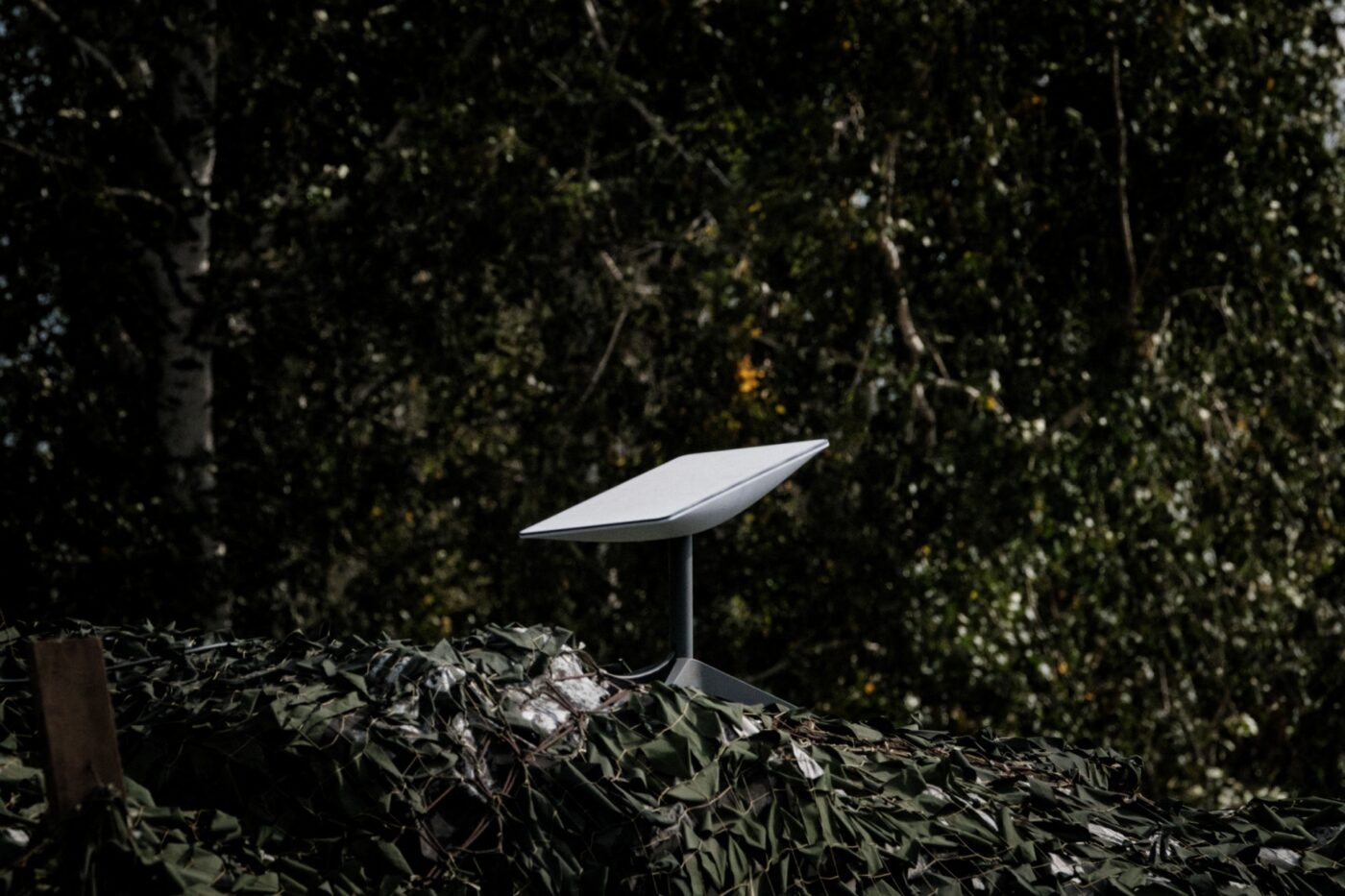
After nearly ten days of restrictions on Starlink and Starshield services for Ukraine’s military, SpaceX has restored them. This wasn’t the first time the US blocked or interrupted critical services, prompting countries like China, India, and France to develop their own navigation systems.
On October 25, Ukrainian President Volodymyr Zelenskyy confirmed that the satellite internet system is working at full speed again. “The speeds are now where they need to be,” Zelensky said. “I thank all Americans and all our partners who took this seriously and truly helped us.”
The restrictions disrupted frontline operations and efforts to intercept Russian attack drones. The speed limits caused “the failure of several missions,” Ukrainian presidential adviser Serhii Beskrestnov wrote on Facebook.
During the nearly 10 days of restrictions, Zelenskyy repeatedly complained that restrictions were hampering Ukrainian military operations and causing casualties.
“People were killed because [there was] not enough destruction, not enough interceptors, including interceptors with Starlink, which didn’t work, of course,” Zelenskyy complained.
After days of complaints, requests, and intense lobbying by Ukraine’s European partners, including Germany and Poland, who are paying for Kyiv’s access to Starlink services, the service was finally restored.
However, the restrictions in the middle of a war severely affected Ukraine’s military operations, and the effects were quickly visible.
On October 22, ICEYE, the European leader in sovereign intelligence from space, and Nokia signed a Letter of Intent (LoI) with Ukraine’s Ministry of Defense to explore cooperation in space.
“The partnership aims to support Ukraine’s defense capabilities, particularly in building sovereign satellite communications,” Nokia said in a press statement.
The partnership aims to “develop secure, sovereign and high-performance broadband low Earth orbit (LEO) satellite communications systems for governments, supporting missions from defense and border security to emergency services and disaster response,” it added.
These LEO satellite communications systems will compete directly with SpaceX and provide similar broadband services with defense applications.
“Modern warfare has proven that reliable communications are a matter of national security,” Zelenskyy said, while commenting on the LoI. “We must all rely on capabilities that we can control.”
Poland has also signed a similar LoI with ICEYE to urgently develop what Prime Minister Donald Tusk described as “Polish Starlink.”
“The culmination of the process that began today can and will be a Polish Starlink.”
Similarly, many Indian experts warned that the incident should serve as a lesson to New Delhi.
Sridhar Vembu, the founder of Zoho Corporation, a prominent Indian multinational cloud software company, said, “This is why we cannot trust technology from them. We have no option but to build.”
Former Indian Air Force (IAF) fighter pilot and defense analyst, Ajay Ahlawat, said, “The episode revealed a key vulnerability that also served as a center of gravity (CoG). It highlighted the dangers of operational dependence on a privately controlled satellite system that relies on the operator’s willingness to act in a compliant and friendly manner. When Starlink and Starshield were withheld, Ukraine appeared defenseless.”
Several Indian think tanks also highlighted the Ukraine example to highlight the dangers of overdependence on a US-based satellite communication system.
The Observer Research Foundation (ORF) and the Center for Aerospace Power and Strategic Studies (CAPSS) published reports highlighting the national security risks of over-reliance on Starlink and urged the Indian government to prioritize developing “sovereign capacity” for satellite-based broadband connectivity.
Interestingly, earlier this month, SpaceX CEO Elon Musk complained that “certain oligarchs” were blocking the start of Starlink services in India.
Similar concerns were expressed in other countries as well.
Canadian Prime Minister Mark Carney, for instance, said he’s concerned about the manipulation of SpaceX’s Starlink satellite system, which has made it harder for Ukraine to defend itself, and suggested Musk’s reported involvement shows why he’s focused on making Canada less dependent on any one country or technology.
US dominance in space-based imaging, intelligence-gathering, satellite communication, and early missile warning is real, and Europe currently has no system with similar capabilities.
Europe also recognizes this weakness.
“Starlink is really necessary for Ukraine, and unfortunately in the short term Europe can’t replace this capability,” EU foreign policy chief Kaja Kallas told reporters last week.
How the US Forced China, India and France To Develop Own Systems
In 1996, a major crisis erupted between Beijing and Taipei over former Taiwanese president Lee Teng-hui’s proposal to conduct relations on a ‘state-to-state’ basis, which Beijing took as a move toward full independence.
Beijing responded by conducting large-scale military exercises and firing three missiles into the East China Sea only 18.5 kilometers from Taiwan’s Keelung military base as a warning.
The first missile hit its target. However, even as Beijing was celebrating its success, the other two missiles veered off course, and the PLA lost track of them.
PLA analysis afterward suggested the two failures could have been caused by a sudden GPS disruption.
“It was a great shame for the PLA … an unforgettable humiliation. That’s how we made up our mind to develop our own global [satellite] navigation and positioning system, no matter how huge the cost,” a retired PLA Colonel told Hong Kong-based South China Morning Post in 2009.
“Beidou is a must for us. We learned it the hard way,” he added.

Notably, China’s BeiDou navigation system is today comparable to GPS in civilian accuracy; however, in the Asia-Pacific region, BeiDou’s reported accuracy is even touted as slightly better than GPS.
The US repeated this mistake again three years later with India.
In 1999, during the Kargil War between India and Pakistan, New Delhi requested access to military-grade GPS data to understand the precise location of Pakistani positions on the mountains.
The request was denied, exposing India’s strategic vulnerability.
At the time, the civilian GPS signal was deliberately degraded worldwide under the US policy of Selective Availability (to roughly 100 meters of accuracy), while the encrypted military-grade Precise Positioning Service was available only to the US and select partners.
India was also under US sanctions following its 1998 nuclear tests, further limiting access to sensitive military technology.
The episode highlighted India’s strategic vulnerability in relying on a foreign-controlled navigation system. India’s defense community describes the incident as a “bitter lesson,” and it prompted New Delhi to develop its own satellite-based positioning and navigation system.
The project was formally approved in the mid-2000s; the first satellite was launched in 2013, and the system became operational around 2018.
Currently, apart from India and China, several other countries, including Russia, Japan, and Europe, have their own satellite navigation systems.
Many other examples show how restrictions on information collected by US satellites forced rival or even partner countries to develop their own capabilities.
For instance, in 1991, during the Gulf War, French officials described the country as “practically blind” without US intelligence and satellite imagery.
The then-French defense minister Pierre Joxe said France’s commercial satellite Spot provided cartography-useful data during the Gulf War, but its 10-meter resolution was not sharp enough to capture essential military details.
This prompted France to launch its own Helios program, which provided 1-meter resolution images.
Notably, France’s military optical reconnaissance satellites Helios 1A (launched 1995) and Helios 1B (1999) gave Paris independent high-resolution imagery, which informed France’s decision not to join the 2003 Iraq invasion.
Later, retired French general Bernard Molard publicly stated, “France didn’t follow other allies into the war in Iraq because we had our own satellite means to verify whether WMD were actually there. We could see they weren’t there, and we didn’t go for it.”
- Sumit Ahlawat has over a decade of experience in news media. He has worked with Press Trust of India, Times Now, Zee News, Economic Times, and Microsoft News. He holds a Master’s Degree in International Media and Modern History from The University of Sheffield, UK.
- He can be reached at ahlawat.sumit85 (at) gmail.com