The Trump administration has been weighing launching fresh strikes on Iran. If a fresh offensive begins, the US could use the “Mother of All Bombs,” a move that would coincide with the 65th anniversary of the Tsar Bomba test conducted by the Soviet Union.
US forces have conducted a significant military buildup in the region. Troops have been repositioned from more vulnerable facilities, air defenses and ammunition stocks have increased, and cargo aircraft have landed at bases in Israel, including Ovda and Nevatim, as well as in Jordan, Saudi Arabia, and Qatar.
Additionally, US officials have said sufficient forces are in place to launch major operations within roughly 96 hours of an order.
Iran has also signaled that it is preparing for another round of war, with Iranian officials warning of expanding their objectives, hitting oil and gas installations, cutting underwater internet connections, and attacking AI data centers, among other things.
According to CNN, the US military could use the GBU-43/B Massive Ordnance Air Blast bomb—commonly called the “Mother of All Bombs” or MOAB—the largest non-nuclear weapon in the US arsenal.
A 21,600-pound air-burst weapon, the MOAB produces a powerful blast wave effective against surface targets, light structures, cave or tunnel entrances, and soft infrastructure. It has been used in combat only once, against an ISIS tunnel complex in Afghanistan in 2017.

“It’s not nuclear at all; this is just an extremely large bomb. It’s like a tiny nuclear bomb. But the ‘Mother of All Bombs’ is one big bomb – but it’s not nuclear,” Trump said. “I wouldn’t use nuclear, we don’t have to,” he added.
Earlier, the US military dropped GBU-57 Massive Ordnance Penetrator (MOP) bombs on Iranian underground nuclear facilities during “Operation Midnight Hammer” in June 2025. However, it failed to completely destroy Iran’s nuclear program.
Recalling The Tsar Bomba Test
On October 30, 1961, the Soviet thermonuclear bomb, which came to be known as ‘Tsar Bomba’, was detonated in a test over the Arctic island of Novaya Zemlya. The bomb was constructed at the height of the Cold War between the Soviet Union and the US.
By the mid-1950s, thermonuclear weapons had already been developed in the USSR, but the US still had an unquestionable nuclear weapons advantage over the USSR.
Until 1961, there were no effective means for the Soviet Union to deliver nuclear bombs to the United States, thus limiting the possibilities for plausible nuclear retaliation.
Nikita Khrushchev’s Soviet government had to show the United States that it had gained a strategic edge, which paved the way for the development of RDS-220, popularly known as the Tsar Bomba.
Khrushchev ordered the project in July 1961 as part of the Soviet resumption of nuclear testing following the Test Ban Moratorium, and a group of Soviet physicists led by Andrey Sakharov built it.
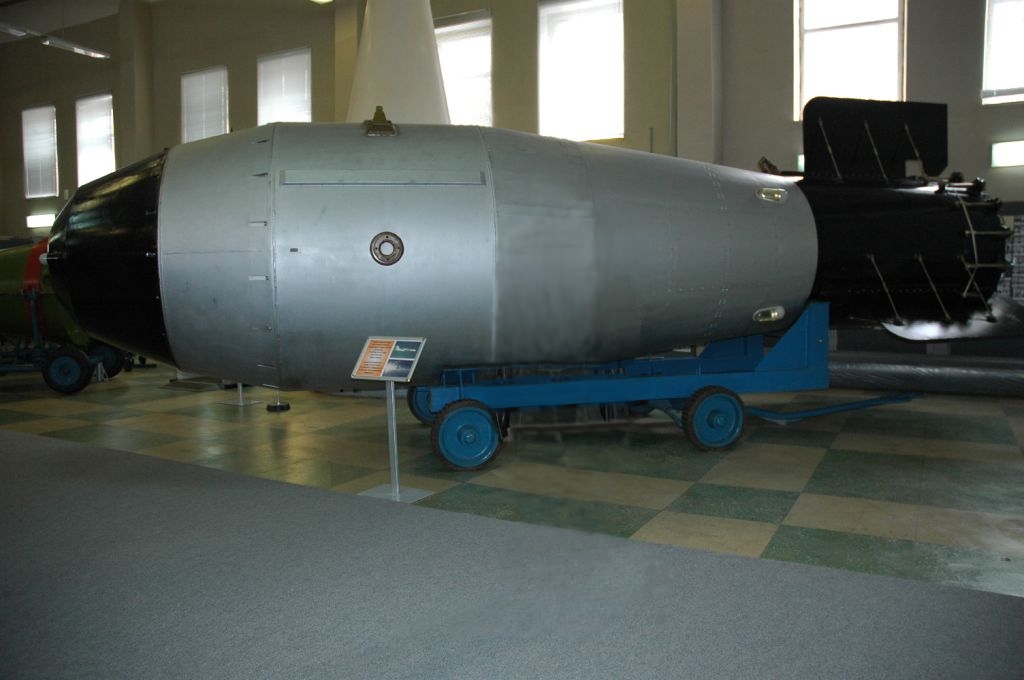
The explosion was supposed to occur during the Communist Party of the Soviet Union’s 22nd Congress, and was meant to show off Soviet power.
It was a three-stage hydrogen bomb. A small atomic (fission) explosion first set off a fusion reaction in a second stage. The enormous energy from that second stage then compressed and ignited an even larger third fusion stage, producing the bomb’s massive yield.
The full design yield was calculated at about 100 megatons of TNT equivalent. However, that was too dangerous to test. So, it was modified to generate 50 megatons, which was believed to be over 3,800 times more potent than the American bomb used on Hiroshima during WWII.
For the actual test, the uranium-238 tamper in the tertiary stage, and possibly the secondary, was replaced with lead. This halved the yield and eliminated most of the radioactive fallout that would have come from fast fission of the uranium, making the explosion one of the “cleanest” high-yield tests ever conducted.
According to the Atomic Heritage Foundation, “With a yield of 50 megatons of TNT, Tsar Bomba was the culmination of several hydrogen bomb tests conducted throughout this time by both the Soviet Union and the United States.”
By comparison, the most powerful thermonuclear device the United States had previously tested, Castle Bravo, had a yield of 15 megatons.
Major Andrei Durnovstev’s Tu-95V, a Soviet long-range bomber, dropped Tsar Bomba during the test on October 30, 1961. The aircraft, piloted by Major Andrei Durnovtsev and painted with a reflective white coating to reduce heat damage, took off from Olenya airfield on the Kola Peninsula.
A Tu-16 aircraft accompanied it and was tasked with filming and collecting data. Notably, the nuclear bomb-carrying Tu-95V was so large that the bomb bay doors and fuselage fuel tanks were removed.
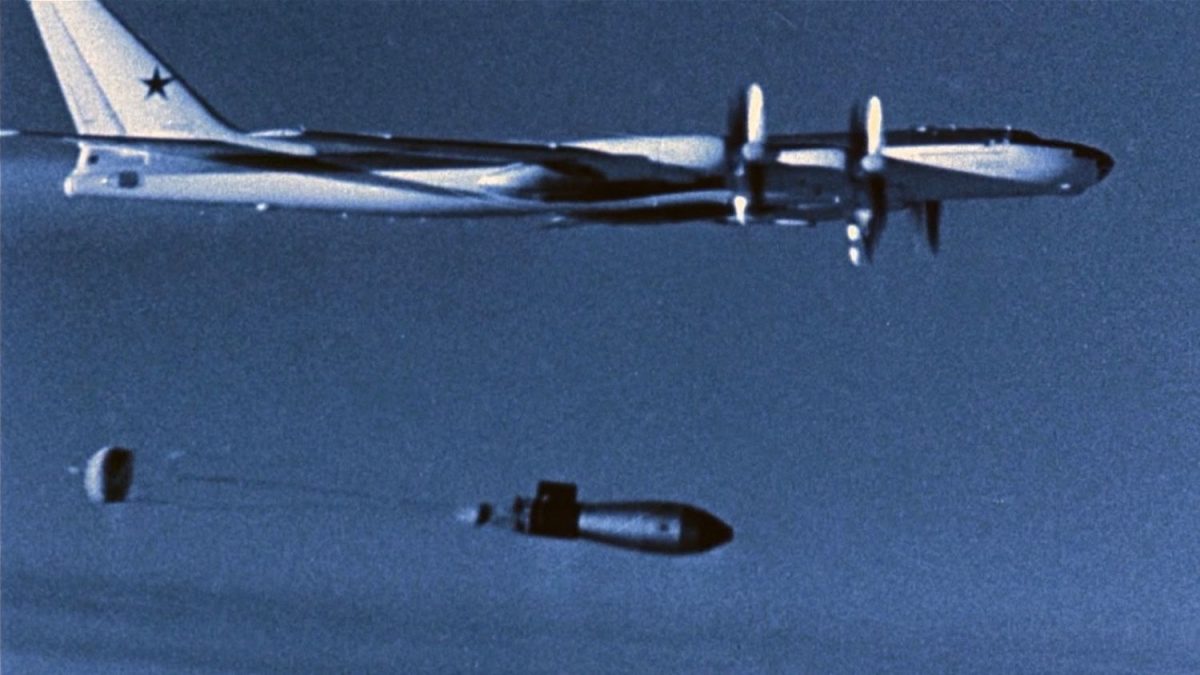
The bomb was released from about 10,500 meters altitude over the Mityushikha Bay test range on Severny Island in the Novaya Zemlya archipelago in the Arctic Ocean. A large parachute slowed its descent for roughly 188 seconds, allowing the aircraft to reach a safer distance. It detonated automatically by barometric sensors at approximately 4,000 meters above the surface at around 11:32 Moscow Time.
The Tsar Bomba was the biggest nuclear weapon ever detonated and produced the strongest explosion ever witnessed by a human. The mushroom cloud rose more than 60 kilometers into the mesosphere and spread tens of kilometers wide. The flash was visible up to about 1,000 kilometers away, and scientists assessed that the thermal radiation could have caused third-degree burns up to 100 kilometers away.
The blast completely destroyed everything at a distance of about 25 kilometers, caused severe damage beyond that, and flattened the uninhabited village of Severny, about 55 kilometers from ground zero. According to some accounts, the windows were broken hundreds of kilometers away, and the seismic shock wave circled the globe three times.

The test’s final report said new design ideas for high-yield thermonuclear charges were validated, making it possible to create a nuclear bomb “of practically unlimited power.”
However, despite its success, the Tsar Bomba was never considered practical for operational use. Its enormous size made it impossible to deploy via ballistic missile, so it had to be transported by conventional aircraft. Such aircraft, however, could be detected and intercepted before reaching their intended targets.
The test allowed the Soviet Union to demonstrate its capability to develop nuclear weapons of unprecedented destructive power. However, the test served primarily as a political demonstration of Soviet technological capability during a tense Cold War.
No second device of this design was ever tested or deployed.
- Contact the author at sakshi.tiwari13 (at) outlook.com
- Follow EurAsian Times on Google News