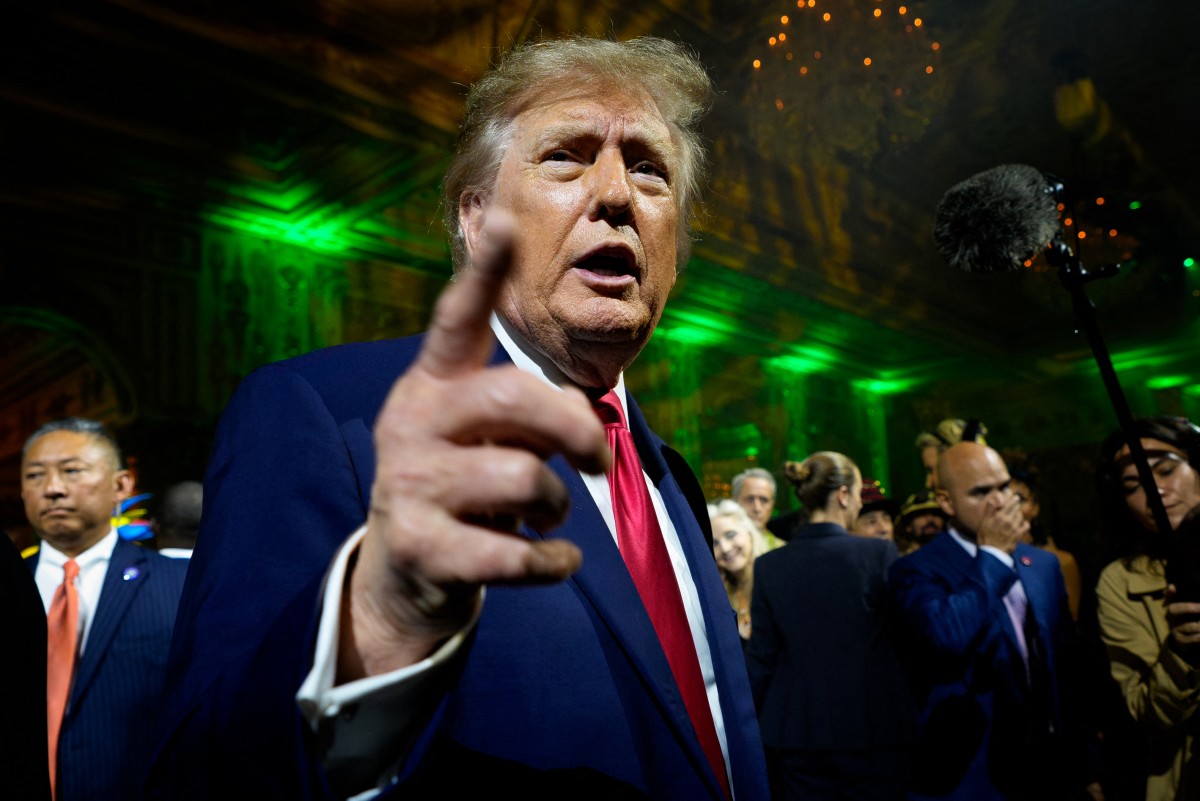
US President Donald Trump has again put the spotlight on Pickaxe Mountain. He said on Saturday that the US has knocked out much of Iran’s military, but it still has to “take care of” one or two targets, including a suspected nuclear site at Pickaxe Mountain.
“We’ve knocked out their nuclear. We still have to take care of, I would say, one or two sites, but we can do that in 10 minutes,” Trump told reporters at his Florida residence.
“You probably could look at Pickaxe Mountain, and you have to take care of that. We can do that all very quickly,” he added, referring to a suspected underground nuclear complex.
This was not the first time Donald Trump has talked about striking an alleged Iranian nuclear facility at Pickaxe Mountain.
On July 13, 2026, Trump said during Hugh Hewitt Show: Trump said: “Pickaxe is a possible target for a nice, big, fat shot right into the front door. And I think that you’ll — maybe you’ll see that. I’ll tell them right now.”
He added: “It is on the list. We’re watching it closely. We see no activity there. They’re not doing well with their nuclear situation. Every time we hear about it, we blow it up. So they don’t like talking about it. But we’ll probably give Pickaxe a shot relatively soon.”
Trump concluded by saying: “We’re going to take out Pickaxe Mountain. Tell the Iranians to be ready. Let them know we’re coming.”
About a week later, on July 21, Trump told reporters: “We’ll be hitting that area pretty soon, and very heavily. There’s not a thing they can do about it. Normally I wouldn’t say that. If I thought they could do something about it, I would never say that.”
He also addressed reports of centrifuges being moved there: “They may have. We don’t have it on record… It doesn’t mean anything unless they have the material. We follow the material. That’s where the action is.”
Again, a week later, July 28, Trump told Fox News: “I know exactly what’s going on at Pickaxe. It’s not a big problem. We took out their nuclear sites, and we’ll have to take out Pickaxe if we don’t make a deal. We don’t make a deal, we’ll take it out very easily.”
Then on September 9, during a Republican midterm convention in Dallas, Trump said: “We notice there’s a little activity at Pickaxe. I would advise Iran not to get cute because we will have to hit them very hard.” He linked it to preventing an Iranian nuclear weapon and noted U.S. surveillance capabilities.
On October 16, 2026, in an interview, Trump said: “Their nuclear is buried under millions of tons of mountain. Now we’re looking at Pickaxe Mountain. We may have to go there. We’ll take a shot at that one. We’ll knock it out fast.” On nuclear weapons: “I wouldn’t use nuclear. We don’t have to.” On ground troops: “No, I don’t see that.”
What is Pickaxe Mountain?
Pickaxe Mountain, also known as Kuh-e Kolang Gaz La, is a massive underground tunnel complex located near Iran’s Natanz uranium enrichment facility in central Isfahan province.
Work on the site reportedly began in 2020 after an explosion damaged an above-ground workshop at Natanz used to assemble advanced centrifuges.
Tehran called the blast an act of sabotage.
At the time, the then-head of Iran’s Atomic Energy Organization, Ali Akbar Salehi, said construction had begun on a replacement facility, adding that a “more modern, larger and more comprehensive hall in all dimensions” would be built “in the heart of the mountain near Natanz.”
IAEA Director General Rafael Grossi noted that Iran previously announced its “intention to have nuclear activity” at the site, describing it as part of a broader pattern of moving sensitive facilities underground. He also said the IAEA has observed construction activity in satellite imagery but admitted it lacks concrete details.
On 26 September 2025, Iranian President Masoud Pezeshkian was asked by NBC’s Tom Llamas about reports of construction at Pickaxe Mountain, and Pezeshkian said: “If they are really telling the truth, we have been—we have come to an agreement most recently with the IAEA.
They can come and inspect on the ground. To put something out based on purported satellite photography, it’s not pertinent in order to create frameworks that are not based in reality. In fact, would it not be easier and much more tangible and verifiable to have inspections in person on the ground?”
Pezeshkian was responding to reports that satellite-based images had detected new activity near Natanz. At the time, Iran and the IAEA had discussed arrangements for inspections, but Tehran continued to restrict full access to sites after American June 2025 bombing under Operation Midnight Hammer.
The US military targeted the Fordow Uranium Enrichment Plant, the Natanz Nuclear Facility, and the Isfahan Nuclear Technology Center with fourteen GBU-57A/B MOP “bunker buster” bombs carried by B-2 Spirit stealth bombers, and Tomahawk missiles fired from a submarine
In July 2026, Foreign Ministry spokesman Esmaeil Baghaei stated that “no nuclear activity is taking place” at Kolang (Pickaxe) Mountain and described Washington’s attention to the site as “a fabricated pretext for aggression, destruction, and sabotage.”
The site at Pickaxe Mountain may have been selected to defend it from air strikes, with analysts estimating it could be as deep as 100 m (328 feet).
This means that the new facility is much deeper and more fortified than Fordo and Natanz, which the US bombed in 2025.
The bunker-buster GBU-57, which weighs about 13,000 kg, can penetrate about 60 feet of concrete or 200 feet of earth before exploding. So, these munitions may have little impact on the Pickaxe Mountain facility, which is about 328 feet underground.
That is probably why reports of GBU-43/B Massive Ordnance Air Blast (MOAB) may have surfaced — the most powerful non-nuclear bomb in the American arsenal.
Israeli intelligence has assessed that Iran moved thousands of uranium-enrichment centrifuges into tunnels deep inside Pickaxe Mountain last fall, after the bombing.
An Israeli military official said the earlier strikes left “more work to do,” including at the site. The report noted the move did not necessarily mean enrichment was underway there; Tehran may have relocated surviving machines for protection.
“The concern is Pickaxe Mountain could be a location where Iran puts an enrichment plant that could produce weapon-grade uranium for nuclear weapons,” said David Albright, president of ISIS. “None of this is happening as far as we know, but the fear is that it could turn into a place to make weapon-grade uranium metal.”
Separately, CNN reported that Israel also assessed that at least part of Iran’s roughly 440 kg stockpile of 60% highly enriched uranium (HEU) was transferred to the mountain.
Since intelligence reports believe that Tehran could have moved at least part of its stockpile of 60% highly enriched uranium—along with thousands of centrifuges—into the deeply buried tunnels at Pickaxe Mountain after the 2025 strikes, that could be the reason why President Donald Trump has repeatedly singled out the site for potential attack.
Mail us at: editor (at) eurasiantimes.com