One of the two US Air Force’s KC-135R Stratotankers that collided mid-air earlier this year during hostilities with Iran is now flying with a replacement vertical stabilizer sourced from another aircraft.
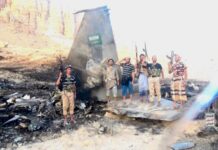
During the height of the clash between the US and Iran, two USAF KC-135 refuellers collided mid-air in friendly airspace in Iraq in a freak accident on March 12, 2026.
One of these tankers, call sign Zeus 95, was unable to recover from the impact and crashed close to Turaibil on the border between Iraq and Jordan. Meanwhile, the other aircraft managed to steer away and land safely at Ben Gurion Airport in Israel—the hub of USAF’s aerial refueling capability during the conflict—despite sustaining damage to its vertical stabilizer, or tail, as previously reported by the EurAsian Times.
“U.S. Central Command is aware of the loss of a U.S. KC-135 refueling aircraft. The incident occurred in friendly airspace during Operation Epic Fury, and rescue efforts are ongoing. Two aircraft were involved in the incident. One of the aircraft went down in western Iraq, and the second landed safely. This was not due to hostile fire or friendly fire,” the US Central Command (CENTCOM) said in a statement on the day of the tragic accident.
As it turns out, the surviving KC-135 has been repaired by cannibalizing the vertical stabilizer from another aircraft of the type. It was spotted at RAF Mildenhall, UK, during its transit from Israel to the continental US, featuring two distinct serial numbers: although the fuselage itself carried 63-8017, the original serial number, the tail bore 63-8002, as seen in photos shared by UK-based aviation photographer Havoc Aviation.
The U.S. Air Force KC-135 "Stratotanker" that survived the fatal midair collision with another KC-135 over Iraq in March is now en route towards the United Kingdom, likely beginning its return to the United States.
Based on the extensive structural damage sustained in the… pic.twitter.com/1aHcRvPXhg
— OSINTdefender (@sentdefender) August 2, 2026
According to reports, the donor aircraft had previously served with the 22nd Air Refueling Wing and was last noted at the KC-135 depot at Tinker AFB, Oklahoma, where it appears to have entered retirement or storage. The repair work was apparently carried out at Israel’s Ben Gurion Airport, which recently made headlines for refusing to accommodate additional USAF tankers amid overcrowding.

This repair approach—using a donor component from another airframe—is an established practice for returning heavily damaged aircraft to service.
Earlier, the USAF successfully reassembled two damaged F-35 stealth fighters into one Frankenbird. One of the F-35s was damaged in a catastrophic engine fire at Eglin Air Force Base in 2014, whereas the other was damaged in a nose-gear collapse at Hill Air Force Base in Utah in 2020. The team developed specialized tooling, supports, and other equipment to assemble and connect the aircraft components, as you can read about here.
Similarly, the B-2 Spirit of Georgia, whose wing composite was severely damaged after it suffered a landing-gear collapse at Whiteman AFB in 2021, was later repaired by equipping it with an 8×4-foot donor composite skin panel from Test Article 0998.
Nevertheless, the KC-135 with two different numbers at RAF Mildenhall remains a unique sighting, particularly as the mid-air crash occurred during intense combat and killed six crew members.
Iran’s proxies in Iraq claimed responsibility for the attack as soon as the crash was announced by official channels.
“In defense of our country’s sovereignty and its airspace violated by the aircraft of the occupation forces, the mujahideen of the Islamic Resistance in Iraq targeted, with appropriate weaponry during the past twenty-four hours, a second aircraft of the KC-135 type belonging to the American occupation in western Iraq. Its crew managed to escape with it after it was hit, and it made an emergency landing at one of the enemy’s airports,” the Islamic Resistance in Iraq (IRI), an umbrella group of Iran-backed Iraqi militias, said in a statement at the time.
The claim was unsurprisingly amplified by Iranian state media and others, though CENTCOM immediately refuted it.
USAF Has Lost Many KC-135 Tankers
The KC-135, introduced nearly 70 years ago, remains the most numerous aerial-refueling aircraft in US service and the backbone of the tanker force. It enables long-range operations by fighters, bombers, and other aircraft of the Air Force, Navy, Marine Corps, and allied nations.
Ben Gurion Airport became a major forward operating location for both KC-135s and newer KC-46 Pegasus tankers before and during Operation Epic Fury. The concentration of refueling and cargo aircraft there grew substantially as the conflict continued past the April ceasefire, at one point reaching 70–75 aircraft and prompting Israeli authorities to press for a drawdown to protect commercial airline operations.
However, for the one KC-135 that the USAF managed to restore, it has lost many others during its high-tempo war with Tehran.
Following the fatal accident on March 12, media sources on March 14 stated that an Iranian missile and drone attack had destroyed five KC-135s while they were on the ground at Prince Sultan Air Base in Saudi Arabia. The refuellers were parked in the open on the apron, making them “sitting ducks” for Iranian missiles and drones, because the base, which is roughly 600 kilometers from Iran, lacked shelters for large planes like the KC-135.
Due to a lack of clear information from CENTCOM, the extent of damage to each tanker remains unknown.
In fact, the latest arrival of the KC-135 at RAF Mildenhall was the third of a damaged tanker at the British facility, according to reports.
The Mildenhall transit of 63-8017 marks at least the third appearance of a battle-damaged KC-135 at the British base.
On April 12, 2026, KC-135R 59-1444 arrived covered in temporary battle-damage-repair patches before continuing to the Oklahoma City Air Logistics Complex at Tinker AFB. On May 23, 2026, Alaska Air National Guard KC-135R 63-8028 of the 168th Wing arrived with shrapnel repairs on its tail and flaps and without its refueling boom.
The substantial damage to the USAF’s KC-135 aircraft in the Middle East has spurred discussion about the attrition and pressure on the aging tanker fleet during high-tempo operations. As of now, parts cannibalized from boneyard-decommissioned aircraft are essential to the KC-135 fleet.
- Contact the author at sakshi.tiwari13 (at) outlook.com
- Follow EurAsian Times on Google News