A month after the collapse of the France–Germany–Spain Future Combat Air System (FCAS) fighter program, the outlook for France’s Rafale F5, the next major upgrade standard of the Dassault Rafale multirole fighter succeeding the F4, has itself grown uncertain.
The French Air and Space Force has indicated it would rather receive additional F4-standard jets sooner than wait for the more advanced F5 variant.
The Chief of Staff of the French Air and Space Force, General Jérôme Bellanger, told senators that his force needs more Rafales well before the fighter’s next standard, the F5, becomes available.
Taking more Rafale F4-standard jets, which Bellanger described as a very capable fighter, would be preferable to waiting for the F5.
While Bellanger did not directly mention the Russia-Ukraine War and fears of the war spreading to Europe and NATO, he did suggest that changed geopolitical circumstances necessitated greater fighter fleet strength sooner.
General Jérôme Bellanger appeared before the Senate foreign affairs, defense and armed forces committee in May, during hearings on the bill updating France’s 2024-2030 military programming law. However, the whole session was held behind closed doors, and transcripts of the meeting were released only in the first week of August.
France’s updated 2024-2030 military programming law, which was adopted by the Senate on July 1, 2026, defers the delivery of 20 Rafale fighter jets from 2031-2032 to 2033-2034, so that the aircraft could be delivered directly to the upgraded F5 standard.
Rafale F5 Standard
France’s planned Rafale F5 standard will be armed with ASN4G hypersonic nuclear missiles and STRATUS RS missiles for suppressing enemy air defenses and for anti-ship warfare, will be powered with a domestically produced, high-thrust T-REX engine, and will feature Manned-Unmanned Teaming (MUM-T) with loyal wingman drones, including plans for a stealth combat drone by 2035.
France’s defense procurement agency, the Direction Générale de l’Armement (DGA), notified MBDA on June 2, 2026, about the framework agreement for the implementation and development contract for the ASN4G (Air-Sol Nucléaire de 4ème Génération), the country’s fourth-generation nuclear-armed hypersonic cruise missile.
The DGA has set a target of 2035 for the missile’s induction, adding that it will be carried by the Rafale F5 and integrated into both the French Air and Space Force’s Strategic Air Forces (FAS) and the Navy’s Nuclear Air Force component.
Meanwhile, the M88 T-REX is an advanced higher-thrust military turbofan engine developed in France by Safran Aircraft Engines to power the Dassault Rafale F5 fighter jet. Officially unveiled at the Paris Air Show in June 2025, it provides a 20% power boost over the standard M88 engine.
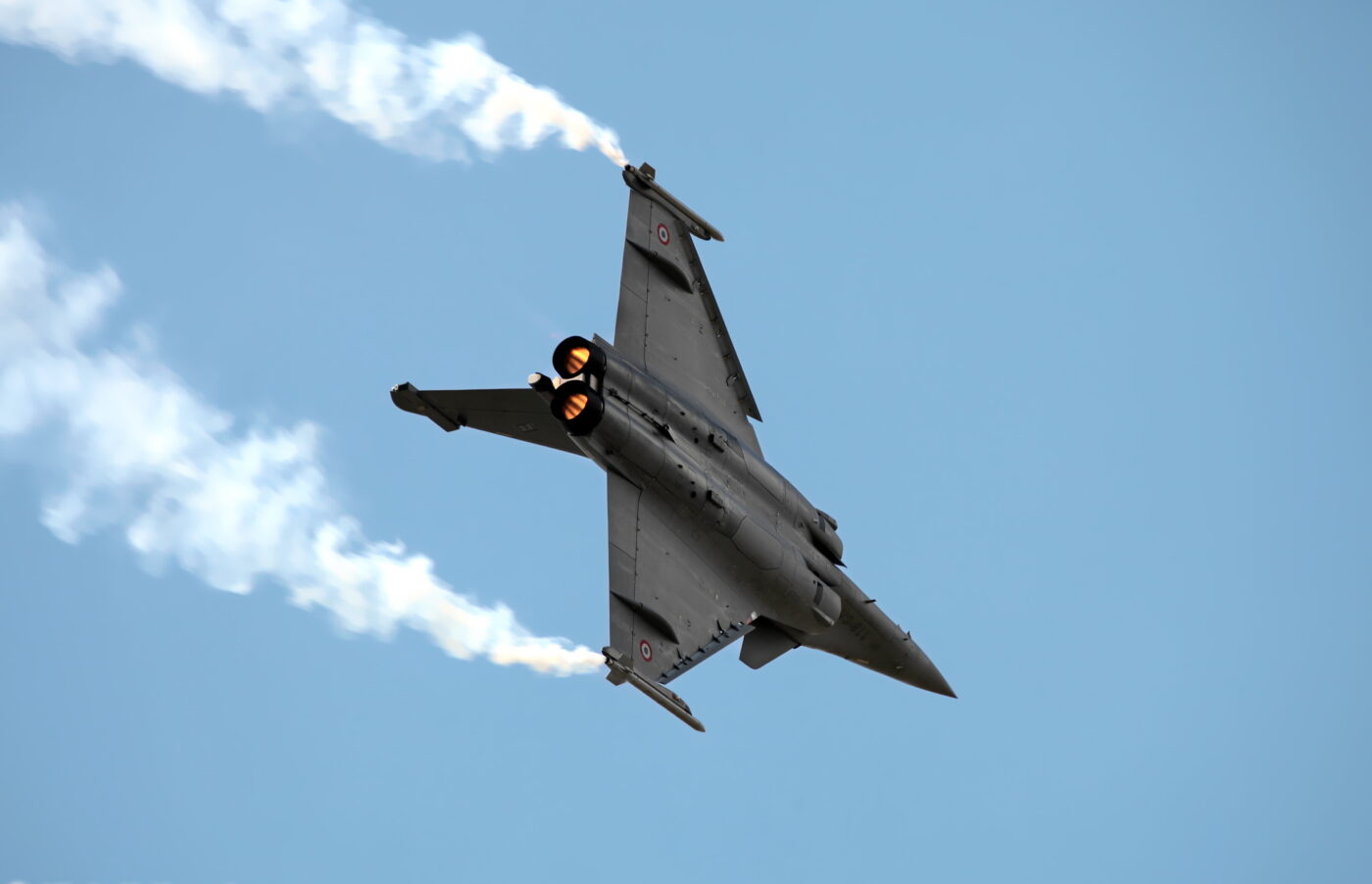
“F5 variant of Rafale will have more powerful engines, improved survivability and data links, and will be accompanied by an unmanned combat air vehicle (UCAV) weighing more than 10t,” Dassault Aviation’s chief executive Officer, Eric Trappier, recently said in an interview.
The Rafale F5 standard is targeting initial operational service capability by 2030. However, integration into the French Air Force and Navy could happen around 2033-2034, with integration of ASN4G hypersonic missiles expected only by 2035.
The aircraft combat fleet target, as per the 2024-2030 military programming law, is unchanged at 225 aircraft by 2035: 185 for the French Air and Space Force and 40 for the French Navy.
However, Bellanger told the Senate that he would need the aircraft sooner, even if they’re of the F4 standard.
“I am going to need more aircraft quickly,” Bellanger told the committee. “If we are not in a position to produce the F5 standard before 2033, we will have to choose the F4, which is already a very fine aircraft, unless the operational contracts of the Air and Space Force on the fighter segment are revised.”
Notably, Bellanger is not alone in demanding more F4-standard Rafale jets sooner, instead of waiting for the F5-standard aircraft.
The Senate committee itself has questioned the design to postpone the induction of 20 Rafale jets so that they can be inducted directly in F5-standard.
It cited the tremendous pressure on the Rafale fleet of the French Air Force, the advanced age of the Rafale Marine aircraft, and mounting operational commitments constraining aircraft availability, according to reports.
Warning that the postponement could widen the capability gap at a critical time, the Senate committee said that the decision seems to be motivated more by budgetary considerations than operational choices.
Notably, in June this year, nearly 80% of the French fighter fleet was airborne at the same time for the first time ever.
Bellanger attributed it to Operation Poker, the quarterly Strategic Air Forces nuclear raid exercise, and intensive deployments in the Near and Middle East, where French Rafales were helping defend Gulf countries against Iranian drones and missiles.
French Rafales are also deployed into Eastern Europe as part of the Baltic Air Policing mission.
In June this year, two French Rafales were scrambled from Siauliai Air Base in northern Lithuania and met up with Gripens to jointly intercept a group of six Russian aircraft, including a Su-35.
📍Lithuania | Interception of 6 🇷🇺 aircrafts within the Baltic air space 🚨✈️
⚡️ Scramble of two 🇫🇷 Rafale aircraft of the Baltic Air Policing 71 detachment, based in Šiauliai 🇱🇹, in order to escort 🇷🇺 aircrafts operating in the Baltic responsibility area.
👀 Visual… pic.twitter.com/eDMIBB7xBI— The 🇫🇷 Joint Staff – Military operations (@FrenchForces) June 4, 2026
“We are overusing the Rafale,” Bellanger said. “Versatility does not mean ubiquity.”
Another reason for overusing the Rafales is France’s expanding nuclear posture.
Earlier this year, French President Emmanuel Macron unveiled the “forward deterrence” nuclear doctrine, proposing to expand France’s independent nuclear deterrent umbrella across Europe.
However, this “forward deterrence” nuclear doctrine would put additional pressure on the Rafale fleet.
Bellanger said that the larger arsenal announced by President Emmanuel Macron at Île Longue in March would “mechanically” force France to reconsider the number of nuclear-armed Rafale B, the single-seat Rafale C assigned to protect them, and potentially its tanker fleet, which remains capped at 15 A330 MRTTs under the updated law.
This would be a major issue for the next programming law, he said, adding that “many more” aircraft would be needed.
“If we expand the nuclear arsenal, it is not so the weapons can sit in storage,” Bellanger said.
Another issue is the tremendous pressure on Dassault Aviation to deliver on its large Rafale orderbook.
France currently has nearly 165 Rafales in its fleet, 41 in the French Navy, and 124 for the French Air Force.
France has a target of 225 Rafale jets by 2035. So Dassault will have to deliver around 60 more Rafales in the coming years.
However, Dassault also has to deliver 165 Rafales for export customers, including India, Egypt, Qatar, Greece, Croatia, the UAE, Serbia, and Indonesia.
This does not include the 100 aircraft that Ukraine has shown intent to acquire, nor the Indian Air Force’s (IAF) proposal for 114 Rafale aircraft, which is currently under active consideration by India’s Ministry of Defense (MoD). If these two deals go through, the numbers will be even more significant, around 380 for export customers and 60 for France.
For perspective, Dassault delivered 26 Rafale fighter jets in 2025, one more than its target of 25. Of the 26 Rafales, 15 were for export customers and 11 for the French armed forces.
A year ago, the Rafale production rate was 2 aircraft a month (24/year). The same has now been increased to 3 per month (36 per year), with plans to increase to 4 per month (48 per year) to handle a growing backlog of orders.
Meanwhile, France’s existing Rafale fleet is working at full capacity, its Rafale Marine fleet is aging rapidly, and the current geopolitical environment and France’s expanding nuclear posture demand more Rafale aircraft sooner rather than later.
Under these circumstances, Bellanger feels that more F4-standard Rafales sooner is preferable to fewer F5-standard Rafales at a later date.
- Sumit Ahlawat has over a decade of experience in news media. He has worked with Press Trust of India, Times Now, Zee News, Economic Times, and Microsoft News. He holds a Master’s Degree in International Media and Modern History from the University of Sheffield, UK.
- He can be reached at ahlawat.sumit85 (at) gmail.com