This year’s Memorial Day, marked on May 25, 2026, was particularly somber for the United States Air Force (USAF), which lost six crew members in a KC-135 crash during the Iran War.
“Memorial Day is personal to us. In 40 years of service, I’ve lost friends, wingmen, and Airmen I had the honour to lead. Today, I remember them all. This year feels especially personal after Zeus 95, where we lost six Airmen in a KC-135 while supporting Operation Epic Fury. I’m thinking of them and their families today. We never forget that some gave all,” General Kenneth S. Wilsbach, the Chief of Staff of the USAF, said on X.
The United States observes Memorial Day on the last Monday of May as a federal holiday to remember and honor service personnel who lost their lives while serving in the US Armed Forces. This year, the holiday comes after the US launched “Operation Epic Fury” against Iran, which escalated into a regionwide conflict and claimed the lives of 13 US personnel.
During the height of hostilities between the two sides, two USAF KC-135 refuellers collided mid-air in friendly airspace in a freaky accident on March 12, 2026.
One of the aircraft sustained damage to its vertical stabilizer, or tail, but managed to steer away and land safely at Ben Gurion Airport in Israel. Meanwhile, the second KC-135—call sign Zeus 95—was unable to recover from the collision and crashed near Turaibil along the Iraqi-Jordanian border.
“U.S. Central Command is aware of the loss of a U.S. KC-135 refueling aircraft. The incident occurred in friendly airspace during Operation Epic Fury, and rescue efforts are ongoing. Two aircraft were involved in the incident. One of the aircraft went down in western Iraq, and the second landed safely. This was not due to hostile fire or friendly fire,” the US Central Command (CENTCOM) said in a statement the same day.
The deceased crew was officially identified on March 14. Three of them were from the 6th Air Refueling Wing at MacDill AFB, Florida, while the other three were from the 121st Air Refueling Wing of the Ohio Air National Guard. The tanker may have been supporting the US fighters that were pounding the Iranian proxies in Iraq.
“We will never forget the KC-135 crew, Zeus 95, that paid the ultimate sacrifice,” Wilsbach said at the time. “These heroes make up our total force team, and we mourn with their families. Their memory strengthens our resolve to fight, as we carry their legacy forward.”
Interestingly, Iran’s proxies in Iraq claimed responsibility for the attack as soon as the crash came to light.
The Islamic Resistance in Iraq (IRI), an umbrella group of Iran-backed Iraqi militias, quickly claimed responsibility.
“In defense of our country’s sovereignty and its airspace violated by the aircraft of the occupation forces, the mujahideen of the Islamic Resistance in Iraq targeted, with appropriate weaponry during the past twenty-four hours, a second aircraft of the KC-135 type belonging to the American occupation in western Iraq. Its crew managed to escape with it after it was hit, and it made an emergency landing at one of the enemy’s airports,” the group said in a statement.
Iranian state media and other media outlets also expectedly promoted the claim made by the militia, portraying it as a successful strike by “resistance groups” against US forces supporting operations against Iran.

“US Central Command said that the crash over Iraq’s western Anbar province had occurred in “friendly airspace” and had not been caused by hostile fire. Initial intelligence reports told a different story. They indicated that the U.S. government had detected anti-aircraft fire by Iran-backed militias in the area around the time of the collision and that the pilots may have been forced to take evasive actions,” it stated.
The US lost a total of 13 service personnel during the Iran War, which ended in a ceasefire after nearly 40 days of fighting, and its KC-135 fleet suffered an unprecedented loss.
The US Lost Several KC-135 Tankers
The Iran War proved more expensive for the USAF than the service had probably envisioned before embarking on the 40-day offensive. In addition to the KC-135 that went down in Iraq and the one that escaped to Israel after the collision, at least five other KC-135 aircraft were damaged (or destroyed) in Iranian missile and drone strikes on bases across the Gulf region.
After the deadly March 12 crash, media reports on March 14 claimed that five KC-135s were damaged while on the ground at Prince Sultan Air Base, Saudi Arabia, during an Iranian missile and drone attack. The base, about 600 kilometres from the Iranian coast, lacked hardened shelters for large aircraft such as the KC-135, which forced the refuellers to park in the open on the apron, becoming “sitting ducks” for Iranian missiles and drones
Due to a lack of clear information from CENTCOM, the extent of damage to each tanker remains unknown. Nevertheless, the high number of KC-135 hits has revealed vulnerability in forward basing valuable assets during a war.
One of the damaged aircraft, a KC-135R Stratotanker 59-1444, likely belonging to an Ohio Air National Guard unit, was spotted landing at RAF Mildenhall in the United Kingdom on April 12, 2026. The photos of the aircraft showed dozens of irregular metal patches over holes and across the fuselage, wings, and tail sections, and were widely shared on social media at the time, as reported by EurAsian Times.
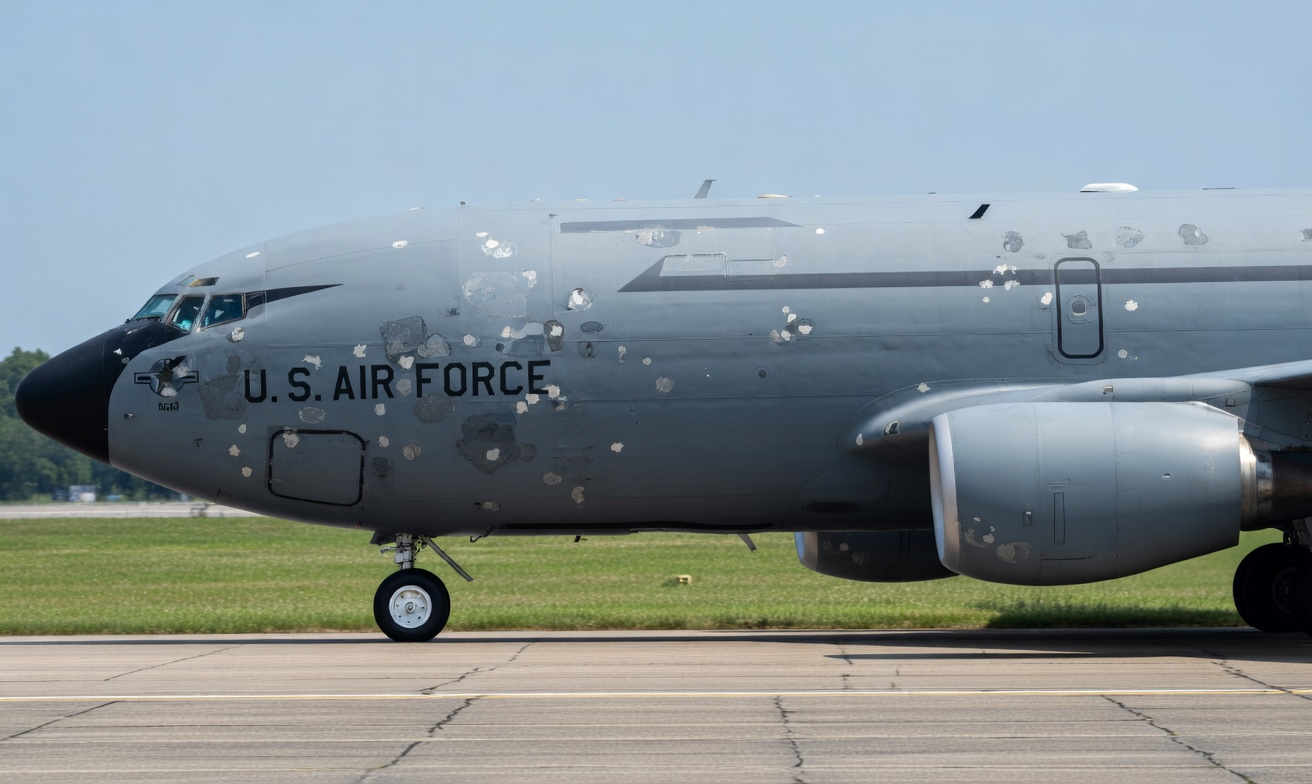
These field-applied patches, officially known as Battle Damage Repairs (BDRs), likely enabled the aircraft to self-deploy from the Middle East to RAF Mildenhall, from which it likely flew to the United States for repairs.
Another KC-135 was photographed at RAF Mildenhall recently, showing visible shrapnel damage on the vertical stabilizer and tail, inflicted by Iran. The photos were taken by aviation photographer Andrew McKelvey.
The KC-135 is an essential “force multiplier” that keeps fighters, bombers, and other aircraft in the air for extended periods. It supports the Air Force, Navy, and Marine Corps, as well as aircraft of allied nations, through aerial refueling. Notably, the significant damage to the USAF’s KC-135 fleet in the Middle East has sparked debate over the strain on the aging tanker fleet during high-tempo operations and its attrition.
The KC-135 fleet relies on parts cannibalized from boneyard-decommissioned aircraft. Furthermore, its replacement, the KC-46 Pegasus, is still smaller than the KC-135 fleet, years behind schedule, and plagued by persistent technical issues.
Following the collapse of post-ceasefire negotiations in Pakistan, the US reportedly ordered the reactivation of the tankers from the boneyard at Davis-Monthan Air Force Base to full duty at Tinker Air Force Base to fill the void created by the damage and be combat-ready for a resumption of war.
The Air Force is required by law to increase the number of refueling aircraft in its fleet from 466 to 478 by October 1, 2027, and then to 502 by October 1, 2028.
The Air Force declared in late April that it was on schedule to fulfill its 466-aircraft requirement by September 30. The service possessed about 370 KC-135s and 105 KC-46 refuelers, according to fiscal 2027 budget documents published in early April, but those numbers did not account for aircraft lost or destroyed during Epic Fury.
- Contact the author at sakshi.tiwari13 (at) outlook.com
- Follow EurAsian Times on Google News