Britain’s far-right, anti-immigration party, Reform UK, has announced that it would stop immigrants from France with the biggest military operation in the English Channel since the Second World War.
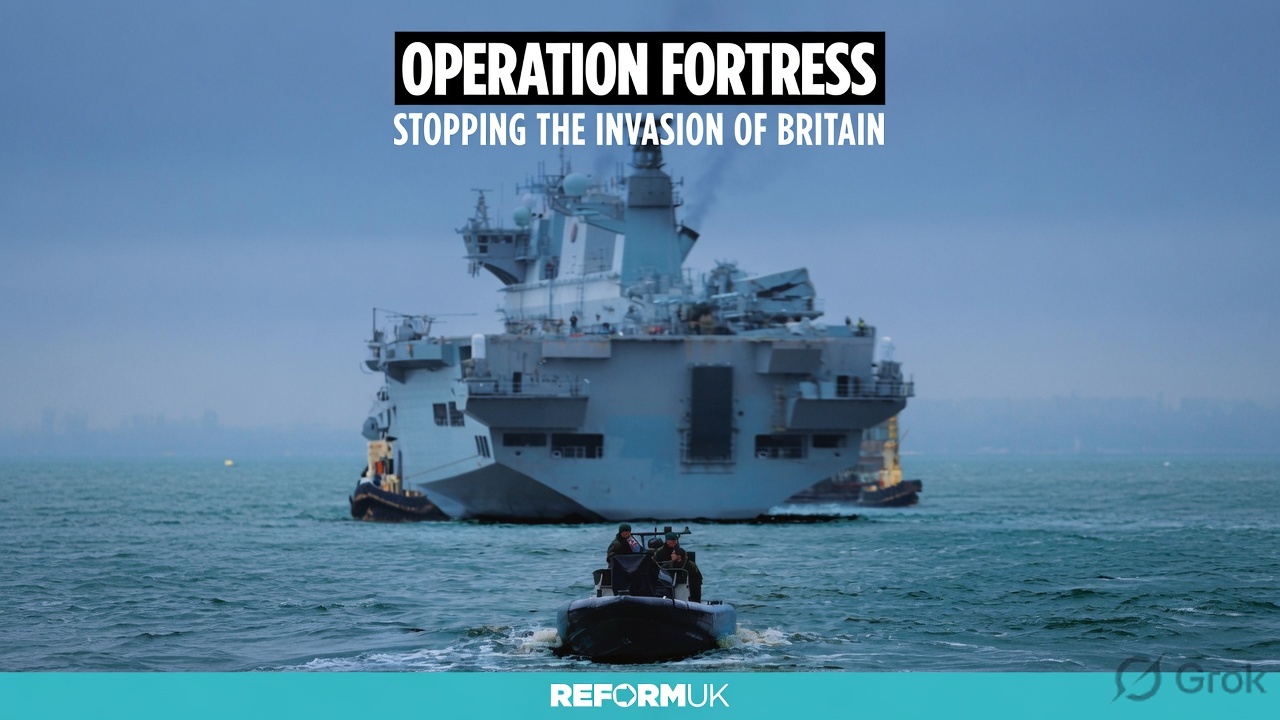
Unveiling the proposal, dubbed “Operation Fortress”, Reform leader Nigel Farage said at a press conference that asylum seekers arriving in small boats from France will be detained and sent back.
“Under a Reform government, within a fortnight, there would be no more boats,” Farage declared, claiming the plan would render Britain’s borders “impenetrable.”
Farage, whose party has recently lost its lead in national opinion polls for the first time in more than a year amid controversies over donations and gifts to senior figures, pointed to the recent migrant surge into the Spanish enclave of Ceuta.
Roughly 60,000 people crossed from Morocco over a few days in late July, with at least 72 deaths from drownings and crushes at the breakwater barriers. “What happened in Ceuta over the weekend shows you just how serious this situation is,” he told reporters.
The Reform UK party has reportedly proposed a joint military command drawing units from the British Army, Royal Navy, Royal Marines, and RAF, supported by a specialized surveillance command to track vessels. The military would stop unauthorized boats, hold those on board, and return them on navy ships. The party said it would introduce emergency legislation “as necessary” to give the command any extra powers required.
“When you think about it, what is the Royal Navy for? If the Royal Navy is not there to protect this country from invasion, then, frankly, I can’t see what its purpose is,” Farage said at the press conference.
Reform UK has said it wants to launch “the largest military operation in the English Channel since World War Two” to stop small boat arrivals.
A Nigel Farage-led government would send the Royal Navy to intercept migrant boats there and return them to France or Belgium.
Labour… pic.twitter.com/TA081Ig5QS
— Channel 4 News (@Channel4News) August 3, 2026
The French Interior Ministry condemned the plan, telling AFP it “would be a violation of French sovereignty as well as a violation of maritime law and international law.”
While the ruling Labor Party vociferously opposed the Reform proposal, Prime Minister Andy Burnham pledged to make “relentless” efforts to halt asylum seekers after new data revealed that over 2,000 people had entered Britain since he took office two weeks ago.
Several former service personnel, particularly ex-Royal Navy officers, have strongly criticized and dismissed Reform UK’s “Operation Fortress” proposal.
The Royal Navy is there to protect this country from invasion and that is what I intend to use it for. pic.twitter.com/jbvTUTEzZR
— Nigel Farage (@Nigel_Farage) August 3, 2026
For example, Retired Royal Navy Commander Tom Sharpe questioned the “substance” of the concept, adding that the navy lacks ships to conduct the operation. “A billion-pound warship that’s configured for anti-air warfare or anti-submarine warfare, which are both threats to the UK, is not best used ferrying people around. You’re better off using an actual ferry,” Sharpe told BBC Radio 4’s Today program.
The concept “sounds magnificent, provided you know nothing about ships, sailors, France, or the law,” said Andrew Fox, a former paratrooper and senior associate fellow at the Henry Jackson Society think tank. He noted that London won’t be able to move warships into French territorial waters, seize boats, or disembark passengers without French permission.
Ben Obese-Jecty, a Conservative MP and former British army officer, dismissed the proposal as “ridiculous”, adding that Reform had announced this ridiculous idea before. Additionally, he pointed out in a post on X that Reform UK’s “Operation Fortress” poster uses the image of HMS Ocean, which was sold to Brazil in 2018.
Meanwhile, Former Royal Navy officer John Foreman CBE dismissed the plan bluntly as “a crock of shit,” in a post on X.
Undeterred by the criticism, Farage justified his proposal, saying, ”humanitarian missions do not violate maritime or international law,” and the party defiantly vowed to “stand up for British interests,” whether French President Emmanuel Macron “likes it or not.”
While experts from both the military and legal domains believe that the proposal is unfeasible, Farage’s call for “the largest military operation” after World War II has created quite a stir and brought back memories of the actual biggest military operations in the channel that changed the face of the WW2 and reversed Germany’s fortunes.
The Largest Operation In The English Channel
The English Channel saw intense, sustained naval warfare throughout the Second World War. However, two operations in particular stand out for sheer scale and are the clear historical benchmarks that Farage invoked.
One of these operations came to be known as Operation Dynamo, or Dunkirk Evacuation, which took place between May 26, 1940, and June 4, 1940.
In May 1940, German forces invaded the Low Countries and France using Blitzkrieg tactics. They rapidly advanced, cutting off the British Expeditionary Force (BEF) and large numbers of French and Belgian troops. Thus, the Allies were driven back towards the English Channel and found themselves trapped in a shrinking pocket around the port of Dunkirk, with their backs to the sea and the prospect of annihilation or capture.
This necessitated an evacuation. Vice Admiral Bertram Ramsay directed the rescue operation from the tunnels beneath Dover Castle.

The Dunkirk harbor was heavily damaged by Luftwaffe bombing, rendering its inner docks unusable. This meant that larger warships could not approach the shallow beaches stretching roughly ten miles east. So, a plan was hatched: two-thirds of the rescued troops boarded destroyers, minesweepers, and other ships from the East Mole, a 1,400-yard breakwater that extended into deeper water. Meanwhile, the remaining one-third were lifted from the open beaches at Malo-les-Bains, Bray-Dunes, and La Panne by small ships.
Nearly a thousand vessels, including Royal Navy destroyers, minesweepers, and merchant ships, formed the backbone of the effort, while hundreds of civilian “little ships” such as yachts, fishing boats, pleasure craft, and lifeboats, ferried men from the shallow beaches to the larger ships waiting offshore or carried them all the way to England.
The Luftwaffe subjected the harbor, beaches, and shipping to intense bombing, while the RAF fought to provide air cover at considerable cost.
Planners initially expected to save only about 45,000 men over a couple of days. However, as the operation progressed, roughly 338,000 troops, including around 224,000 British and some 120,000 French and other Allied soldiers, were brought safely across the Channel.
And, by the time the operation ended on 4 June, the bulk of the British Expeditionary Force had been saved.
The second major operation in the Channel was Operation Neptune, the codename for the naval and amphibious assault phase of the Allied invasion of Normandy on 6 June 1944. This operation apparently formed the seaborne component of the larger Operation Overlord, the plan to liberate north-west Europe from German occupation, and remains the largest seaborne invasion in history.
Admiral Sir Bertram Ramsay of the Royal Navy commanded the Allied Naval Expeditionary Force. The fleet was organized into two task forces: the Western Task Force for the American beaches and the Eastern Task Force for the British and Canadian beaches.
Allied forces assembled in ports along the southern coast of England, then crossed the English Channel overnight on 5–6 June 1944 to land on the beaches of Normandy in German-occupied France. The distance varied by route and beach but was typically between about 60 and 100 miles.
The naval armada of nearly 7,000 vessels transported troops, vehicles, and supplies through these waters under the protection of warships and air cover.
The successful execution of Neptune opened the long-awaited second front in Western Europe and marked the beginning of the final campaign against Nazi Germany.
- Contact the author at sakshi.tiwari13 (at) outlook.com
- Follow EurAsian Times on Google News