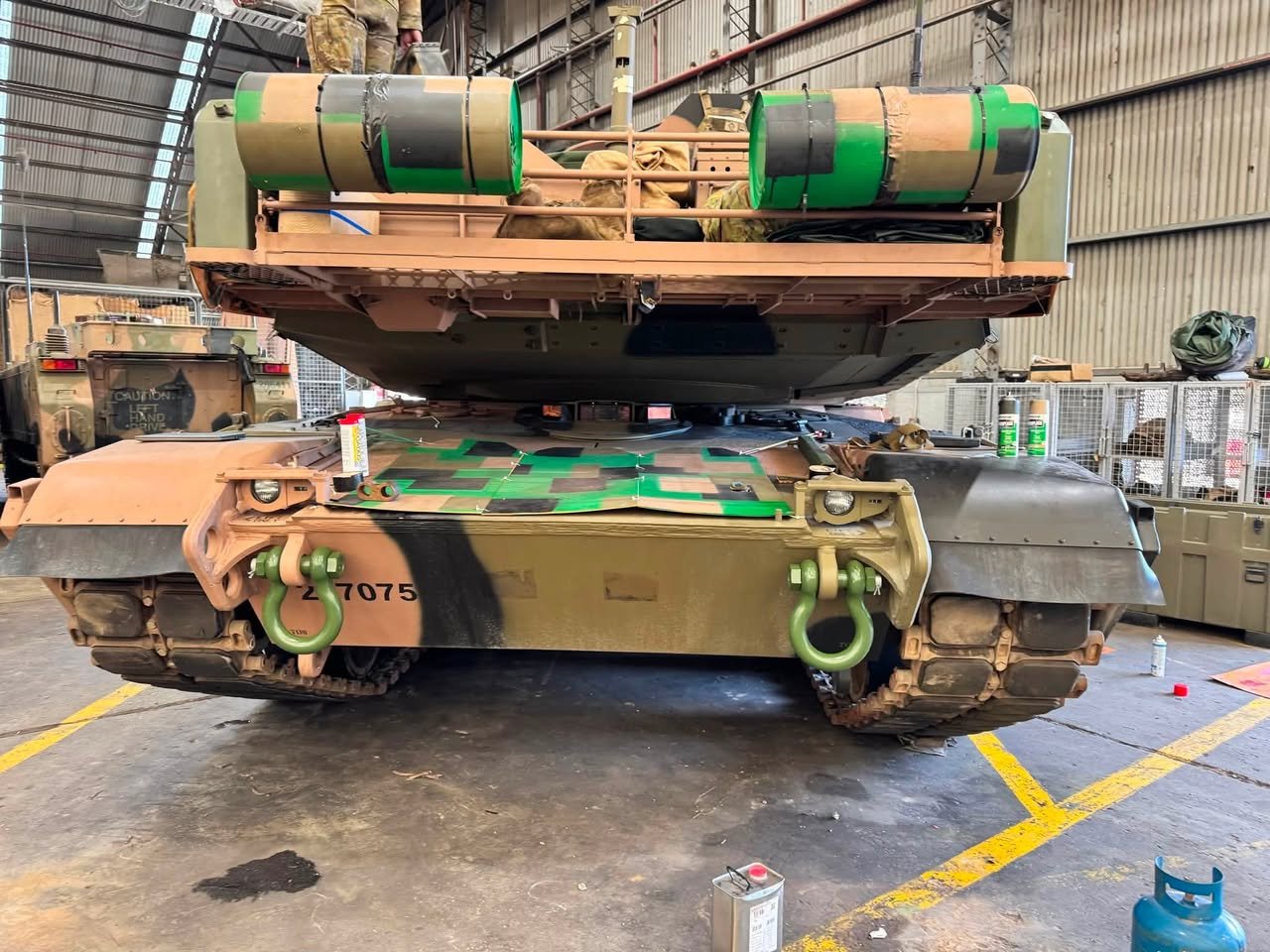
The Australian Army recently published images of an M1A2 Abrams Main Battle Tank disguised as a Chinese Type 99 for Opposing Force (OPFOR) training, a move that demonstrates Canberra’s preparation to counter the People’s Liberation Army (PLA) in the Indo-Pacific.
The photos appeared last week on the Facebook account of the Australian Army’s School of Armor at Puckapunyal Military Area in Victoria.
Soldiers from B Squadron, 3rd/4th Cavalry Regiment, prepared the tank as part of the Royal Australian Armored Corps Officer Basic Course (ROBC). The course culminates in Exercise Tungsten Forge/Gauntlet Strike, a combined-arms capstone event for junior officers in mechanized warfare.
The modifications to the M1A2 MBT—the backbone of the Australian Army—include PLA-style “digital” camouflage with prominent blocks in four colors, including China’s signature bright green. In addition, a dummy external fuel tank is visible on the turret rear, a common feature on Russian and Chinese tanks.
Australia’s decision to use what appears to be a Type 99 surrogate represents a notable shift in its security posture, in line with the 2023 Strategic Defense Review, which listed China as the biggest security threat. Moreover, it may also signal Canberra’s readiness to publicly acknowledge the possibility of confronting cutting-edge Chinese armor in the future.
The disguise helps soldiers practice critical skills, including target recognition, vehicle identification, battlefield observation, and tactical decision-making.
Australia selected the Type 99 because it is the PLA’s most advanced and widely fielded third-generation main battle tank, featuring composite armor, a 125mm smoothbore gun with autoloader, modern fire control systems, and ATGM capability.
Nonetheless, the latest photos showing the tank surrogate are significant because they demonstrate that China is not the only one to develop visual modification (VISMOD) of opposing force (OPFOR) vehicles or mock-ups for training purposes.
Since visual familiarity and tactical repetition greatly increase combat effectiveness, militaries worldwide frequently modify existing platforms or build specialized copies to emulate opposing capabilities.
For example, the US Army’s National Training Center (NTC) at Fort Irwin, California, is considered the gold standard, fielding an extensive fleet of visually modified (VISMOD) vehicles that replicate Russian and Chinese systems. These include surrogate T-72 and T-80 tanks based on the M113 chassis or older Abrams chassis, as well as BTR-90 armored personnel carriers, among others.
Last year, the US reportedly unveiled a replica of a Chinese HQ-16 air defense missile system at the Experimental Aircraft Association’s AirVenture Show in Oshkosh, Wisconsin, as EurAsian Times reported at the time. Similarly, a replica of a Chinese Type 99 was spotted somewhere in Arkansas in 2021.
China Practices Against Western Targets Too
Last month, a structure resembling a US Navy Arleigh Burke-class guided-missile destroyer was spotted at Ruoqiang Test Range in China’s Taklamakan Desert, located in the far-western Xinjiang region. The full-scale replica of the US destroyer was reportedly captured in satellite images of the facility, as the EurAsian Times reported at the time.
Arleigh Burke-class destroyers serve as the backbone of US Navy surface operations and will most certainly be part of a US-China conflict.
Similarly, satellite imagery in 2021 spotted mock-ups of an American aircraft carrier and two Arleigh Burke-class destroyers at the same testing range. Meanwhile, satellite photos from January 2024 revealed a full-scale black silhouette measuring roughly 1,085 feet and resembling the USS Gerald R. Ford, the newest and largest aircraft carrier of the US Navy.
China is also said to have practiced destroying the F-35 Lightning II and the F-22 Raptor, two American stealth aircraft. Satellite imagery in July 2024 showed what was thought to be the aftermath of a Chinese military attack against American stealth aircraft, based on the burnt F-35s and F-22s positioned at one end of a lengthy runway.
Not just that, the mock-ups of the U-2 surveillance plane and the P-8A Poseidon were also purportedly present at the location, suggesting the scope of Chinese preparations against the US military in a prospective conflict.
Much like the aircraft and the ships, China has created surrogates and mock-ups of US-origin ground-based systems. A remote-controlled target tank resembling the Abrams tank was seen at a 2021 air show in China.
During its two-day war games in December 2025, codenamed “Justice Mission 2025,” the PLA had explicitly simulated strikes on Taiwan’s high-value land-based targets such as the HIMARS launchers. The Chinese state media reportedly showed scenarios where long-range rockets, such as the PCL-191, were fired after “confirming” HIMARS positions.
This is an incomplete list of incidents in which China or its adversaries, such as the US and its allies, have turned to surrogate weapons or mock-ups to train for a potential military contingency. With the looming threat of a conflict in the Indo-Pacific, stakeholders have ramped up realistic combat training, and surrogates and mock-ups enhance the effort by providing visual, structural, and sometimes functional replicas of adversary equipment for live-fire, sensor, or AI-driven drills.
As the 2024 Defense Update emphasized, Australia must assume that any major conflict in the region will involve the rapid employment of integrated joint forces against a capable, technologically sophisticated adversary—making realistic opposing-force training essential for operational effectiveness and survivability.
- Contact the author at sakshi.tiwari13 (at) outlook.com
- Follow EurAsian Times on Google News