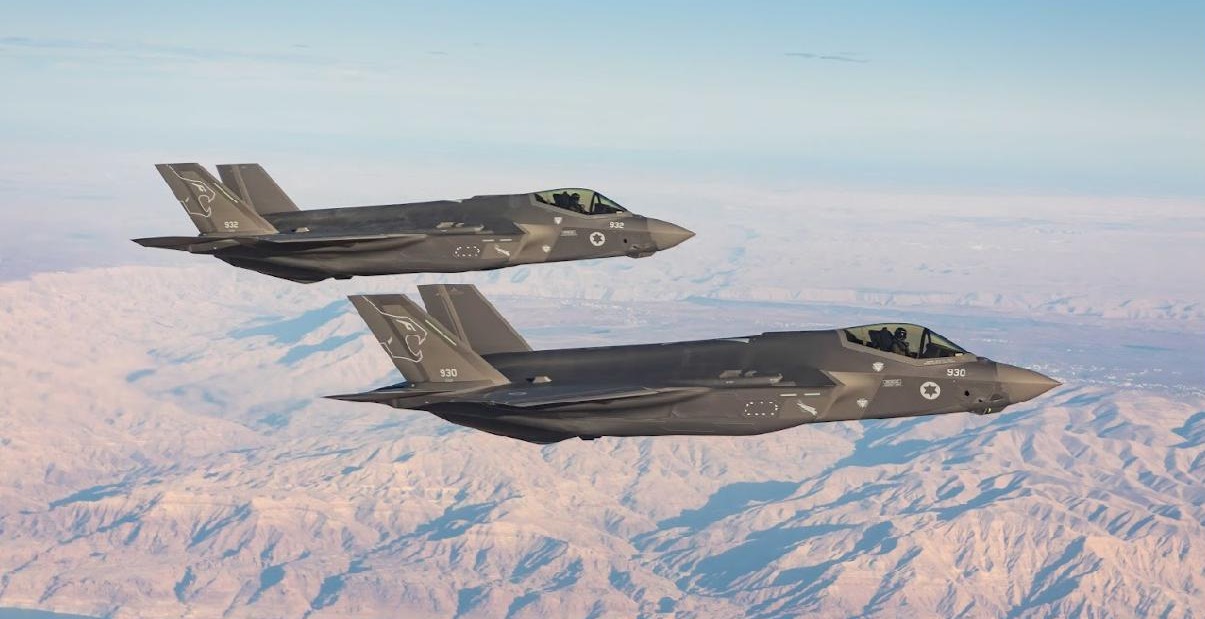
Turkey has startled the world with its rapid rise in military technology, particularly in drone warfare. However, it is now charging full steam ahead with the development and testing of the KAAN combat aircraft, a move that will place it in the elite group of nations with stealth fighters
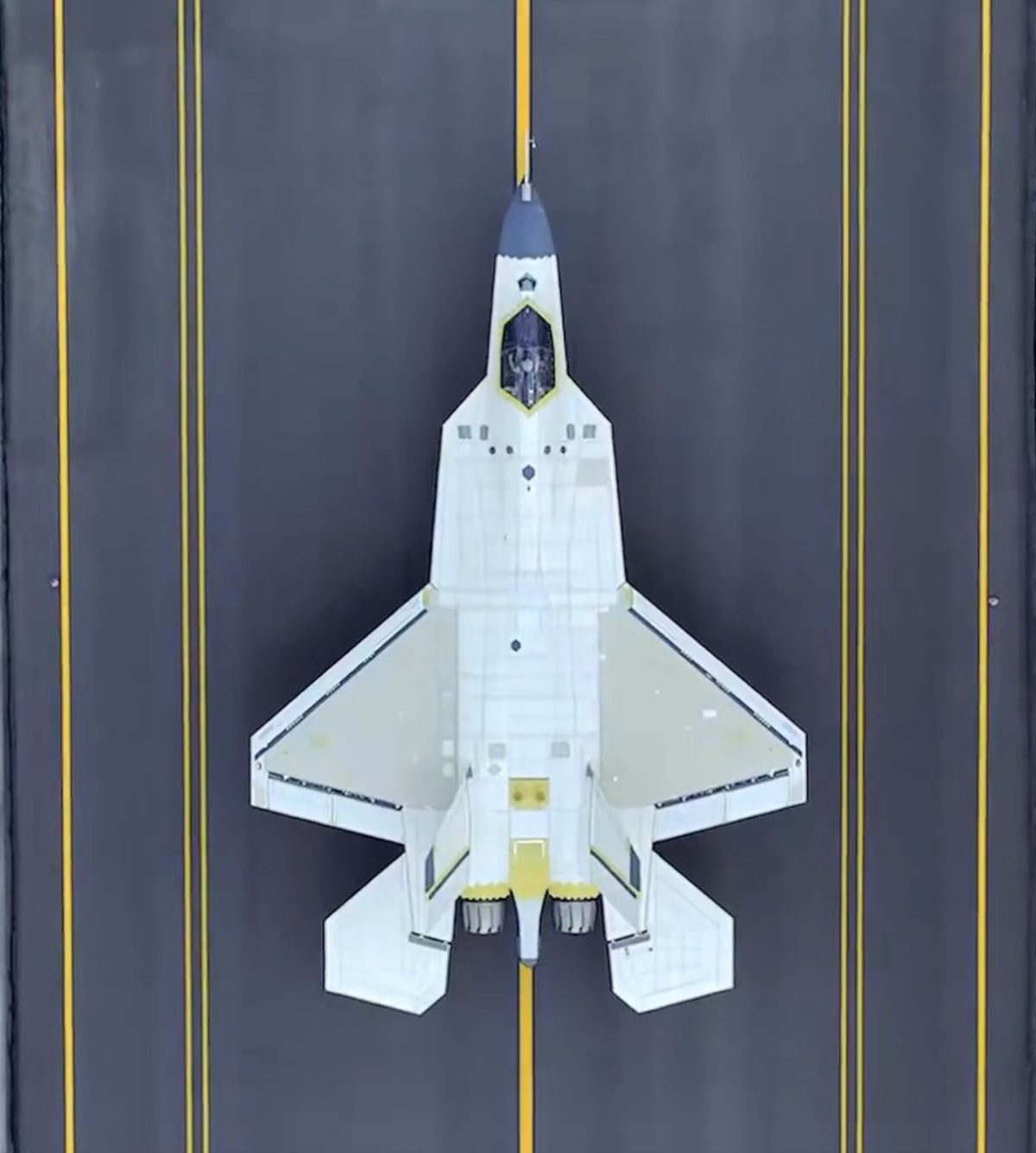
Turkish Aerospace Industries (TAI) recently released a video of KAAN’s new prototype performing powered taxi testing, suggesting that the first flight may be imminent. The video, posted on X, shows the aircraft moving on its own, verifying the functionality of the engine, brakes, steering, and flight control systems prior to flight clearance.
The new prototype, known as P1, is based on the original P0, which flew for the first time in February 2024, as EurAsian Times reported at the time.
However, the P1 is considered a more mature aircraft that will be crucial to the fighter development and testing campaign. The P0 prototype was constructed to confirm the aircraft’s fundamental flight characteristics, flight control system, and core platform. The P1, by contrast, incorporates a more advanced systems architecture and is intended to carry the bulk of performance, avionics, and mission-systems validation.
Notably, a second prototype, P2, remains in parallel production and integration, with the goal of having both aircraft flying by the end of 2026 to accelerate the test campaign through concurrent work.
😉#KAAN pic.twitter.com/wWXXweP4af
— Türk Havacılık Uzay Sanayii (@TUSAS_TR) July 31, 2026
TAI CEO Mehmet Demiroğlu earlier stated e that the company hopes to see KAAN airborne within a few months and aims to have the second aircraft flying by year-end. “We hope to see KAAN in the sky within a few months. We also aim to fly the second aircraft by the end of the year. Our goal is to have two KAANs flying one after the other, or side by side, at year-end,” Demiroglu said at the Farnborough Airshow in the UK last month
Turkey plans three pre-production prototypes followed by series production of 250 aircraft. A deal was reportedly signed last month for 20 units of the original Block 10 KAAN
Notably, the P1 symbolizes the Kaan program’s evolution from a technology demonstrator into a developmental test fleet. It demonstrates that the program is proceeding at a speed to match the aspirational schedule of delivering the jets to the Turkish Air Force by 2028.
In addition to accelerated development and testing, the KAAN received another big boost last month when the US cleared for export the General Electric-made F110 engines initially destined to power the plane, removing a major roadblock in the program. Simultaneously, TAI is advancing work on the indigenous TF35000, which will power the aircraft in the long run, as EurAsian Times reported earlier.
The induction of the KAAN fighter will transform the Turkish Air Force, which has been operating aging F-16s since Ankara’s removal from the F-35 program in 2019 over its purchase of Russia’s S-400. The expulsion pushed Turkey to develop its own advanced fighter, aiming to achieve technological sovereignty and reduce dependence on the US.
More significantly, KAAN is Turkey’s most ambitious defense project in decades, positioning the country among the select group of nations that have independently designed and built a fifth-generation stealth aircraft. This progress aligns with Ankara’s broader emergence as a major defense producer and innovator, most notably in drones.
Turkey seems to be overtly prioritizing stealth, as evidenced by the development of KAAN. The KAAN is a twin-engine, single-seat stealth fighter featuring internal weapons bays, low-observable shape, and composite materials that improve stealth by lowering weight and radar signature. Furthermore, it carries a range of weapons internally, including air-to-air and air-to-ground munitions, such as indigenous Gökdoğan (BVR) and Bozdoğan (WVR) missiles, to bolster lethality while preserving stealth.
Alongside the manned fighter, Turkey continues advancing stealth unmanned systems. This includes the Anka-3, the first flying-wing, deep-strike drone developed by Turkish Aerospace Industries. According to reports, this stealthy unmanned combat aerial vehicle (UCAV) is currently advancing toward serial production, with design upgrades to intakes, exhausts, antennas, and other components.
More importantly, Turkey’s list of unmanned stealth aircraft prominently features the Kizilelma, an unmanned fighter jet expected to conduct a wide range of military operations.
The Bayraktar Kızılelma incorporates low-observable design features. It is routinely described by Baykar and Turkish defense officials as a low-RCS (radar cross-section) unmanned fighter. In fact, the Kizilelma recently conducted a weapons-firing test that further added to its stealth characteristics.
Stealthy Kizilelma Fired From Internal Weapons Bay
Last month, Kizilelma successfully conducted its first live-fire tests from its internal weapons bay, achieving direct hits. The test was reportedly conducted at the Corlu Flight Training and Test Center in the northwestern province of Tekirdag, using the production model with tail number S2 and Roketsan’s TEBER-82 munition and TOLUN munitions.
Baykar hailed the test as a historic milestone that confirms the jet’s ability to attack with precision while maintaining a low radar signature.
It is worth mentioning that external weapons, pylons, and the cavities they create dramatically increase an aircraft’s RCS. In fact, even a well-shaped low-observable airframe loses much of its stealth advantage once munitions are hung outside.
By successfully firing precision-guided munitions from the internal bay on the serial prototype, Kızılelma demonstrated that it can carry and release weapons without compromising its clean, low-RCS airframe, conduct stand-in or penetrating attacks in contested airspace while remaining harder to detect, and maintain higher speed and better aerodynamic efficiency.
“Thanks to its internal weapons bay, Kizilelma will be able to penetrate deep into hostile territory and strike using indigenous munitions while maintaining a low radar signature,” Baykar said, adding that internal carriage allows it to function “more effectively in areas with dense air defense coverage.
#KIZILELMA ✈️🚀🍎
✅ TEBER-82 & TOLUN-P Munition Firing Test from the Internal Weapons Bay
🎯 Bull’s Eye#Baykar 🤝 @Roketsan 🤝 @Aselsan#NationalTechnologyInitiative 🌍🇹🇷 pic.twitter.com/hw6ukagjGU
— BAYKAR (@BaykarTech) July 30, 2026
The Kizilelma is a stealthy multi-role unmanned platform designed for air-to-air combat, air-to-ground strikes, ISR (intelligence, surveillance, reconnaissance), close air support (CAS), missile strikes, suppression of enemy air defenses (SEAD), and destruction of enemy air defenses (DEAD), among other things.
“Bayraktar Kizilelma made its first flight in 2022. Since then, intensive flight activities have continued. Serial production was completed last year, and our goal this year is to place Kizilelma into service for Türkiye,” Bayraktar said at SAHA 2026.
The platform integrates Artificial Intelligence and can be operated out of aircraft carriers, according to the manufacturer, although those capabilities are still being refined. Moreover, it can fly alongside KAAN in a manned-unmanned teaming configuration (MUMT), adding what is referred to as “affordable mass” and substantially reducing the risk to manned fighters in contested environments,
If the current trajectory holds, KAAN and stealthy unmanned platforms will strengthen Turkish airpower and advance Ankara’s goal of self-reliance.
- Contact the author at sakshi.tiwari13 (at) outlook.com
- Follow EurAsian Times on Google News