


Rear Admiral Girish Kumar Garg, VSM (Retd)
The Holistic Development of Great Nicobar Island remains a landmark project of the Government of India with major economic and strategic significance, positioned near the strategic Malacca Strait.
As of late October 2026, the project continues to advance through tenders and clearances across its four main components—an International Container Transshipment Port at Galathea Bay, a dual-use greenfield airport, a power plant, and a township—while legal and political scrutiny persists.
The Greenfield International Airport is an important part of the project.
The dual-use, Military-Civil airport will have a 3000-meter runway in Phase 1 and an initial capacity of 4000 PHP (Peak Hour Passengers).
This airport will be one of the Project’s most important components, especially given the island’s unique location and limited alternate connectivity options.
A transshipment port without reliable air connectivity will be severely handicapped. The Project’s strategic nature requires rapid reinforcement and an efficient air bridge.
Apart from supporting civilian connectivity, it will facilitate tourism, provide a logistics bridge, support emergency medical evacuation, and enable rapid induction/deinduction of military personnel and equipment. The airport would therefore support multiple elements of the project simultaneously.
Critics have raised concerns in the public domain, arguing that the runway and allied facilities at INS Baaz, the Naval Air Base at Great Nicobar, cannot be extended and thereby obviate the ‘wasteful’ expenditure on the Greenfield airport.
It is a valid concern, and one cannot fault this argument.
INS Baaz is a small Naval Air Station with a runway of approx. 1000 meters in length. It is therefore unsuitable for any commercial aircraft and most military aircraft operations.
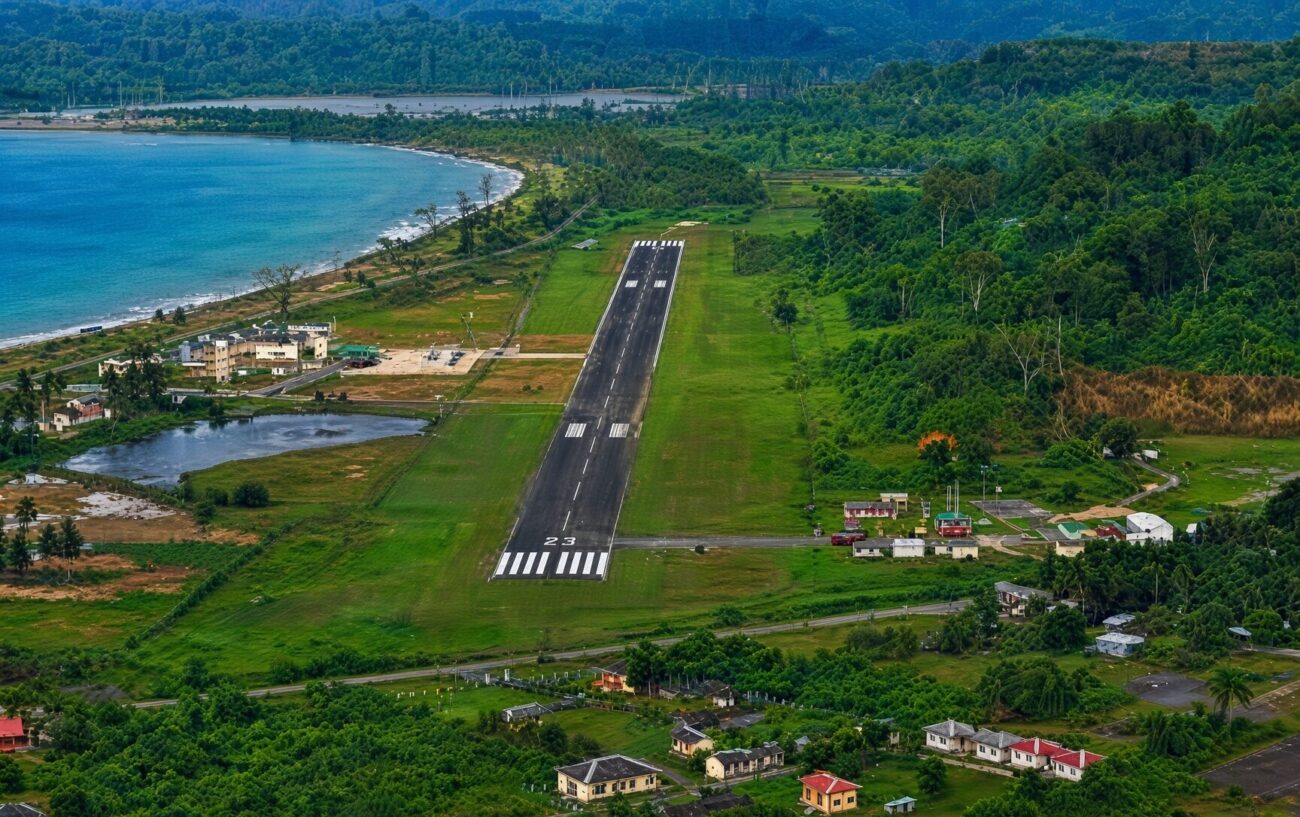
Only small turboprop aircraft like the Dorniers can land there. It has very limited real estate and most facilities are housed in temporary structures.
The INS Baaz extension was, of course, the first option and was extensively examined by an independent professional body specializing in airport construction, in consultation with various stakeholders.
However, the INS Baaz runway was found unfeasible to extend for several reasons.
Firstly, this would require cutting the hill on one side, which falls within the ICAO OLS (Obstacle Limitation Surfaces). Apart from this being an ecological disaster, the hill is traversed by the critical East-West Road. If that goes, the island would lose connectivity.
Secondly, on the other side is the sea, which would require huge reclamation to meet the mandatory ICAO safety regulations. This would adversely affect the area’s fragile marine ecosystem.
Thirdly, the project would adversely affect the highly eco-sensitive, perennial Magar Nallah, which is more than a freshwater resource for Great Nicobar; it forms an important ecological corridor linking Great Nicobar’s forested interior with its coastal environment.
It supports a diverse variety of aquatic and semi-aquatic fauna. It links the island’s pristine forests and wetlands with the Andaman Sea, allowing these seemingly separate ecosystems to function as one interconnected ecological system.
Fourth, almost 80% of Great Nicobar Island’s population lives around INS Baaz.
The area includes extensive private and public infrastructure. Under the mandatory landing/take-off safety arc required by ICAO regulations, a significant part of this infrastructure would have to be removed and relocated. This would cause tremendous inconvenience to the local populace.
Fifth, because of the restrictions on approaches from the south, the airport could be approached from only one direction (North-East); therefore, it would be available for operations only when the wind is from the third quadrant or calm. Thus, the airport would be available about 50% of the time.
Sixth, most of the additional land required for the runway extension and airport infrastructure was private. Apart from the challenges of such land acquisition, it would have displaced a large population, which was highly undesirable.
The idea of INS Baaz runway extension therefore had to be jettisoned. Consequently, the greenfield airport had to be developed at an alternate site.
The proposed airport location largely consists of revenue (government) land and has few families living in non-permanent dwellings. It has large barren tracts and poses no significant ecological challenge.
The airport will be a bi-directional, all-weather airport with scope for further runway extension in the future, if required. The available land would meet anticipated expansion requirements up to 2075, which was not feasible beyond the immediate area in the case of the INS Baaz runway extension.
Also, the airport will be adjacent to the proposed International Container Transshipment Port (ICTP) and the other ecosystem being developed as part of the Holistic Development of Great Nicobar Island. It would therefore provide good, close support. The airport at INS Baaz would have been 45 kms away from the ICTP.
The extension of INS Baaz, though desirable, was not feasible. If it had still been pursued, it would have faced resistance from the local population, as it would not only have adversely affected local connectivity but also displaced many homes.
Moreover, beyond being ecologically disruptive, it would have been costlier and would have required much longer timelines. The airport must meet the ICTP timelines. This would have been highly improbable for the INS Baaz extension.
The current site for the proposed airport ticked all the right boxes. Thankfully.
- OPED By Admiral (R) Girish Kumar Garg
- This is an Opinion Article. Views Personal of the Author
- The writer is a retired Rear Admiral and was the Naval Officer-in-Charge (A&N Islands)