As the tussle for power over Syria in the post-Bashar al-Assad era continues, Israel and Turkey appear to be ambling towards a possible military confrontation.
Israel carried out eight airstrikes on the runway and storage facilities at the Abu al-Duhur base near Aleppo in northwest Syria this week. This marked the first Israeli strike on a Syrian airbase since March 2026, when it had struck two facilities, including the T4 in Homs and the Palmyra airbases.
Responding to the strikes on the airbase, barely 70 kilometers from the Turkish border, Ankara said that the attack violated Syria’s sovereignty.
Ankara was reportedly ready to scramble its “aging” F-16s to counter IDF aircraft.
“We call on the international community to take a more decisive stance to end Israel’s escalating aggression against Syria,” the Turkish Foreign Ministry said in a statement immediately after the strike.
Israeli Prime Minister Benjamin Netanyahu’s office acknowledged the strikes later, saying Syria was about to violate a “status quo agreed with Israel in security matters” by allowing Turkish troops to deploy at the airbase.
“Israel repeatedly warned Syria that such a deployment would pose a threat to Israel’s security. Syria chose to ignore these warnings,” the Prime Minister’s office said in the statement. “Israel will not tolerate threats to its security,” yet “would welcome a return to the status quo.”
Syrian officials later admitted that a Turkish delegation had visited an air base the day before it was struck by Israel. However, Syrian Foreign Minister Asaad Al-Shaibani told Axios that Israel was informed that Syria was not collaborating with Turkey to establish a military presence at a Syrian airbase, but it proceeded to bomb the location anyway.
Observers say that the strikes are consistent with Israel’s policy of neutralizing the Syrian air force, evident since Bashar al-Assad’s regime fell in December 2024. In fact, the strikes were launched a week after Su-22s were spotted flying in Syrian skies, indicating that the country was rebuilding its aerial capabilities.
Israel views the new Syrian government with suspicion due to their Islamist roots and close engagement with Turkey, which was one of the first Muslim states to recognize the Ahmad al-Sharaa government.
Moreover, both Israel and Turkey see Syria as a zone for expanding their regional footprint. While Israel occupies a buffer zone in the south and has been able to seize more territory in the Golan Heights since Assad’s overthrow, Turkey has supported opposition troops and is attempting to exert influence in northern Syria.
Israel has repeatedly signaled it opposes a Turkish military foothold in the country or assistance that could strengthen Syrian air capabilities, and potentially threaten Tel Aviv. Earlier this year, reports indicated that Turkish military teams examined at least three air bases in Syria near Palmyra where they planned to deploy troops, but Israel bombed the sites and rendered them useless.
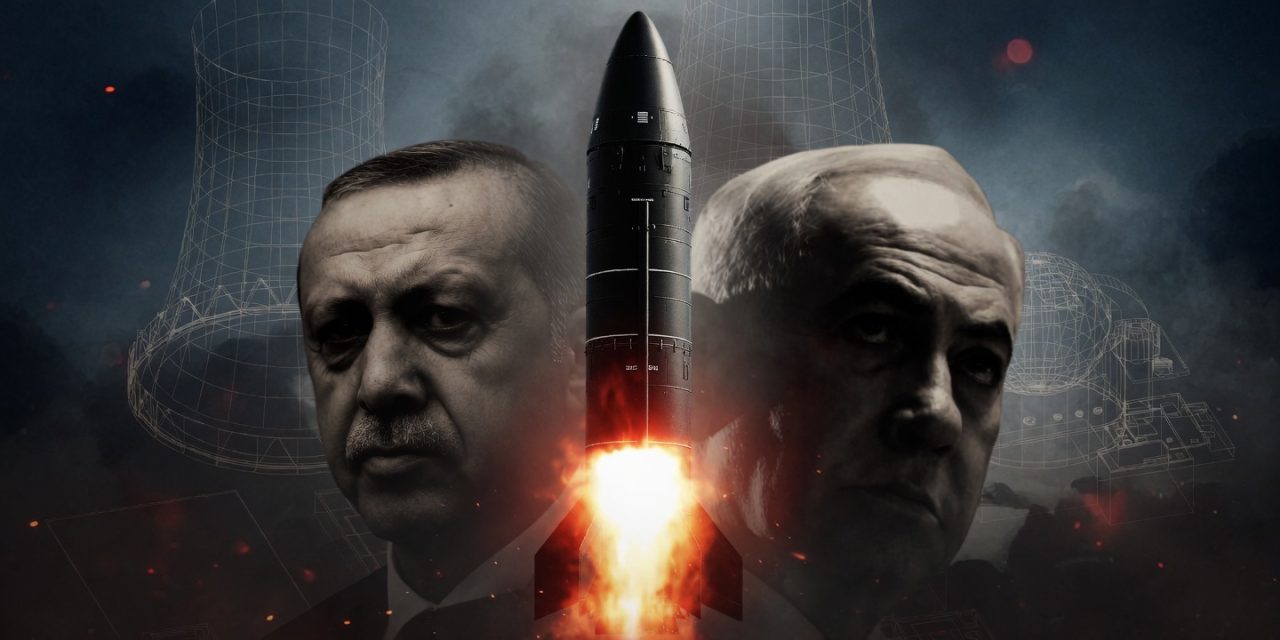
Following this, the two sides reached an agreement in May 2026 to prevent untoward incidents and set up a hotline to avert clashes.
On its part, Turkey has vociferously condemned the Israeli strikes on the Syrian facility.
The claims “aim to legitimize Israel’s unlawful air strikes targeting the sovereignty and territorial integrity of Syria,” the Turkish Presidential Communications Directorate said in a post on X. It linked the accusations to Netanyahu’s intention to carry out “expansionist and destabilizing policies” in the region prior to Israel’s general elections, and added that Turkey would “steadfastly continue its cooperation with the Syrian government on legitimate grounds” and “never allow Syria to be destabilized.”
Even the United States—chief Israel patron, Turkey’s NATO ally, and partner of the new Ahmad al-Sharaa government—denounced the strikes.
The US is “deeply concerned that the confirmed Israeli airstrikes on Abu al-Duhur Airbase constitute an unnecessary escalation that does not advance regional stability,” Tom Barrack, US ambassador to Turkey and special envoy to Syria and Iraq, said in a post on X.
“The United States continues to believe that restraint and engagement offer the more constructive course. We encourage all parties to prioritize logical discourse over further military incidents,” he added.
Furthermore, Barrack warned that the Israeli strike on a Syrian airbase near the Turkish border risked a major escalation between Tel Aviv’s and Ankara’s fighter jets if the latter misread the situation.
Risk Of Escalation
The strike “carried a real risk of rapid escalation into a direct military confrontation between Israel and Turkey as well as Syria,” Tom Barrack said.
“Turkish forces were not aware that the Israeli aircraft were en route to that specific Syrian base, nor of their intended purpose, and therefore could potentially have been inclined to scramble their own jets in the belief that they themselves were under attack,” Barrack said in an interview with The Jerusalem Post on August 19. “The events of yesterday were serious and worrisome. However, we are relieved that no human life was harmed and that the situation did not escalate,” he added.
Barrack told the Post that the situation might have been “much worse” without clear lines of communication, adding that “this has to improve.”
This animosity between Turkey and Israel is, in part, based on the fact that both countries are emerging as the two strongest non-Arab powers vying for dominance in the Middle East and the wider Eastern Mediterranean region. Furthermore, the two nations are virtually at odds because they hold radically different political philosophies.
For example, Turkey has consistently denounced Israel’s actions in Gaza, and even issued arrest warrants for war crimes committed in Gaza since October 2023 against Israeli Prime Minister Benjamin Netanyahu. You can read a detailed report about the power struggle between the two states here.
When asked about the latest bombing and the potential for escalation, Shay Gal, Ex-Vice President of External Relations at Israel Aerospace Industries (IAI), told the EurAsian Times, “Israel is not seeking war with Turkey. The danger is Ankara creating a military fait accompli, assuming Jerusalem will no longer reverse. Abu al-Duhur answers that assumption. The first Turkish soldier changes the price of an Israeli strike. He does not decide whether it happens. Tom Barrack reverses responsibility. The attempted Turkish deployment altered the military status quo; Israel enforced its red line.”
“Deconfliction can prevent accidents. It cannot protect a deployment Israel has already defined as a threat. Washington may cultivate Erdogan. Its envoy in Ankara does not determine Israeli red lines. Nor can Ankara carry NATO protection abroad in a uniform. Turkish troops do not turn Syrian or occupied Cypriot soil into Turkish territory. Article 5 is not automatic; NATO acts by consensus, and Turkish membership raises the price of confrontation without ceding the decision to Ankara,” Gal added.
There have been incidents in the past where Israeli and Turkish fighter jets had close encounters.
For example, Turkish media reported in September 2011 that two Israeli F-15 jets approached a Turkish seismic research vessel near Cyprus, prompting Turkey to scramble F-16 fighters from Incirlik Air Base. Meanwhile, some reports, which EurAsian Times cannot authenticate, alleged that Turkish F-16 and Israeli F-15s were involved in a dogfight over Hatay province in January, 2012.
With a significant proportion of state-of-the-art fighters, such as the F-35I Adir stealth jets, F-15s, and F-16s, as well as indigenous upgrades and superior pilot training, Israel boasts an enviable air force.
Turkey, on the other hand, has a larger air force, although it fields the older F-16C/D jet as its cornerstone. Additionally, the Turkish Air Force has a host of cutting-edge combat drones that augment its capabilities and perform a variety of missions, and it is currently upgrading existing F-16s and acquiring Eurofighter Typhoons.

“Turkey remains a serious air power. Israel brings stealth, intelligence penetration, electronic warfare, integration, precision, and recent strategic depth combat experience. Iran demonstrated sustained campaigning at strategic depth; Yemen, repeated long-range reach,” Gal told the EurAsian Times.
However, “it is not the fighter jet, it is the pilot” when comparing the performance of aircraft of different generations.
For example, Iran’s archaic F-5 conducted a daring low-pass mission to bomb Camp Buehring in northwestern Kuwait, a major staging ground for US military operations, during the war.
- Contact the author at sakshi.tiwari13 (at) outlook.com
- Follow EurAsian Times on Google News