Even as the U.S. develops Golden Dome, its space-based, multi-layered missile defense system, China may already be pursuing a countermeasure: an orbital strike platform that could possibly hit any target on Earth within minutes.
The backbone of this alleged capability could be China’s reusable spaceplane, the Shenlong.
It has undergone multiple testing phases since 2020, has dual-use military potential, and could be adapted into an orbital weapon system.
According to a new study by Chinese researchers, a fleet of just 40 such maneuverable spaceplanes, stationed in orbit and ready to descend on command, would be sufficient to achieve global strike coverage.
Once ordered to attack, it could begin its descent toward a target in as little as 150 seconds, the Chinese paper claims.
This rapid-response capability would not only slash reaction times for traditional ground-based missile defense systems, but also complicate the architecture of the U.S.’s planned Golden Dome, as it would also need to monitor multiple spaceplanes deployed in orbit.
The Military Potential Of China’s Reusable Spaceplanes
In October, the US Defense Intelligence Agency (DIA) released a rare image of China’s spaceplane in orbit.
Captured in 2024 by Vantor, a US-based space intelligence company, the image showed a satellite docked to the spacecraft, with its payload bay doors open.
The image offered an unusually detailed view of China’s top-secret Shenlong spaceplane in orbit during its third space mission.
However, neither China nor the US confirmed that the spaceplane was Shenlong.
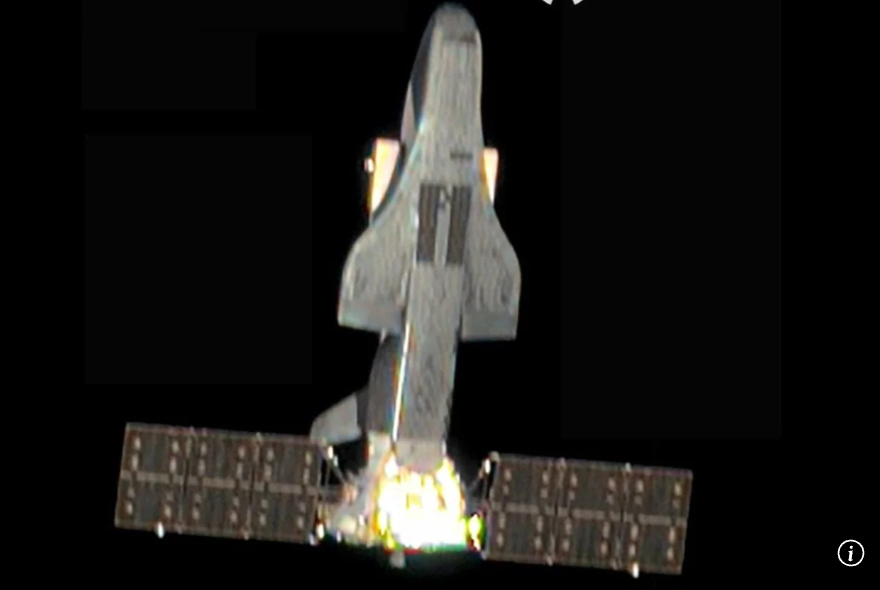
The image appeared in DIA’s 130-page report on space-based threats posed by China, Russia, North Korea, and Iran.
While the report highlighted China’s growing counterspace capabilities that could threaten satellites operated by other countries, the detailed image of the Shenlong reusable spaceplane got everyone talking about its possible military applications.
“China continues to improve its counterspace weapons capabilities to deter and compel other nations from taking actions Beijing deems counter to its national security interests,” the report said, adding that it is also developing on-orbit counterspace weapons.
China’s maneuverable spaceplane raised a critical question: how many reusable orbital vehicles like Shenlong would be needed for a rapid global strike?
According to the latest research by China’s Northwestern Polytechnical University, an institution under US sanctions, a fleet of just 40 spaceplanes would be sufficient for that purpose.
In the study, Chinese researchers proposed an orbital constellation that could let uncrewed spacecraft begin descending toward any location on Earth after a “maximum wait” of 150 seconds.
If the target were located in most of the world’s populated regions, it would take only about a minute, Hong Kong-based South China Morning Post reported, quoting the research paper.
The findings were based entirely on computer simulations, and the “maximum wait” time of 60 to 150 seconds refers to the time required for the spaceplanes to begin their descent toward their target on Earth, rather than the time needed to reach their destination.
The findings have major implications, showing that orbital spacecraft could serve as global-strike platforms, allowing vehicles already in orbit to engage distant targets almost immediately after receiving an order, leaving little time for a target to detect or respond.
The study was published online on October 30 in the peer-reviewed Chinese journal Acta Aeronautica et Astronautica Sinica, just four days after the DIA report published an image of China’s reusable spacecraft program.
It showed a delta-wing spacecraft, possibly Shenlong, with a satellite mounted at its rear.
What is China’s Shenlong Spaceplane?
China’s Shenlong, also known as the Chinese reusable experimental spaceplane, is a secretive spacecraft designed to launch into orbit aboard a rocket and return to Earth by landing on a runway. It can stay in orbit for extended periods.
In 2020, China launched its first-ever spaceplane prototype into orbit; it stayed for 2 days before returning to Earth.
In August 2022, China’s second spaceplane mission spent 276 days in orbit, much longer than the first mission.
In November 2022, this spaceplane appeared to maneuver with a companion satellite and conduct station-keeping at around 1 kilometer separation. At one point, the two objects appeared within 100 meters of one another. The spaceplane and satellite possibly rendezvoused before the satellite was re-released.
In December 2023, China launched its third spaceplane mission, which was in orbit for 268 days. During this third mission, the spaceplane released and interacted with an object.
Such operations could support satellite deployment, inspection, and servicing but might also have military applications, including intelligence gathering, interference with other spacecraft, and even launching strikes on ground targets.
Notably, China’s Shenlong spaceplane resembles the US military’s Boeing X-37B, an uncrewed reusable spaceplane that can stay in orbit for extended periods before returning to Earth for a runway landing.
During its last mission, the X-37B stayed in orbit for two and a half years, and it is believed that, similar to Shenlong, it can also deploy small satellites.
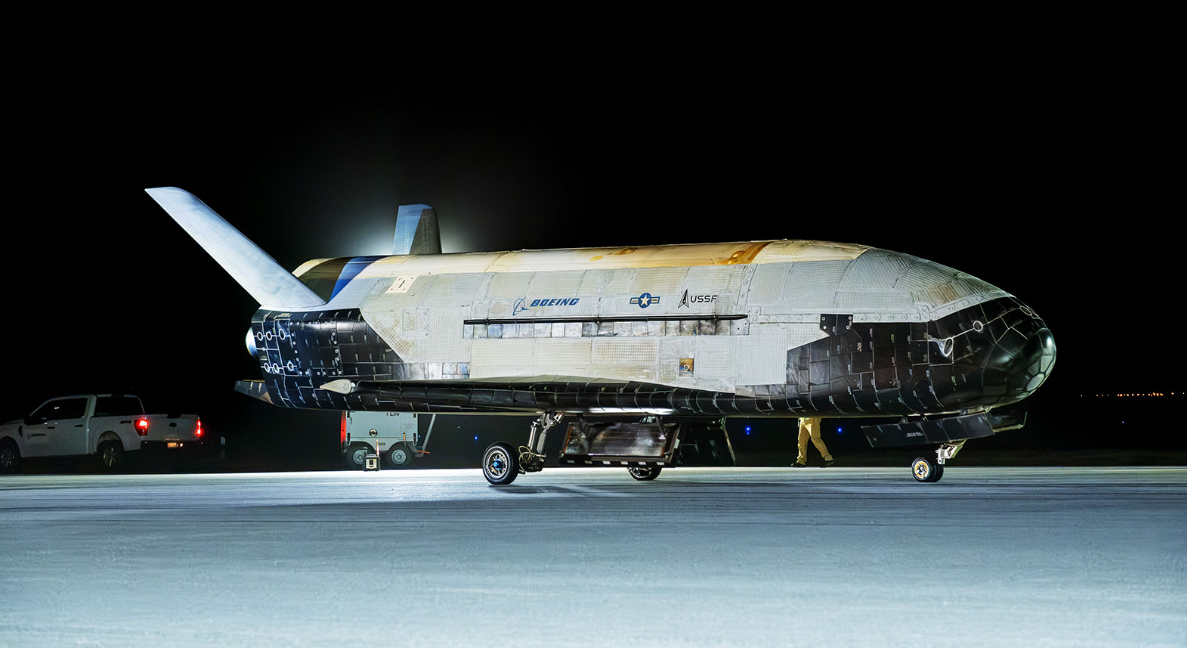
Both US and Chinese spaceplanes are launched on a rocket and remain in space longer before returning to Earth via runway landing. The technology is similar to, and in fact based on, the space shuttle, though both spaceplanes are uncrewed.
While China has always described the Shenlong program as an effort to develop technologies that “will pave the way for more convenient and affordable round-trip methods for the peaceful use of space in the future,” the latest study explored how an entire fleet of reusable orbital vehicles could be positioned to minimize delays in reaching destinations worldwide.
For an orbital vehicle headed to a specific destination on Earth, the timing and position of its departure from orbit is extremely important.
The team used computer simulations to calculate the ideal departure position from orbit for these spaceplanes to reach any specific destination on Earth.
The researchers described such spacecraft as capable of “rapidly departing orbit and reaching their destinations with precision”.
Returning orbital vehicles must first leave orbit, descend into the atmosphere, and use aerodynamic lift to glide toward their destinations.
For the simulation, the researchers assumed 40 vehicles operating in circular orbits 400 km above Earth, using a reference hypersonic glide vehicle model known as CAV-H rather than Shenlong’s actual specifications.
Each vehicle was assumed to descend to 100km before beginning its atmospheric glide, with a maximum longitudinal range of about 10,348 km and a lateral maneuvering distance of 2,485 km.

The team used a mathematical model to calculate orbital transfer time, atmospheric gliding capability, and Earth’s rotation to determine which areas each vehicle could reach.
It then used Artificial Intelligence to suggest the optimal positioning of each spacecraft in orbit to ensure global coverage.
In a 24-hour simulation, the optimized constellation achieved a maximum global revisit interval of about 150 seconds.
In simple terms, after receiving a command, one of the 40 spaceplanes will descend from orbit within 150 seconds to reach a specific destination on Earth.
When the optimization focused on regions between 60 degrees north and south, home to most of the world’s population, the maximum interval fell to one minute, a reported reduction of 58.8 percent compared with the global design, it said.
Unlike ballistic missiles, orbital weapon systems could launch attacks from different directions, maneuver while approaching the target, and reduce the time taken to reach the destination.
All this could complicate ground- and space-based interception.
However, while the spaceplane has dual military applications, China has said it is intended solely for space exploration and disaster response.
The team has also not shared much information about the computer simulation they used. The findings, therefore, must be read with caution.
- Sumit Ahlawat has over a decade of experience in news media. He has worked with Press Trust of India, Times Now, Zee News, Economic Times, and Microsoft News. He holds a Master’s Degree in International Media and Modern History from the University of Sheffield, UK.
- He can be reached at ahlawat.sumit85 (at) gmail.com