

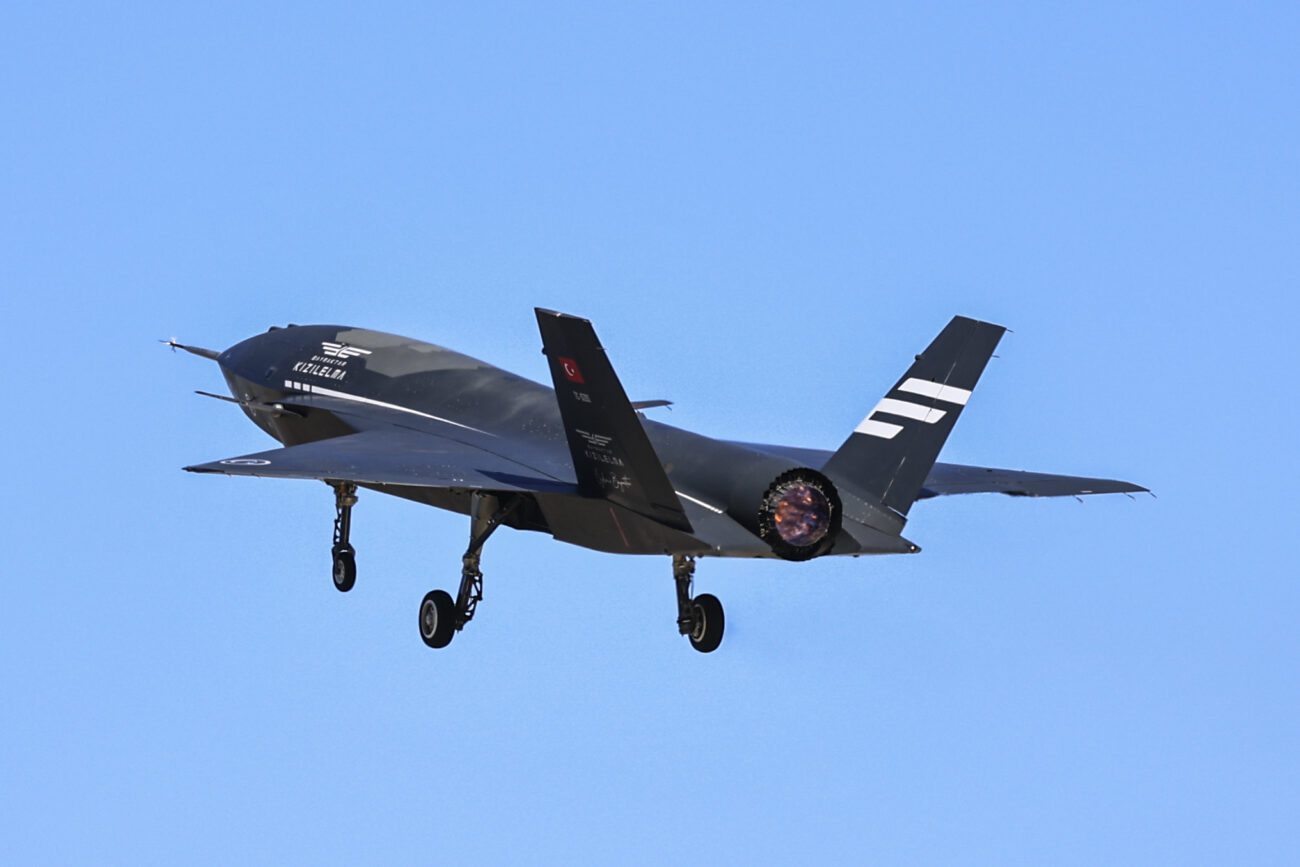
With Bayraktar Kızılelma, Turkey has become the first country in the world to publicly confirm the induction of a purpose-built, jet-powered unmanned fighter aircraft into military service.
On November 19, 2026, Turkish drone manufacturer Baykar announced the delivery of three jet-powered, low-observable Kızılelma jets to Turkish security forces after acceptance tests.
“With the delivery of the first three KIZILELMA aircraft, an unmanned fighter jet has been operationally inducted into service for the first time in global aviation history. Baykar’s greatest dream since the first day of its unmanned aerial vehicle journey, KIZILELMA has ushered in a new era in the air combat of the future,” it said in a statement. However, it did not disclose the delivery date or the service that received the jets.
The delivery marks another milestone for Baykar, best known for its unmanned aerial vehicles (UAVs), such as the TB2 that gained prominence primarily during the Armenia-Azerbaijan war.
The company has since signed several export deals for its cutting-edge drones, including the TB2, TB3, Akinci, and Anka. In fact, Indonesia placed an order for Kızılelma in May this year, even ahead of its official induction into service, as EurAsian Times reported.
Developed by Baykar Technology, Kızılelma is Turkey’s first indigenously developed jet-powered unmanned fighter aircraft.
Unlike conventional combat drones that primarily conduct surveillance and ground-attack missions, Kızılelma is intended for a far wider range of military operations, such as air-to-air combat, air-to-ground strikes, intelligence, surveillance and reconnaissance (ISR), close air support (CAS), missile strikes, and suppression and destruction of enemy air defenses (SEAD/DEAD), among other things.

The aircraft incorporates artificial intelligence-assisted autonomy and is being developed to operate both independently and alongside crewed combat aircraft.
Notably, the Kızılelma features a low-observable airframe with a canard-delta configuration, cantilevered vertical stabilizers, and aerodynamic characteristics intended to provide high maneuverability. Its design incorporates an internal weapons bay, allowing it to carry certain weapons inside the fuselage rather than on external pylons.
The platform is also being developed around an increasingly sophisticated combination of onboard sensors, radar systems, autonomous flight controls, and weapons.
It is worth mentioning that the Kızılelma is not a glorified surveillance or combat drone, but a specialized unmanned fighter jet designed for air-to-air combat and military operations.
Kızılelma & A Series Of Firsts
Baykar publicly unveiled the conceptual design of Kızılelma in July 2021, and the aircraft entered production within months, in March 2022.
The aircraft made its maiden flight in December 2022, which was particularly noteworthy because Baykar had initially targeted 2023 and got the aircraft airborne ahead of schedule. This essentially established the foundation for Turkey’s ambition to develop a jet-powered unmanned combat aircraft rather than a propeller-driven drone.
The next milestone for Kızılelma came in April 2023, when it flew in close formation with the Bayraktar AKINCI UAV for the first time. Later that month, it also flew in formation with the Turkish F-16 display team and another team flying F-5s.
Over the past year, Baykar conducted advanced testing and weapon integration on Kizilelma, transforming the aircraft from a flying technology demonstrator into a true combat aircraft.
The first major breakthrough came in October 2025 when the Kızılelma successfully completed its first firing tests with the TOLUN precision-guided munition and the TEBER-82 guided munition. These tests marked a major step toward operational weapons capability.
The following month, on November 17, 2025, Baykar announced the integration of the TOYGUN electro-optical targeting system. This added another important sensor capability to the aircraft’s combat-system architecture.
TOYGUN apparently works alongside ASELSAN’s MURAD AESA radar and KARAT infrared search-and-track (IRST) system, giving KIZILELMA complementary targeting and detection capabilities.
Days later, the Kızılelma performed a historic air-to-air engagement on November 29, 2025. It scored a direct hit on a jet-powered target aircraft designated by ASELSAN’s MURAD AESA radar, using the GÖKDOĞAN beyond-visual-range (BVR) air-to-air missile developed by TÜBİTAK SAGE.
With this achievement, KIZILELMA went down in history as the world’s first unmanned fighter jet to strike a jet-powered aerial target with a beyond-visual-range air-to-air missile, as Baykar itself noted.
Traditionally, combat drones have largely concentrated on surveillance and attacking ground targets. However, Kızılelma demonstrated a much more ambitious capability: engaging aerial targets using an onboard radar and an air-to-air missile.
The following month, the platform achieved another first when two Kızılelma aircraft flew autonomously in formation on December 27, 2025. Two prototypes, PT3 and PT5, completed a close-formation flight using Baykar’s intelligent fleet autonomy algorithms. According to the manufacturer, the aircraft operated with an autonomous combat-pilot system and coordinated their movements.
Notably, the same test also included a Combat Air Patrol (CAP) mission. A CAP mission involves patrolling a designated area to protect airspace against potential aerial threats.
As a first step toward crewed-uncrewed combined operations, the aircraft flew autonomously in formation alongside an Italian M-346 trainer in July 2026. This was an important step towards what military planners call Manned-Unmanned Teaming (MUMT).
Another major milestone was achieved when Kızılelma hit a target with a direct strike using the JET-230 supersonic missile on July 13, 2026. This indicated that the aircraft’s weapons-development program was going beyond conventional guided munitions and was finally including real air-to-air missile engagements.
Days later, Kızılelma completed its first firing tests using TOLUN and TEBER-82 munitions from its internal weapons bay. This was a major milestone because an internal weapons bay lets an aircraft carry weapons inside its fuselage rather than mounting them on external pylons, and reduces radar detectability.
These milestones—achieved on a compressed timeline—culminated in the delivery of three of these aircraft to the security forces this week.
With the induction, Turkey has now effectively beaten the world’s two major military superpowers—the United States and China—by formally inducting a jet-powered unmanned fighter into its inventory. Although both the US and China have also been developing unmanned combat aircraft and collaborative combat aircraft programs, a crucial distinction remains between developing and testing an unmanned fighter, flying experimental prototypes, and formally inducting an aircraft into military service.
Turkey Beats US & China With Kızılelma Induction
The United States and China are both pursuing ambitious unmanned combat aircraft programs. However, their approaches differ considerably from Turkey’s.
For instance, the US is developing a family of autonomous combat aircraft under its Collaborative Combat Aircraft program, with General Atomics YFQ-42A and Anduril YFQ-44A Fury chosen as the two initial candidates. The concept is to deploy relatively affordable unmanned aircraft alongside expensive fifth-generation fighters like the F-35 as well as the upcoming sixth-generation fighter jets, the F-47.
These CCAs are essentially designed to fly missions with manned aircraft in a manned-unmanned teaming (MUMT) configuration. They will mostly function as airborne “missile trucks” to provide extra firepower, although they are being modified for other combat roles to become true teammates for advanced manned jets. Besides boosting the manned jet’s firepower, the CCA will also conduct a host of other missions, including intelligence, surveillance, and reconnaissance (ISR), electronic warfare, and providing support for air-to-air and air-to-ground missions. The program is advancing, and the US is putting the aircraft into operational experimentation, as the EurAsian Times reported earlier.
The most important difference between Kızılelma and the American CCA aircraft is their underlying operational philosophy.
Kızılelma is being developed as an independent unmanned fighter, capable of conducting missions using its own radar, sensors, weapons, and autonomous flight systems, or operating alongside crewed aircraft. Meanwhile, the CCA program is built around a broader concept of autonomous aircraft working as part of a network with crewed fighters.
This does not mean American CCAs will be incapable of independent operations; it reflects US policy of prioritizing a distributed ecosystem of autonomous aircraft that can cooperate with existing and future combat aircraft. By contrast, Turkey has focused on developing a dedicated unmanned fighter with a direct emphasis on fighter-like missions.
China’s program is the most important comparison with Kızılelma.
The Chinese GJ-11, also known as the Sharp Sword, is a stealth-oriented, jet-powered unmanned combat aerial vehicle developed for the People’s Liberation Army. It features a flying-wing configuration, an internal weapons bay, and a low-observable design intended primarily for strike missions and suppression of enemy air defenses.
Unlike conventional reconnaissance drones, the GJ-11 is a sophisticated combat aircraft designed to operate in contested airspace.
Kızılelma is designed with fighter-like capabilities, including air-to-air combat, as demonstrated publicly by the successful BVR missile engagement against a jet-powered aerial target. In contrast, the GJ-11 is mainly used for stealth strike and air-defense suppression missions. However, its operational capabilities and weapons integration remain less clear since China has disclosed relatively little technical data.
For now, no publicly established equivalent demonstration shows the GJ-11 conducting the same type of radar-guided BVR air-to-air missile engagement achieved by Kızılelma.
The American approach centers on building a large ecosystem of relatively affordable autonomous aircraft that can work with existing and future fighters.
Rather than developing one aircraft to perform every mission, Washington wants different unmanned platforms to provide different capabilities. China, meanwhile, appears to be pursuing a combination of stealthy unmanned strike aircraft, autonomous wingmen, and potentially carrier-based unmanned combat aviation.
The Kızılelma occupies an interesting position between these approaches. It is being developed as an unmanned fighter in its own right, rather than simply as a reconnaissance drone or an expendable loyal wingman aircraft.
- Contact the author at sakshi.tiwari13 (at) outlook.com
- Follow EurAsian Times on Google News