Turkey and Israel are engaged in a heated war of words with threats, personal insults, and mutual accusations flying between Turkish President Recep Tayyip Erdoğan and Israeli Prime Minister Benjamin Netanyahu.
Turkish President Erdoğan earlier warned of potential Israeli “provocations and sabotage,” referring to the fragile US-Iran ceasefire and accusing Israel of undermining regional peace efforts by relentlessly bombing Lebanon.
While addressing the International Asia-Political Parties Conference in Istanbul recently, Erdoğan said, “The blood-stained genocide network continues to kill innocent children, women, and civilians without any rule or principle, ignoring all kinds of human values.”
Subsequently, reports indicated that Erdoğan had allegedly threatened military intervention against Israel, comparing it to its noted past actions.
“We must be strong to prevent Israel from doing this to Palestine,” Erdoğan was quoted as saying. “Just as we entered Karabakh, just as we entered Libya, we will do the same to them,” he stated. “There is nothing to prevent us from doing it. We just need to be strong so that we can take these steps.”
“Netanyahu is blinded by blood and hatred.
Just as we entered Libya and Karabakh, we can enter Israel. There is no reason not to do it,”
warns Turkish leader Erdogan and adds that Netanyahu “has been described as the Hitler of our time due to the crimes he has committed”. 🇮🇱🇹🇷 pic.twitter.com/eKrH73600b
— Visegrád 24 (@visegrad24) April 12, 2026
Interestingly, these reports were debunked by Turkey’s Communications Directorate’s Center for Countering Disinformation, as reported by Daily Sabah. The EurAsian Times understands that the claims, now classified as fabricated by Turkey, made by some reports were built on Ankara’s previous campaigns.
Turkey in Nagorno-Karabakh & Libya Wars
Turkey provided significant military support to Azerbaijan in the 2020 Second Nagorno-Karabakh War and the 2023 operation that ended Armenian control of the region. At the time, Israel also provided military support to Azerbaijan.
However, during the Libyan Civil War between the Government of National Accord (GNA) and the Libyan National Army (LNA), both Turkey and Israel reportedly supported opposing sides. While Ankara provided military advisors, training, drones (Bayraktar TB2), armored vehicles, ammunition, and rebel fighters as proxies, Tel Aviv was believed to be supporting General Khalifa Haftar’s LNA.
Amid sustained tensions between the two countries, Benjamin Netanyahu wrote on X: “Israel under my leadership will continue to fight Iran’s terror regime and its proxies, unlike Erdoğan, who accommodates them and massacres his own Kurdish citizens.”
Turkish response to Netanyahu’s X post was even fiercer, with the Foreign Ministry labeling Netanyahu the “Hitler of our time” for actions in Gaza and beyond.
Regarding the Social Media Post by Israeli Prime Minister Netanyahu https://t.co/CMg9hJzc1h pic.twitter.com/LOLDqOZpH3
— Turkish MFA (@MFATurkiye) April 11, 2026
“Netanyahu’s current objective is to undermine ongoing peace negotiations and continue his expansionist policies in the region. Failing this, he risks being tried in his own country and is likely to be sentenced to imprisonment,” Turkey’s foreign ministry retorted.
When asked about the claims of Turkish invasion made in recent reports, Umur Tugay Yücel, a Turkish Political Scientist, told the EurAsian Times, “Ankara has always used a measured and balanced political language in the region and has always been an actor in favor of diplomacy and peace. Such threats of invasion belong only to Israel and the Netanyahu government. The occupations in Palestine and Lebanon are the clearest examples of this. The ongoing genocide in Gaza and the illegal unilateral attack on Iran demonstrate Israel’s expansionist and occupying ambitions.”
“While such a threat is not real, the purpose of such news is to increase regional unrest and erode regional trust,” he added.
Shay Gal, an Israel-based strategic analyst specializing in international security, foreign policy, and geopolitical crisis management, told EurAsian Times, “Erdoğan has established a cumulative pattern. He stated Turkey could “enter” Israel as it entered Libya and Nagorno Karabakh. His foreign ministry labelled Prime Minister Netanyahu “the Hitler of our time”. Turkish prosecutors moved against Israeli leadership. Ankara hosts and legitimizes Hamas. Rhetoric and policy align.”
Nonetheless, on the Article 5 NATO treaty question, Shay Gal said: “Turkey is a NATO member. Israel is a US Major Non-NATO Ally. This does not create automatic protection. Article 5 is a political decision requiring consensus. Each ally determines its response. In a crisis shaped by Ankara’s conduct, especially where it involves Hamas infrastructure or actions colliding with European legal positions, consensus fractures before it forms.”
Turkey vs Israel: Political Difference
This animosity between Turkey and Israel is, in part, based on the fact that both countries are emerging as the two strongest non-Arab powers vying for dominance in the Middle East and the wider Eastern Mediterranean region. But more importantly, both countries espouse fundamentally different political ideologies, which essentially pit them against one another.
For example, Israel bombed Gaza for nearly two years to decimate the Hamas terror network. It has been relentlessly pounding southern Lebanon to decapitate the Iranian proxy group Hezbollah.
Turkey has consistently denounced Israel’s activities as unlawful. In fact, Ankara also issued arrest warrants for war crimes committed in Gaza since October 2023 against Israeli Prime Minister Benjamin Netanyahu.
On his part, Netanyahu has gradually changed his rhetoric towards Turkey in recent years, while simultaneously moving closer to Greece and the Republic of Cyprus, both of which remain at odds with Ankara over historical disputes.
Another major point of contention between the two countries is their influence in Syria. Turkey has backed opposition forces and seeks influence in northern Syria, including against Kurdish groups it views as tied to the Kurdistan Workers’ Party (PKK)—considered a terrorist organization by Turkey.
Meanwhile, Israel occupies a buffer zone in the south and backs local groups like the Druze, and has struck Syrian sites to counter Iranian and Turkish entrenchment and secure its borders. Additionally, Israel has also maintained covert relations with the Kurds, seeing them as a possible ally against shared enemies.
Both Israeli and Turkish governments see Syria as a zone for expanding their regional footprint, especially after Bashar al-Assad’s fall.
While Turkey has been a NATO member since the 1950s, Israel is the closest partner of the United States, its chief patron for military and political assistance.
Interestingly, although Israel has close ties with multiple NATO countries, Turkey has had strained relations with its own alliance members due to a host of reasons ranging from political defiance to human rights violations. However, in recent years, Ankara has been making concerted efforts to repair ties and become a more active participant in NATO and European defense architecture.
Israel signed the Abraham Accords with countries like the UAE, Bahrain, Morocco, and Sudan, to normalize ties—a move aimed at sidelining Iran and also simultaneously challenging Turkish influence. However, Turkey criticizes these as betrayals of Palestinians and has pushed back with its own outreach to states like Qatar, Saudi Arabia, and Egypt.
Israel vs Turkey: Who Holds the Edge?
As far as the overall military power is concerned, matters are more nuanced.
Based on Global Firepower rankings and other open-source assessments, Turkey ranks significantly higher overall, with a Power Index of 0.1975, compared to Israel’s 0.2707. In fact, Turkey ranks 9th globally, while Israel ranks 15th.
Turkey ranks first in the Global Firepower Index in the Middle East, reflecting its advantages in scale and manpower. However, Israel emphasizes technological superiority, qualitative edge, combat experience, and intelligence.
Turkey possesses a much larger military in terms of sheer numbers. It fields around 481,000 active personnel. Meanwhile, Israel maintains about 170,000 active-duty troops, but it can rapidly mobilize up to 465,000–500,000 reserves in a full call-up thanks to its citizen-soldier model.
Turkey has one of the biggest tank fleets in Europe, with an estimated 2,200 to 2,600 main battle tanks (MBTs) in service or storage as of 2026. This mainly includes modernized Leopard 2A4s, aging Leopard 1s, and M60T Patton tanks. However, the indigenously developed Altay tank is now being mass-produced.
Israel, on the other hand, has over 2,200 main battle tanks (MBTs), which include about 1,750-2,000 combat-ready Merkava tanks (Marks II, III, and IV), though some reports suggest it may have lost about 100 since October 2023.
Turkey’s army is structured for large-scale conventional operations and has gained recent experience in cross-border operations in Syria and Iraq.
Israeli ground forces, on the other hand, follow an urban combat doctrine, have superior networking and precision weapons, and are technologically sophisticated. They are also supported by outstanding intelligence and quick mobilization.
Israel has a clear edge over Turkey in airpower.
The Israel Air Force (IAF) continues to maintain a qualitative advantage in air power with a large percentage of cutting-edge fighters, including the F-35I Adir stealth jets, F-15s, and F-16s with domestic upgrades and excellent pilot training. The service has also built an integrated, multi-layered air defense network that includes Iron Dome, David’s Sling, and Arrow-class missile defenses.
Turkey, on the other hand, may have a numerically larger air force, but it is technologically inferior. The Turkish Air Force is predominantly composed of aging F-16 fighter jets, and the service has been desperately seeking to upgrade them with the F-35, but to no avail.
However, the country has finally secured clearance to buy 20 Eurofighter Typhoons, as previously reported by EurAsian Times. Additionally, it is also upgrading its air force with newer, more advanced F-16 Block 70 jets.
Turkey, unlike Israel, is developing its own indigenous fifth-generation stealth fighter, the KAAN. Furthermore, it has invested heavily in unmanned aerial vehicles (UAVs) and has extensive experience in drone warfare across a range of battlefields—from Nagorno-Karabakh to Ukraine.
Turkey has a significant advantage in naval scale and power projection, with a sizable fleet of warships, submarines, frigates, and corvettes, expanding amphibious capabilities, and a strong domestic shipbuilding sector. This aligns with its “Blue Homeland” concept and enables Turkey to operate effectively in the Mediterranean, the Black Sea, and other regions. Additionally, Turkey already has the TB3, a carrier-based UAV that would greatly enhance its mission capabilities.
Israel’s navy is much smaller and focused primarily on coastal defense, submarine operations, and the protection of offshore gas fields.
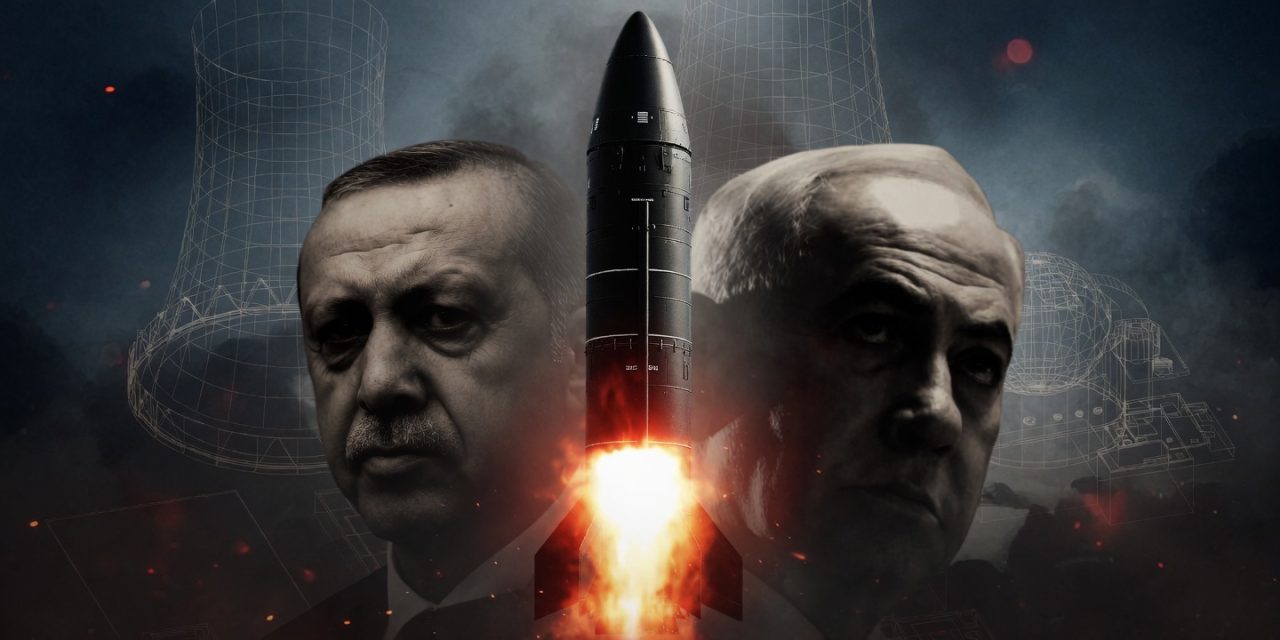
However, Israel has undeclared nuclear weapons—something that Turkey does not have. Additionally, the Jewish state has “unconditional support” from the United States, another advantage that Ankara lacks.
In conclusion, it is safe to say that Turkey may be better adapted for extended or multi-theatre operations due to its superior conventional scale, manpower, land forces, and naval presence. However, Israel’s strengths in air supremacy, technology, intelligence, rapid response, and asymmetric capabilities have historically enabled it to overwhelm its rivals despite numerical inferiority.
- Contact the author at sakshi.tiwari13 (at) outlook.com
- Follow EurAsian Times on Google News