The U.S. Navy’s F-35C Lightning II aircraft recently completed its first shipboard launch-and-recovery trials aboard USS John F. Kennedy (CVN 79), marking a major breakthrough in integrating America’s cutting-edge fifth-generation stealth JETS with its newest generation of aircraft carriers.
Two F-35C fighters have completed the first round of launch-and-recovery testing aboard the second Ford-class carrier, the USS John F. Kennedy, Lockheed Martin announced on November 19, 2026.
The two jets completed 34 flights, 122 catapult launches, and 122 arrested landings during an 11-day testing period that started on October 13, the Navy’s 251st birthday.
The F-35C fighters from Air Test and Evaluation Squadron (VX) 23 (“Salty Dogs,” NAS Patuxent River) made the first arrested landing aboard the Pre-Commissioning Unit (PCU) John F. Kennedy (CVN-79) on October 13, 2026. Meanwhile, the first catapult launch occurred on October 14, as captions on images published by the U.S. Navy show.
The launch and recovery were part of Kennedy’s Aircraft Compatibility Testing (ACT), which lets engineers examine how the ship’s equipment interacts with specific aircraft types while gathering data to confirm those systems function as intended.
The successful completion of F-35C launch and recovery operations aboard the future USS John F. Kennedy (CVN-79) demonstrates the successful integration of America’s fifth-generation carrier-based stealth fighter with its newest generation of aircraft carriers.
Although the U.S. Navy has flown the F-35C from its Nimitz-class carriers, the latest trial marked the first time the jet operated from a Ford-class ship, the U.S. Navy’s largest and most advanced carrier class.
The lead ship of the class, USS Gerald R. Ford (CVN-78), has never embarked the F-35C for sustained missions because the carrier was reportedly supplied without the full set of modifications needed to continue stealth-fighter operations, due to cost-saving efforts.
Currently, the USS Gerald R. Ford hosts air wings mainly equipped with F/A-18E/F and Growler variants for its current combat posture.
Earlier, the former Navy spokesman, Capt. Daniel Hernandez said in June 2019 that even though Ford-class carriers were designed to launch and recover the F-35C fighter jet, they still needed improvements like stronger jet blast deflectors to shield the deck from hot exhaust during launches and more space for aircraft operations.
Interestingly, the recent launch and recovery trials took place just days after the US Navy took preliminary acceptance of the USS John F. Kennedy. This means they demonstrated the compatibility between the F-35C and the Ford-class carrier’s redesigned flight deck and aviation systems, paving the way for the carrier to operate the F-35 from the outset.
A Fifth-Gen Leap In Capability
The successful launch and recovery tests are significant because they validated two critical aircraft-carrier technologies: the Electromagnetic Aircraft Launch System (EMALS) and Advanced Arresting Gear (AAG).
The Ford-class carriers use electromagnetic catapults and advanced arresting equipment. The EMALS replaced traditional steam catapults, such as those used on Nimitz-class carriers, with linear induction motors that deliver smoother, more precisely controlled acceleration.
Similarly, the Advanced Arresting Gear (AAG) improved aircraft recovery by offering greater flexibility across a wider range of aircraft weights and conditions. Combined with a redesigned flight deck and island structure that alter airflow and exhaust dynamics, these systems create an operating environment distinct from that of the Nimitz-class.
Therefore, successfully integrating these two systems with the F-35C is a crucial step in establishing the Ford-class carrier’s operational capabilities.
While shore-based testing had validated key interfaces, only at-sea trials could fully assess structural loads on the aircraft, software performance, and real-world jet-ship interaction.
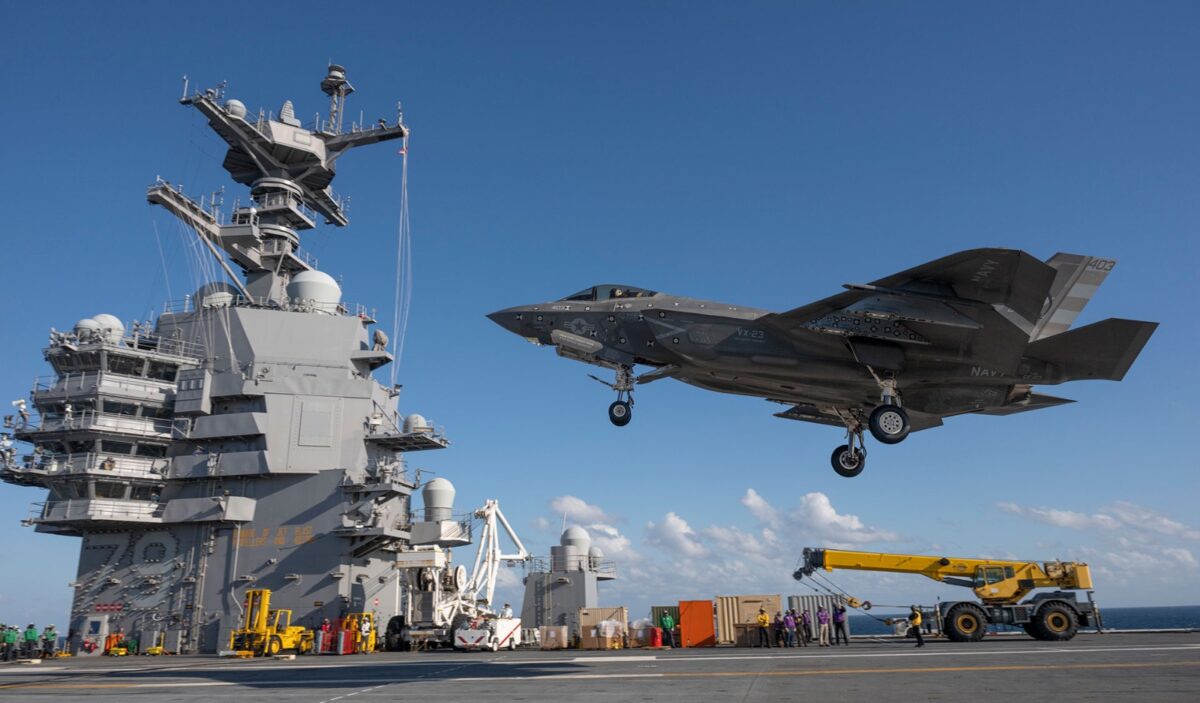
These trials matter because the 244 launch-and-recovery cycles likely generated the engineering data needed to write the official operating bulletins that will govern safe fleet operations in the future. Without this data, the Navy could not confidently expand F-35C operations to the entire Ford-class carrier fleet.
Lockheed Martin said completing the testing cleared the F-35C for operations across the U.S. Navy’s carrier fleet. However, operational deployment will still depend on the publication of aircraft launch and recovery bulletins and the availability of the necessary supporting equipment and modifications aboard individual carriers.
“This is a critical event for the F‑35C, Kennedy, and the United States Navy,” Sean Jackson, vice president of Lockheed Martin’s F-35 Development Program, said. “For the first time, the aircraft has demonstrated launch and recovery operations from a Gerald R. Ford-Class flight deck, advancing the integration of fifth-generation fighter capability with the world’s most advanced carrier technology. With the completion of this test phase, the Navy has now cleared the F-35C for operations across its entire fleet of aircraft carriers,” he added.
Moreover, the trials are expected to bolster the U.S. Navy’s fifth-generation naval aviation amid growing security threats. The F-35C offers longer range, larger internal weapons bays, and superior endurance, making it ideal for long-range operations from the vast ocean.
They can carry over 5,000 pounds of internal weapons or over 18,000 pounds of combined internal and external weapons, and these stealthy warplanes are nearly invisible to enemy radars, allowing them to penetrate even the most advanced air-defense systems. Thus, introducing F-35s aims to close a critical capability gap at sea.
The combination of F-35C and Ford-class carriers will enhance the carrier strike group’s ability to detect, track, and respond to threats in contested maritime environments.
Theoretically, a carrier that can routinely launch and recover F-35Cs can project fifth-generation airpower across large swathes of sea, penetrate contested airspace more effectively, and share high-fidelity targeting data with the strike group and joint force. This would be particularly valuable in high-end scenarios against near-peer adversaries who field advanced integrated air defenses and are developing their own stealth carrier aircraft.
The successful testing and introduction of F-35s on Ford-class carriers is especially significant amid rapid expansion of China’s naval capabilities, including the commissioning of the Fujian aircraft carrier, equipped with electromagnetic catapult technology, and the development of its J-35 carrier-based stealth fighter.
The U.S. Navy appears to be preserving a qualitative edge in carrier-based air power by ensuring its newest carriers can fully exploit fifth-generation fighters.
The ability to generate more sorties, reduce aircraft stress through smoother EMALS launches, and accommodate heavier, more varied weapons loadouts will enhance its ability to sustain combat operations during a potential conflict with adversaries like China.
The milestone also validates years of parallel development of cutting-edge carriers and state-of-the-art fighters. The F-35C was designed from the outset for carrier operations, with larger wings, stronger landing gear, and folding wingtips. Therefore, successfully integrating it with the Ford class’s new systems confirms that the Navy’s long-term investment in both platforms is paying off.
In practical terms, the successful trials mean the USS John F. Kennedy can be armed with F-35C stealth fighters from day one while the rest of the Ford-class carriers can follow suit.
- Contact the author at sakshi.tiwari13 (at) outlook.com
- Follow EurAsian Times on Google News