Royal Navy’s flagship aircraft carrier, the HMS Prince of Wales, broke down and was forced to undergo urgent repairs just months after the US President Donald Trump mocked British carriers, calling them “toys”.
The HMS Prince of Wales, the Royal Navy’s Elizabeth-class aircraft carrier, suffered technical issues late last month, forcing it to dock in Stavanger off the coast of Norway for repairs. The carrier was reportedly en route to the United States to participate in the ceremony marking 250 years since the signing of the US Declaration of Independence.
According to reports, the technical issue was first spotted during an earlier port call to Stavanger in mid-May 2026, but the ship participated in NATO’s “Dynamic Mongoose” anti-submarine warfare exercise anyway. However, the issue surfaced again after it returned to port following the exercise, prompting intervention.
The carrier’s X account said engineers and logisticians were working “tirelessly” to “deliver effective maritime support.” However, reports indicate that the repair work could take longer than previously anticipated, derailing the ship’s plans for visits in the region.
Meanwhile, the UK Ministry of Defense said, “HMS Prince of Wales is currently conducting a port visit to Stavanger as part of the Carrier Strike Group’s deployment across the North Atlantic and Arctic. We expect her to set sail in the coming days. We continue to work closely with our allies and partners to improve global security and strengthen defence cooperation, as recently demonstrated on exercise Dynamic Mongoose.”
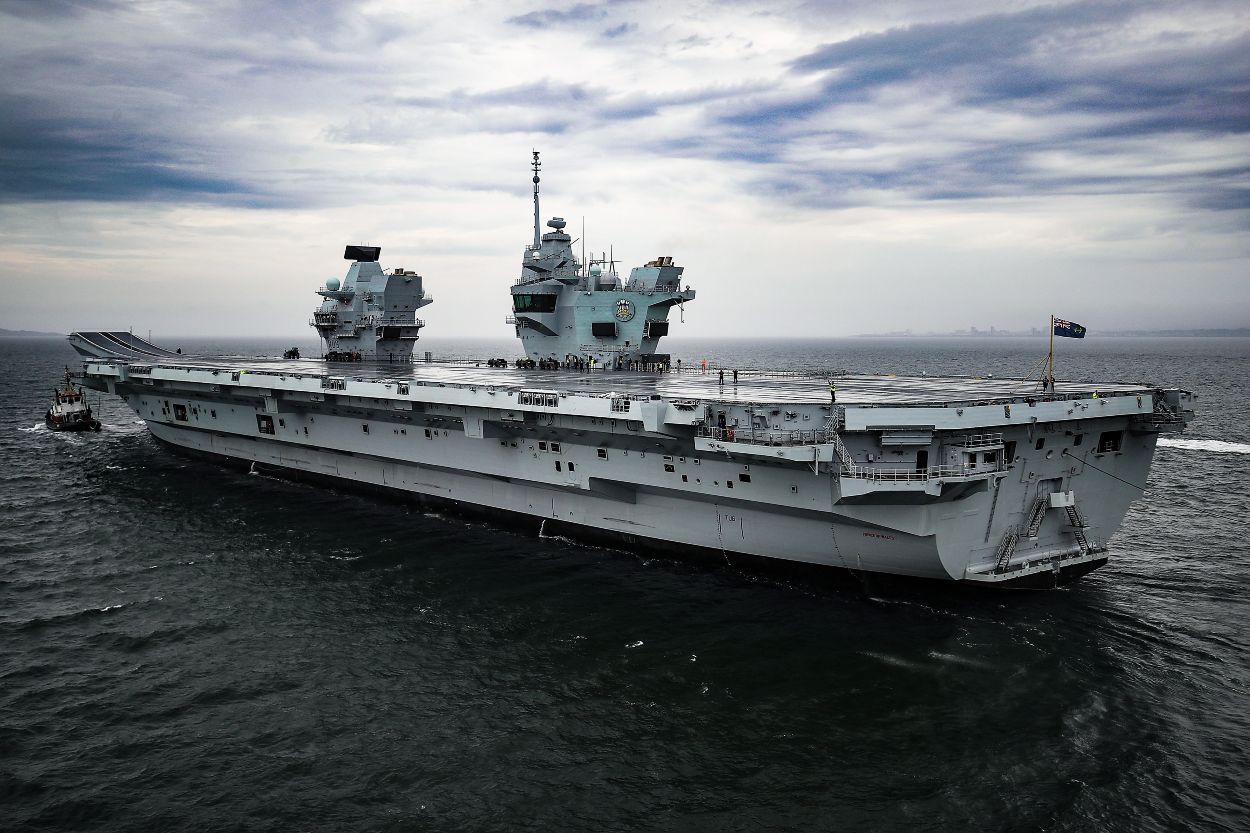
Although the MoD has provided no information on the latest breakdown, reports citing sources have claimed the technical fault is related to the propeller shaft, which has frequently caused issues for the Prince of Wales and her sister ship, HMS Queen Elizabeth.
The HMS Prince of Wales is a 65,000-ton carrier that was christened in 2017 and commissioned in 2019.
Serving as the Royal Navy’s Fleet Flagship, it provides the UK with significant power-projection, carrier-strike, amphibious support, and humanitarian capabilities worldwide. For example, the carrier embarked on a major deployment to the Indo-Pacific last year, along with a cutting-edge Type-45 destroyer, a Type-23 frigate, a Tide-class tanker, and a submarine, as EurAsian Times reported at the time.
Maintaining our equipment and readiness is essential to operational success. Our skilled engineers and logisticians have worked tirelessly, enabling us to deliver effective maritime support away from our home port, sustaining HMS Prince of Wales on operations. #ArcticSentry pic.twitter.com/SoGXQ88Fw0
— HMS Prince of Wales (@HMSPWLS) June 5, 2026
Notably, the latest breakdown comes just weeks after President Donald Trump referred to British carriers as “toys” while criticizing the UK for not joining the offensive strikes against Iran during Operation Epic Fury.
“We had the UK say that ‘we’ll send’, this is three weeks ago, ‘we’ll send our aircraft carriers’, which aren’t the best aircraft carriers by the way. They’re toys compared to what we have,” Trump said at the time. “But ‘we’ll send our aircraft carrier when the war is over’. I said, ‘Oh, that’s wonderful, thank you very much. Don’t bother. We don’t need it.”
Taking offense to what were seen as callous remarks by the US President, Royal Navy officials and veterans jumped to defend the carrier. For example, Al Carns, a former Royal Marines officer and current veterans minister, said, “Let me tell you from my perspective, I was the chief of staff of the carrier strike force and was deployed on those carriers. They have formidable capabilities, and I’m deeply proud of them. I’m also deeply proud of Great Britain. I think it is great. We have a fantastic place in the world.”
The Unending Troubles With The British Carriers
Both Elizabeth-class aircraft carriers of the Royal Navy have been plagued by issues, including leaks, fires, and failed propellers.
For example, engine room leaks were reported when the HMS Prince of Wales was still in the early service phase in 2020. Two such incidents were reported in a span of five months—May and October 2020. At the time, flooding in the engine room damaged electronics and other systems, contributing to delays in achieving full operational readiness.
During the first two years of service, the HMS Prince of Wales spent less than 90 days at sea, likely due to these leaks.
However, the carrier experienced its most debilitating issue in 2022.
The HMS Prince of Wales suffered a breakdown in its propeller shaft coupling close to the Isle of Wight in August 2022, one day before it was scheduled to set sail on a four-month deployment to the United States. The external SKF coupling, which connects the outer propeller shaft section to the drive shaft from the propulsion motors, had reportedly been fractured, causing significant damage to the starboard shaft, the propeller, and the rudder.
The carrier was towed back to Rosyth, Scotland, in October 2022 for complex repairs and returned to sea only in mid-2023.
Later, the Ministry of Defense revealed that the root cause of the incident was that the starboard propeller shaft had been misaligned during the carrier’s construction, which likely led to excessive vibration or wear, culminating in the coupling failure in August 2022.
A May 2023 UK Parliament report revealed that HMS Prince of Wales had spent only 21.3% of her time at sea and 33% undergoing repairs since entering service.
The HMS Queen Elizabeth has faced its own share of difficulties and technical breakdowns since entering service in 2017. The most noted example of this in recent memory is the issue with a starboard propeller shaft coupling reported in February 2024, right before a deployment to NATO’s Exercise Steadfast Defender.
Over the years, several British officials and military watchers have said that it is embarrassing for the service that its opulent aircraft carriers, ostensibly built to give Britain dominance over the far seas, spend much of their time in repair, undermining their overall readiness. This has continued to limit training, exercises, and combat missions, and has created gaps in the Royal Navy’s capability to respond to threats.
Notably, HMS Queen Elizabeth and HMS Prince of Wales are described on the Navy’s website as “investments” in the safety and prosperity of the United Kingdom. However, critics believe this is hyperbole at best, emphasizing that reliability has been an ongoing challenge, especially given limited escorts and extensive maintenance demands.
In fact, previous reports had suggested that one of the two carriers could be mothballed to save costs as the British government reevaluates costs and defense priorities.
The latest HMS Prince of Wales breakdown comes ahead of the much-delayed Defence Investment Plan (DIP) amid concerns that the funding could be postponed in the wake of an ongoing wrangling between the MoD and the Treasury.
Speaking to LBC amid mounting pressure to publish the DIP, British Prime Minister Keir Starmer said, “We do have to be ready, and I’ve always argued that deterrence is the best way of avoiding war, but to deter, you have to be ready, and that’s what this is all about.”
However, the long periods spent by British carriers do not exactly signal the readiness Starmer may have envisioned. Moreover, reports suggest that maintaining and repairing the ships has already cost more than £1bn.
Critics fear that if the next-generation Global Combat Air Program (GCAP) receives strong priority in the final DIP, the government would have to make trade-offs elsewhere due to the persistent funding gap, including for aircraft carriers.
While defense sources have described the breakdown as a “minor technical issue,” a senior naval source quoted by the Daily Mail said that the breakdown is “devastating for morale” of the carrier crew.
“With morale already rock-bottom over defence spending and delays over the Defence Investment Plan, the last thing the Royal Navy needed was HMS Prince of Wales marooned in a Norwegian fjord,” the source added.
- Contact the author at sakshi.tiwari13 (at) outlook.com
- Follow EurAsian Times on Google News