Following the success of Ukraine’s unmanned surface vessels (USVs) in damaging Russia’s Black Sea Fleet and securing sea denial in the absence of a conventional Navy, a US-based shipbuilder has signed a deal to manufacture these drone boats.
Portland-based ReconCraft, which builds boats for US Special Operations Forces, signed a memorandum of understanding with Ukrainian company Uforce, the producer of the Magura series of attack drones, the Wall Street Journal reported on July 21. The agreement, signed last week at the Ukrainian Embassy in Washington, calls for both companies to supply materials, equipment, and personnel.
ReconCraft co-founder Joe Silkovski said the goal is to manufacture hundreds, or possibly thousands, of Magura drones annually at facilities in South Carolina and Oregon.
The agreement has been signed amid a steady rise in the popularity of unmanned combat systems, including inexpensive unmanned surface vessels (USVs), or sea drones.
The US military recently attacked an Iranian port using a one-way attack sea drone, marking its first-ever use in combat, as the EurAsian Times reported at the time. Limited so far to ISR (Intelligence, Surveillance, and Reconnaissance) missions and rescue operations, this strike signaled the rising role of unmanned vessels in modern combat.
Ukraine has emerged as a pioneer in sea drone technology by demonstrating how relatively simple, affordable technology can neutralize expensive naval assets. The country has demonstrated that a navy without traditional warships can achieve effective sea denial against a much larger, conventional fleet using low-cost sea drones.
“They do not approach our shores because of the capabilities of our naval drones,” Ukrainian President Volodymyr Zelenskyy said earlier this year.
Between 2023 and 2024, Ukrainian sea drones damaged Russian intelligence ships like the Ivan Khurs and played a key role in sinking or disabling multiple high-value targets.
In February 2024, the Magura V5 became the first sea drone to sink enemy warships in combat, destroying the Tarantul-class corvette Ivanovets and a large Ropucha-class landing ship.
Ukraine’s F-16 Shot Down Russian Su-35 Fighter Jet in ‘Historic’ Air-to-Air Kill: U.S. Says
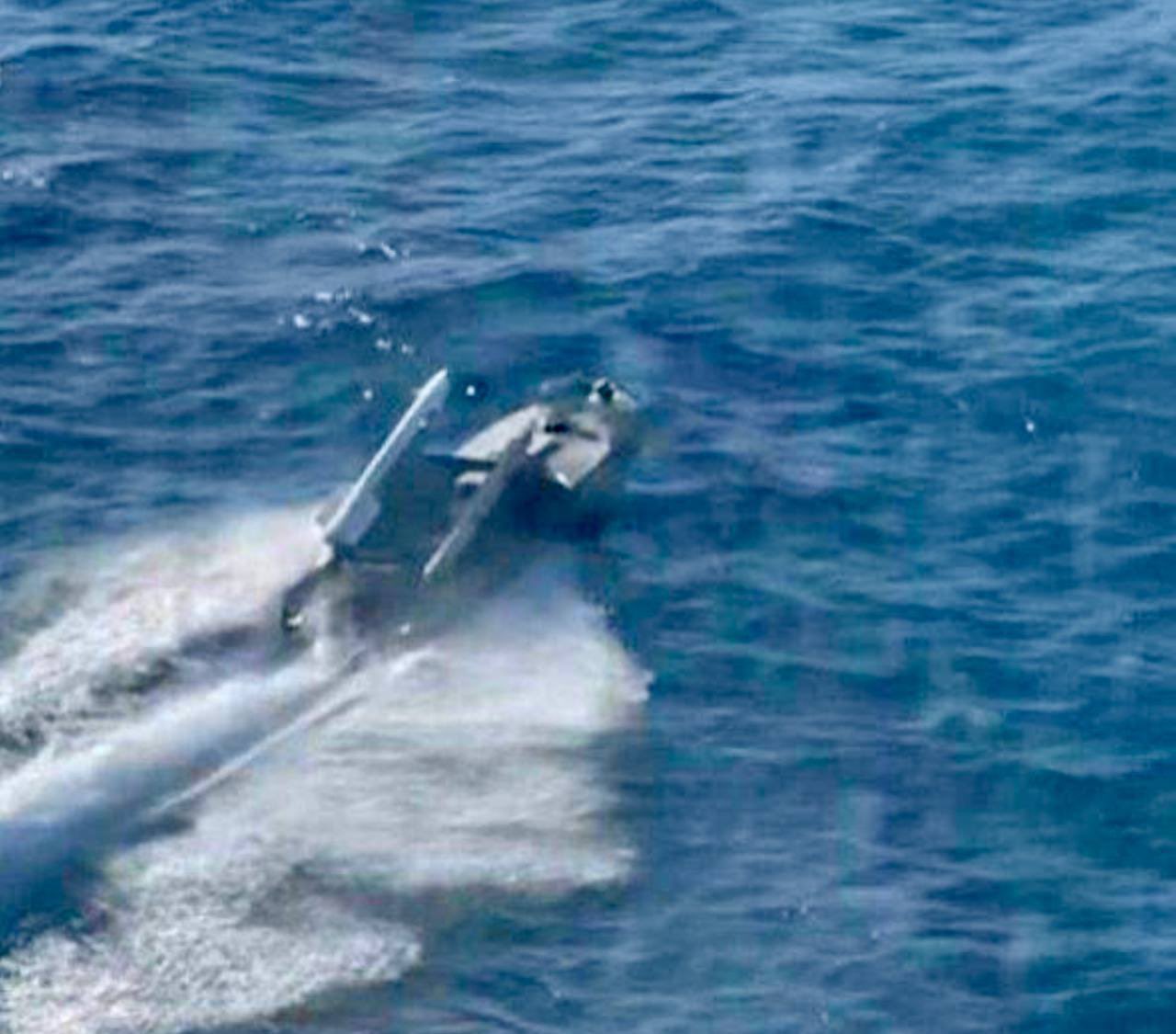
Later, on December 31, 2024, a Magura drone achieved another historic first by downing a Russian military helicopter with an air-to-air missile near Cape Tarkhankut in Crimea. In May 2025, a Ukrainian naval drone also downed a Russian Su-30 fighter jet.
These sea drones helped Kyiv sink or severely damage roughly one-third of Russia’s Black Sea Fleet, showcasing the prowess of asymmetric naval warfare.
Magura Drones for the US Navy
ReconCraft plans to produce the Magura-class sea drone, though the specific variant has not been disclosed. However, Ukrainian media reports state Magura drones can carry a payload of approximately 770 kilograms over a range of about 560 kilometers.
In addition to offensive strike missions, they support a variety of roles, including launching smaller drones, conducting mine countermeasures, and towing sonar arrays for submarine detection. The Magura V5, in particular, features a quasi-stealth hydrodynamic design and streamlined profile that provide high mobility and reduced detectability.
From “Fu** Putin” to Peklo (Hell): Ukraine’s Killer Drones Get Dirty with Wartime Nicknames
Priced under $500,000, depending on configuration, the drones represent a highly affordable option.
Oleh Rohynskyi, CEO of Uforce, described Ukraine’s decision to allow production in the US as “absolutely key,” noting that it will give American partners access to tactics and technologies refined over years of real-world combat.
China Threat Factor
China has the world’s largest navy by hull count and operates close to home with dense missile coverage, whereas the US Navy has fewer but higher-quality ships.
The US could produce hundreds or thousands of attritable platforms that can overwhelm defenses through sheer numbers. Moreover, these sea drones can provide sustained surveillance over long distances and for extended periods, block chokepoints, or harass forces without tying up manned ships.
Notably, crewed ships are high-value targets and losing one means dozens of lives and billions in cost.
Sea drones are “attritable”. They can be sent into high-risk zones with minimal human cost, enabling aggressive tactics such as forward presence, decoys, electronic jamming, or direct attacks that would be too dangerous for manned vessels.
Furthermore, the US needs these inexpensive platforms to blunt the advantage of asymmetric warfare enjoyed by enemies like Iran that heavily rely on sea drones.
This also means the Magura family of drones will enter a highly competitive, rapidly expanding market for unmanned surface vessels (USVs).
The Pentagon is investing heavily in autonomous naval systems, creating opportunities but also intense competition. Several established defense contractors and agile startups are developing or producing USVs with growing capabilities in range, endurance, payload, and autonomy. However, these platforms often emphasize longer range, heavier payloads, and greater autonomy compared to some of the early Ukrainian designs.
Several nations have inked cooperation and co-production agreements with Kyiv due to the popularity of Ukrainian naval drones.
For example, Portugal and Ukraine agreed to collaborate on the production of Ukrainian marine drones in December 2025. Meanwhile, the UK and Ukraine struck a deal earlier this year to enable Ukraine’s development and deployment of long-range naval drones capable of open-sea missions. This agreement includes collaborative production lines, R&D collaboration, AI integration, and broader capabilities in marine unmanned systems.
Not just that, Ukrainian President Volodymyr Zelenskyy said earlier this year that Ukraine was ready to share the technology with partners, while discussing potential military cooperation with Japan. “For example, naval drones to protect the coastline,” he stated.
Similarly, in March 2026, Ukraine signed 10-year defense partnership agreements with Saudi Arabia, Qatar, and the UAE, which include the supply of naval drones.
However, the deal between the US-based company and the Ukrainian sea drone manufacturer aligns with the enhanced defense cooperation between Washington and Kyiv, especially after the recently concluded NATO Summit.
- Contact the author at sakshi.tiwari13 (at) outlook.com
- Follow EurAsian Times on Google News