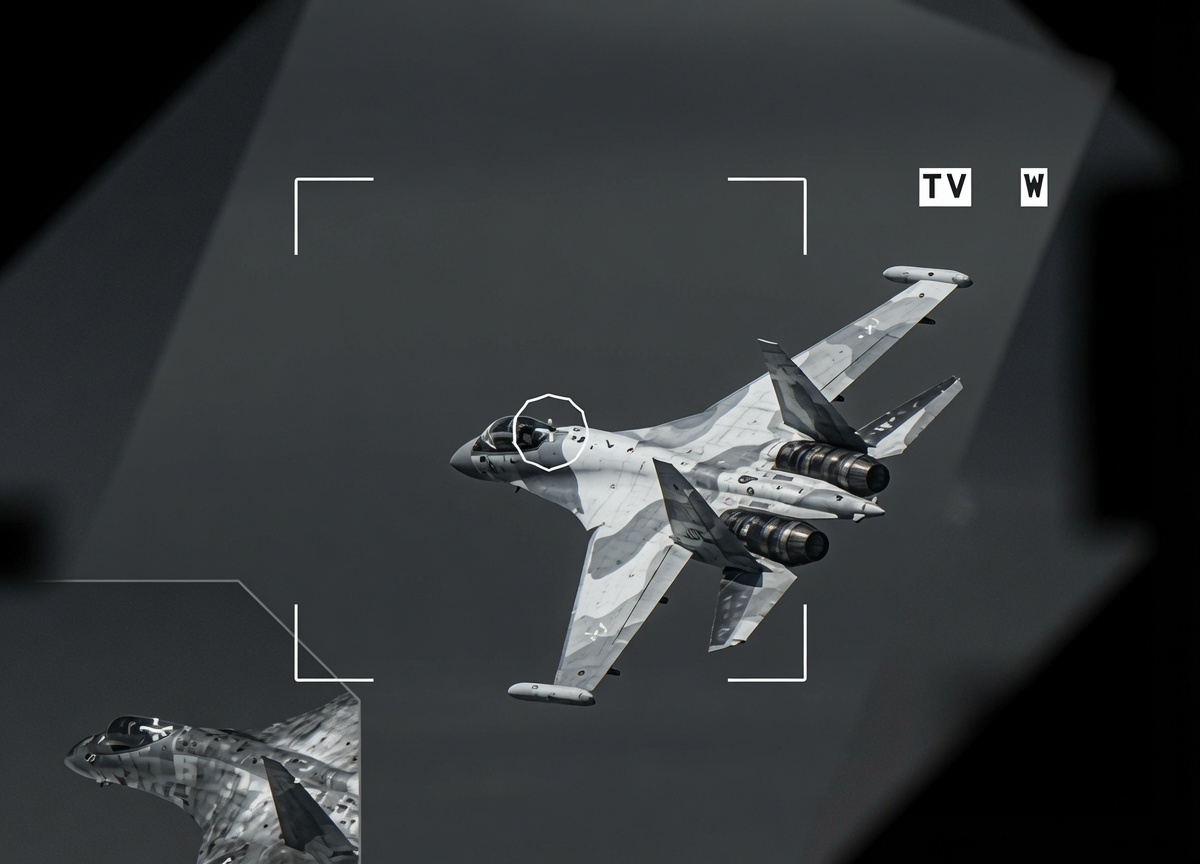
On June 2, French Rafales participating in the Baltic Air Policing mission conducted a close-range visual interception of a Russian Sukhoi Su-35 fighter jet in a tense encounter over the Baltic Sea.
Two French Rafales were scrambled from Siauliai Air Base in northern Lithuania and met up with Gripens to jointly intercept a group of six Russian aircraft, including a Su-35.
France’s Joint Staff also published a video of the interception. “The situation was monitored by our pilots without further escalation,” France’s Joint Staff said in a statement. “As part of the NATO Baltic Air Policing mission, Rafale aircraft provide daily surveillance and defense of the Baltic airspace alongside their allies.”
The Su-35 air-superiority fighter was escorting two reconnaissance aircraft (An-12 and An-30), Su-24 and Su-34 strike fighters, and an Il-76 transport.
Since the Su-35 was the only aircraft in the formation optimized for air-to-air combat, it must have provided escort to the other Russian aircraft as they approached hostile territory.
📍Lithuania | Interception of 6 🇷🇺 aircrafts within the Baltic air space 🚨✈️
⚡️ Scramble of two 🇫🇷 Rafale aircraft of the Baltic Air Policing 71 detachment, based in Šiauliai 🇱🇹, in order to escort 🇷🇺 aircrafts operating in the Baltic responsibility area.
👀 Visual… pic.twitter.com/eDMIBB7xBI— The 🇫🇷 Joint Staff – Military operations (@FrenchForces) June 4, 2026
Such aerial engagements between NATO and Russian aircraft over the strategic Baltic Sea have become quite routine since the last two years, as tensions remain high due to the Ukraine War, and fears of the war spilling into a wider regional conflict and even into a NATO Vs Russia conflict.
Russia frequently flies such missions over the Baltic Sea to assess NATO countries’ reaction times and counter-strategies.
Such missions also serve important psychological and geopolitical purposes by signaling that Russia remains prepared for a wider conflict with Europe.
However, this is perhaps the first close-range visual interception of the Su-35, Russia’s most advanced non-stealth fighter jet, by the Rafale, France’s most advanced combat aircraft.
The incident, therefore, provides an excellent opportunity to compare Russia and France’s frontline non-stealth fighter jets.
Su-35 Vs Rafale
Both the Su-35 and the Rafale are 4.5-generation fighter jets.
However, while the Sukhoi Su-35 is a large, powerful air-superiority fighter derived from the Su-27 Flanker, prioritizing raw kinematic performance and supermaneuverability, Rafale is a compact “omnirole” fighter emphasizing sensor fusion, electronic warfare (EW), and versatility.
In terms of versatility, the Rafale far surpasses the Su-35, as it can seamlessly conduct long-range air-to-air and air-to-ground precision strikes, electronic warfare, and surveillance missions, whereas the more specialized Su-35 is largely limited to air superiority missions.
Both are highly capable 4++-generation jets, but they represent different philosophies: the Rafale as a networked system-of-systems, vs. the Su-35 as a high-energy, agile dogfighter.
In terms of size, the Su-35 is larger and heavier. Its wingspan is 15.3 meters compared with 10.9 meters for Rafale. Similarly, while the Su-35 is 21.9 meters long, the Rafale is 15.3 meters long. The Rafale is also lighter. Its empty weight is around 10,300 kg, whereas the Su-35 is much heavier, weighing 19,000 kg.
The Su-35’s larger size means it can carry more weight than the Rafale.
Rafale’s maximum take-off weight is 24,500 kg, whereas the Su-35’s maximum take-off weight is 34,500 kg.
The Su-35, therefore, could carry a much bigger payload than the French jets.
Both fighter jets are powered by twin engines. The Rafale is powered by two Safran Snecma M88 turbofan engines, producing 50 kN of dry thrust and 75 kN with afterburner. The Su-35 is powered by two Saturn AL-41F1S engines with thrust vectoring, producing 142 kN of thrust with afterburners.
More powerful engines mean that the Su-35 is faster than the Rafale. The Rafale’s top speed is Mach 1.8, whereas the Su-35’s top speed is Mach 2.25. More powerful engines also mean that the Su-35’s service ceiling at 60,000 ft is higher than the Rafale’s at 52,000 ft.
However, Rafale beats the Su-35 in supercruise capability. Rafale can supercruise at Mach 1.4 while carrying missiles. The Su-35, however, has no true sustained supercruise capability.
Rafale has a slight edge in its combat radius. Rafale’s combat radius is 1,850 km, compared to 1,600 km for the Su-35. Despite less powerful engines, Rafale could carry more and heavier missiles.
Rafale has 14 hard points, compared to 12 for the Su-35. Furthermore, Rafale’s maximum payload capacity is 9.5 tonnes, compared to 8 tonnes for the Su-35.
Overall, the Su-35 excels in raw speed, altitude, climb rate, and supermaneuverability thanks to 3D thrust-vectoring nozzles. It dominates visual-range dogfights and can perform complex maneuvers. On the other hand, Rafale is more fuel-efficient and offers supercruise capability.
However, in terms of radar, sensor fusion, Beyond-Visual-Range (BVR) combat, and electronic warfare capabilities, the Rafale has a clear advantage.
Both fighter jets are capable of carrying nuclear weapons.
The Rafale is equipped with the RBE2 AESA radar, which offers improved multi-target tracking and jamming resistance. It has a maximum detection range of over 200 km for standard fighter-sized targets.
Rafale can track up to 40 targets and engage 8 simultaneously at ranges exceeding 100 km, making it one of the most advanced radar systems in its class.

The Su-35 uses the powerful Irbis-E Passive Electronically Scanned Array (PESA) radar, which provides a maximum detection range of 350 to 400 kilometers against standard, large fighter-sized targets under ideal conditions.
However, in standard volume search modes, this typically stabilizes closer to 200 km.
The radar can track up to 30 airborne targets and engage up to 8 simultaneously.
The PESA radar offers a long detection range, but it is an older technology and more vulnerable to jamming.
In fact, the Su-35 is currently the only major fighter in its league (4.5-generation) without an operational AESA radar.
Apart from the Rafale, the F-15EX, Eurofighter Typhoon, J-16, J-10C, and Gripen are all equipped with AESA radars.
In March 2026, Russia unveiled a new AESA radar upgrade for the Su-35; however, all operational Su-35 fighter jets are currently equipped with PESA radar.
The Rafale also has a significant advantage in its SPECTRA EW suite, which provides it with better survivability in contested airspace.
The SPECTRA (Self-Protection Equipment to Counter Threats for Rafale Aircraft) has been jointly developed by MBDA and Thales to provide an integrated self-protection system for the Rafale.
The SPECTRA integrated electronic warfare suite provides long-range detection, identification, and accurate localization of infrared, electromagnetic, and laser threats. The system incorporates radar warning, laser warning, and missile warning receivers for threat detection, plus a phased-array radar jammer and a decoy dispenser for threat countering. It also includes a dedicated management unit for data fusion and reaction decision.
Both are non-stealth aircraft, but here too the Rafale has an edge due to its compact size, SPECTRA EW suite, radar-jamming capabilities, and composite-material surface. Due to these factors, Rafale has much better survivability in contested airspace and is more suited for BVR combat.
The Rafale can carry the Meteor, a ramjet BVR missile with an excellent “no-escape zone” often described by analysts as one of the finest air-to-air missiles. Besides, Rafale can also carry MICA, SCALP/Storm Shadow cruise missiles, and AASM Hammer precision munitions.
The Su-35 is armed with a 30mm GSh-30-1 internal cannon and can carry a diverse and heavy arsenal of air-to-air, anti-radiation, and anti-ship missiles. Notably, it could also carry very long-range AAMs, such as the R-37M (reportedly with a range of 300-400 km) and the R-77M (initially designed for the Su-57 but integrated with the Su-35).
- Sumit Ahlawat has over a decade of experience in news media. He has worked with Press Trust of India, Times Now, Zee News, Economic Times, and Microsoft News. He holds a Master’s Degree in International Media and Modern History from the University of Sheffield, UK.
- VIEWS PERSONAL OF THE AUTHOR.
- He can be reached at ahlawat.sumit85 (at) gmail.com